










eClerx adds 1,400 India seats ahead of delayed demand conversion
Key highlights
- eClerx added about 1,400 India seats in Q2 FY27, taking total India capacity to 16,824 seats.
- Utilisation declined to 74.9% in Q2 FY27 from 75.5% in Q1 FY27 despite 3.5% sequential headcount growth.
- First-half FY27 CapEx was Rs 91.9 crore, and management expects H2 spending to be roughly equal to H1.
- eClerx plans another 800 to 1,000 seats over the next couple of quarters, including Mumbai and Pune facilities.
powered by IRIS
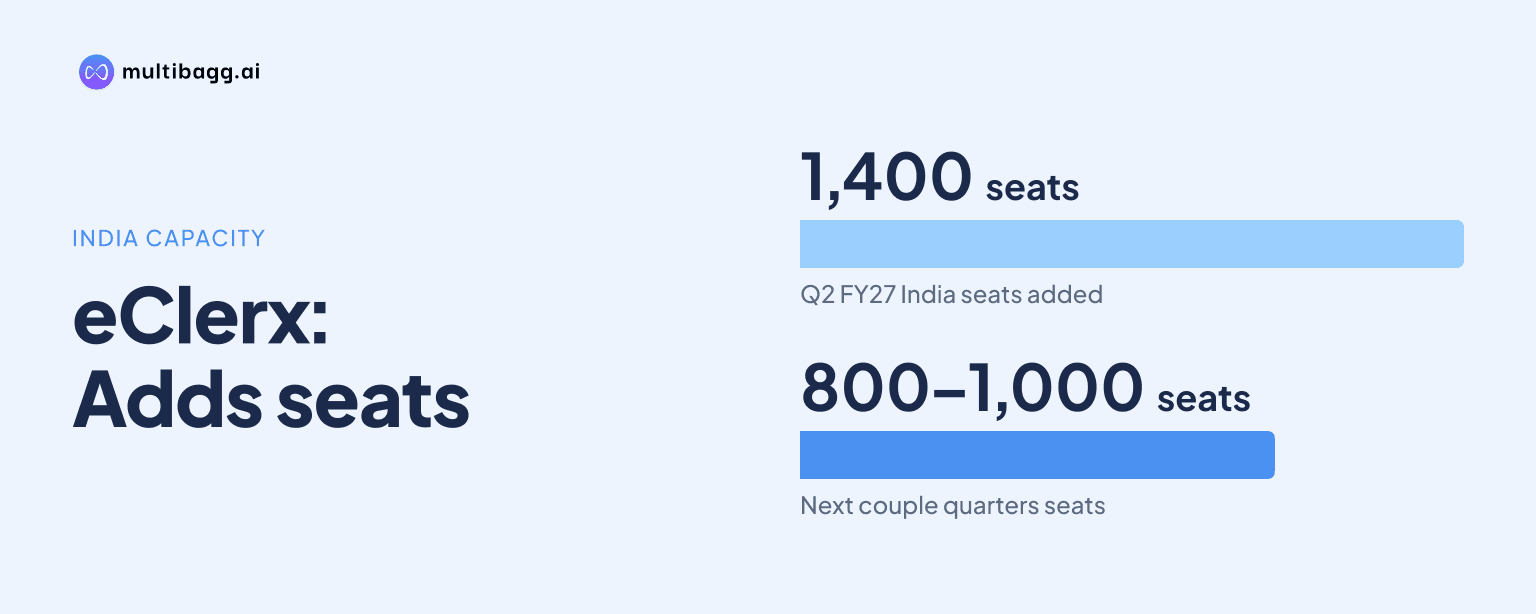
eClerx Services Limited added about 1,400 India seats in the second quarter of fiscal year 2027 (Q2 FY27), taking capacity to 16,824, although utilisation fell to 74.9% from 75.5% in Q1 as client decisions were delayed. eClerx plans another 800 to 1,000 seats over the next couple of quarters and expects second-half capital expenditure to match the Rs 91.9 crore spent in H1.
Know eClerx Services inside out
Results, valuation, peers and who's buying, in one view.
What capacity did eClerx add in Q2 FY27?
eClerx added about 1,400 India seats in Q2 FY27, taking its India seat count to 16,824 as facilities in Mohali and Chandigarh became operational. Total headcount increased 3.5% quarter on quarter, including 724 additions in offshore delivery, while operating revenue rose 1.5% sequentially to Rs 1,188.7 crore.
The seats were added while utilisation declined by 60 basis points to 74.9% from 75.5% in Q1 FY27. Management said Q2 had a higher bench than usual because client decisions had shifted to later periods, making the expansion a preparation for possible demand conversion rather than a response to rising current utilisation.
The location mix remains relevant to the capacity decision. Management said India business-process outsourcing has the highest margins within its delivery network, while the Philippines and Egypt have lower margins. Emerging-business growth has increased the contribution from nearshore centres, even as the new India facilities add offshore delivery capacity.
Why is eClerx expanding while client decisions are delayed?
eClerx is expanding because management is investing for delayed opportunities to convert and for technology-led work, although clients are approving programmes more slowly and starting with smaller projects. Management said client spending on artificial intelligence is lengthening decisions, as customers test technology and its effectiveness before committing to larger programmes.
Deal activity illustrates the delay. New deal wins were lower than the preceding quarter, while first-half wins were about 10% below the prior-year first half. Management nevertheless described the pipeline as healthy and said quarterly revenue growth could pick up if expected conversions occur, since eClerx generally does not carry a large bench.
Demand differed by vertical. Banking, financial services and insurance revenue grew about 3% sequentially, supported by short-term engagements, but reduced U.S. financial-crime compliance refresh volumes affected existing accounts. Analytics and automation revenue grew 5% sequentially and 27% year on year, represented about 20% of revenue and had an annual revenue run rate of about USD 109 million.
The capacity build also supports technology capability. eClerx had a technology team of 2,300 people, while more than 280 employees had received Claude AI certifications by the October 29, 2026 earnings call. Management said artificial-intelligence productivity-tool costs were not significant at present and that it monitored employee access and usage.
Got a follow-up? Ask IRIS
How much is eClerx spending on new facilities?
eClerx spent Rs 58.5 crore on capital expenditure (CapEx) in Q2 FY27, taking first-half CapEx to Rs 91.9 crore. The chief financial officer said second-half CapEx should be roughly equal to the first-half amount, implying full-year spending of about Rs 183.8 crore if the plan is completed.
Mohali and Chandigarh capacity entered service in Q2, while management expects Mumbai and Pune facilities to come live in Q3 and Q4. It did not disclose seat counts for those locations, but said the company expects to add another 800 to 1,000 seats over the next couple of quarters.
The new sites raise depreciation before their utilisation is fully established. Depreciation and amortisation, including rent recognised under Indian Accounting Standard 116, reached Rs 55.8 crore, or 4.7% of operating revenue, in Q2, compared with 4.3% in Q1. Management expects the ratio to rise by about 20 basis points in H2 as new facilities become operational.
For the following financial year, management said it remained in the budgeting process but did not expect seat and headcount additions to be as high as in FY27. That view followed the 1,400 seats already added and the planned 800 to 1,000 further additions.
What does the expansion mean for eClerx margins and cash flow?
eClerx expects facilities-related depreciation to remain elevated in H2, but management retained its full-year operating earnings before interest, tax, depreciation and amortisation margin range of 24% to 28%. Operating EBITDA was Rs 283.9 crore in Q2, or 23.9% of revenue, up 90 basis points sequentially, while the first-half margin of 23.5% was about 190 basis points below the previous year because of investments in locations, technology and AI.
Delivery costs improved by 110 basis points in Q2, primarily because of rupee depreciation. This was partly offset by a 14-basis-point rise in general and administrative costs, mainly legal and professional fees, and a 10-basis-point increase in selling and distribution expense. Management also expects the revised statutory provident-fund wage ceiling, effective September 17, 2026, to reduce margin by 20 basis points.
Operating cash flow recovered to Rs 269.4 crore in Q2, equal to 87.5% of operating EBITDA, from 38% in Q1 when annual variable payouts made cash conversion seasonally lower. Cash and cash equivalents stood at Rs 1,431.8 crore, while days sales outstanding remained unchanged at 79 days.
Revenue mix is another margin variable. Management said nearshore centres have lower margins than India, although those centres are improving profitability from their low or negative-margin investment phase in FY26. It said sustained India growth could mitigate the mix effect, while any change to the FY28 margin outlook would be communicated later.
Conclusion
eClerx is accepting higher facility spending and depreciation while utilisation is lower in order to prepare for delayed client decisions and expand technology-led delivery. The 1,400-seat addition, planned further 800 to 1,000 seats and Rs 91.9 crore of first-half CapEx show management is funding delivery capacity before it has evidence that the new seats are fully absorbed.
The next indicators are the planned Mumbai and Pune facility openings in Q3 and Q4, utilisation after the 74.9% Q2 level, and whether delayed client decisions lift sequential growth. Management also expects a possible banking, financial services and insurance recovery in Q4, second-half CapEx near the first-half amount and about 20 basis points of additional depreciation pressure in H2.