










Ecoboard first-half loss widens 50% despite sales surge
Key highlights
- Ecoboard's first-half net loss widened to Rs 9.50 crore from Rs 6.32 crore a year earlier.
- First-half revenue from operations rose to Rs 21.76 crore from Rs 6.54 crore.
- Eco Build recorded a Rs 9.56 crore first-half loss before interest and tax.
- Current borrowings rose to Rs 14.36 crore at 30 September 2026 from Rs 7.57 crore at 31 March 2026.
powered by IRIS
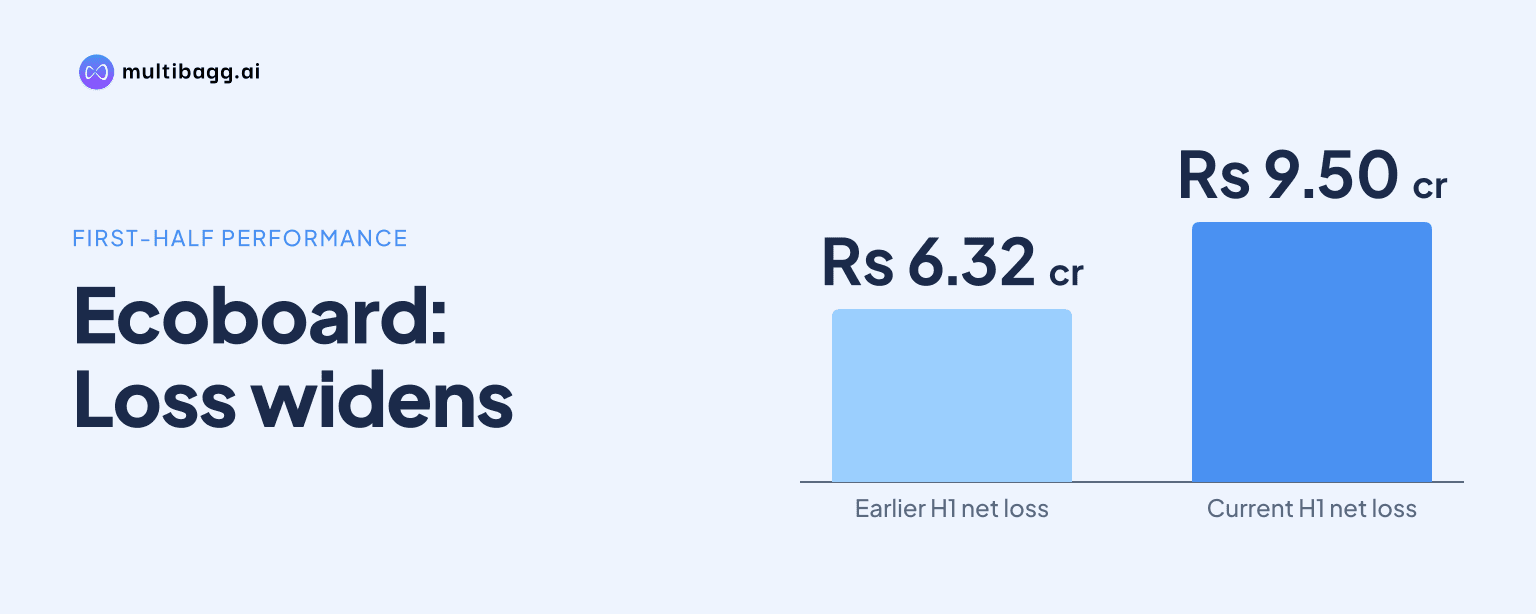
Ecoboard Industries Limited reported a Rs 9.50 crore net loss for the half year ended 30 September 2026, 50% wider than a year earlier, despite revenue from operations more than tripling to Rs 21.76 crore. Total expenses rose to Rs 31.51 crore from Rs 12.95 crore, outpacing the increase in income.
Know Ecoboard Industries inside out
Results, valuation, peers and who's buying, in one view.
What were Ecoboard's first-half financial results?
Ecoboard recorded revenue from operations of Rs 21.76 crore for the half year ended 30 September 2026, compared with Rs 6.54 crore in the corresponding period of 2025. Total income, including other income, rose to Rs 22.01 crore from Rs 6.64 crore, while the loss before tax and net loss both amounted to Rs 9.50 crore because no tax expense or exceptional item was reported.
The loss increased from Rs 6.32 crore in the prior-year half as total expenses rose by Rs 18.55 crore to Rs 31.51 crore. Basic earnings per share, which Ecoboard said were not annualised, were a loss of Rs 3.60 for the six months, compared with a loss of Rs 2.27 a year earlier. Diluted loss per share was Rs 3.14, against Rs 2.25.
In the September 2026 quarter, Ecoboard's revenue from operations was Rs 10.56 crore, below Rs 11.20 crore in the June 2026 quarter but above Rs 4.91 crore in the September 2025 quarter. The quarterly net loss widened to Rs 5.85 crore from Rs 3.65 crore in June and Rs 2.95 crore a year earlier.
Why did Ecoboard's loss rise despite higher sales?
Ecoboard's total expenses reached Rs 31.51 crore in the latest first half, compared with Rs 12.95 crore a year earlier, exceeding the Rs 15.37 crore rise in total income. Cost of materials consumed increased to Rs 15.82 crore from Rs 4.71 crore, while other expenses rose to Rs 11.03 crore from Rs 5.59 crore.
Employee-benefit expense increased to Rs 2.51 crore from Rs 1.79 crore, depreciation rose to Rs 94.04 lakh from Rs 66.15 lakh, and finance costs increased to Rs 54.39 lakh from Rs 43.19 lakh. Inventory changes shifted from a Rs 57.78 lakh reduction in expense in the prior-year half to a Rs 58.18 lakh expense in the latest period, while stock-in-trade purchases fell to Rs 8.50 lakh from Rs 34.65 lakh.
The September-quarter expense pattern also differed from June. Total expenses rose to Rs 16.64 crore from Rs 14.87 crore even as revenue declined by Rs 64.74 lakh sequentially. Other expenses increased to Rs 6.55 crore from Rs 4.48 crore, while materials consumed declined to Rs 7.77 crore from Rs 8.06 crore.
Which Ecoboard segment drove first-half revenue growth?
Ecoboard's Eco Build particle-board division generated Rs 16.60 crore of revenue in the half year ended 30 September 2026, up from Rs 3.22 crore a year earlier. Eco Energy, its bio-system division, generated Rs 5.16 crore, compared with Rs 3.32 crore in the prior-year half, making Eco Build the larger contributor to the Rs 15.22 crore rise in revenue from operations.
The segment results moved differently from revenue. Eco Build reported a Rs 9.56 crore loss before interest and tax, wider than a Rs 5.46 crore loss in the corresponding prior-year half. Eco Energy reported a Rs 60.26 lakh profit before interest and tax, compared with a Rs 42.56 lakh loss a year earlier; finance costs of Rs 54.39 lakh then contributed to the Rs 9.50 crore loss before tax.
In the September quarter, Eco Build revenue fell to Rs 7.01 crore from Rs 9.59 crore in June, while Eco Energy revenue rose to Rs 3.55 crore from Rs 1.61 crore. Eco Build's loss before interest and tax widened to Rs 5.91 crore from Rs 3.65 crore, whereas Eco Energy's profit before interest and tax increased to Rs 34.04 lakh from Rs 26.22 lakh.
Got a follow-up? Ask IRIS
How did Ecoboard's balance sheet and cash flow change?
Ecoboard's total equity declined to Rs 15.32 crore at 30 September 2026 from Rs 22.56 crore at 31 March 2026, as other equity moved to negative Rs 11.09 crore from negative Rs 3.85 crore. Total assets rose to Rs 62.46 crore from Rs 60.96 crore, with trade receivables increasing to Rs 6.69 crore from Rs 4.37 crore and loans and advances rising to Rs 8.88 crore from Rs 6.72 crore.
Current borrowings increased to Rs 14.36 crore at 30 September from Rs 7.57 crore at the March year-end, while non-current borrowings were Rs 78.75 lakh compared with nil. Cash and cash equivalents rose to Rs 85.70 lakh from Rs 31.40 lakh, and current liabilities increased to Rs 45.59 crore from Rs 37.66 crore.
Operating activities used Rs 9.87 crore of cash in the six months, compared with Rs 10.92 crore used in the prior-year period. Financing activities generated Rs 10.87 crore, including Rs 5.48 crore of bank borrowings for working capital, Rs 2.26 crore of warrant application money and Rs 2.00 crore of inter-corporate deposits received.
What operating and legal matters did Ecoboard disclose?
Ecoboard's board approved a temporary suspension of manufacturing at its Eco Build particle-board division for one year from 28 October 2026, citing the division's project viability. The decision followed a half year in which Eco Build generated Rs 16.60 crore in revenue but recorded a Rs 9.56 crore loss before interest and tax.
On 8 October 2026, Ecoboard allotted 5,941,500 fully paid equity shares of face value Rs 10 each on conversion of the same number of convertible warrants. The warrants were issued on 26 March 2025 at an issue price of Rs 30 each, while the balance sheet reported equity share capital of Rs 26.41 crore at 30 September 2026.
The auditor drew attention, without qualifying its review conclusion, to excise-duty demands of Rs 11.15 crore, subject to input-tax credit and excluding interest and penalties. Ecoboard's appeal has been admitted by the Supreme Court. The company also disclosed income-tax demands of Rs 6.90 crore, including Rs 5.10 crore for assessment years 2017-18 and 2018-19 and Rs 1.79 crore for assessment year 2023-24, with no provision made pending appeals.
Conclusion
Ecoboard's first-half sales growth to Rs 21.76 crore did not translate into profitability because expenses reached Rs 31.51 crore. Eco Build accounted for most of the revenue increase and the segment loss, while Eco Energy moved from a Rs 42.56 lakh loss before interest and tax to a Rs 60.26 lakh profit.
The next disclosed event to watch is the one-year Eco Build manufacturing suspension beginning 28 October 2026 and its effect on revenue, expenses and cash needs. Ecoboard also has unresolved appeals relating to Rs 11.15 crore of excise-duty demands and Rs 6.90 crore of income-tax demands.