










EIH Q2 EBITDA rose 19% despite Mumbai hotel room closures
Key highlights
- EIH’s consolidated Q2 FY27 revenue rose 16% and EBITDA increased 19%.
- EIH reported Q2 FY27 net profit after tax of Rs 153 crore, compared with Rs 142 crore a year earlier.
- EIH closed 190 Mumbai rooms for renovation, reducing reported owned-hotel occupancy to 71%.
- Oberoi and Trident RevPAR grew 20.9% and 14.8%, respectively, in Q2 FY27.
powered by IRIS
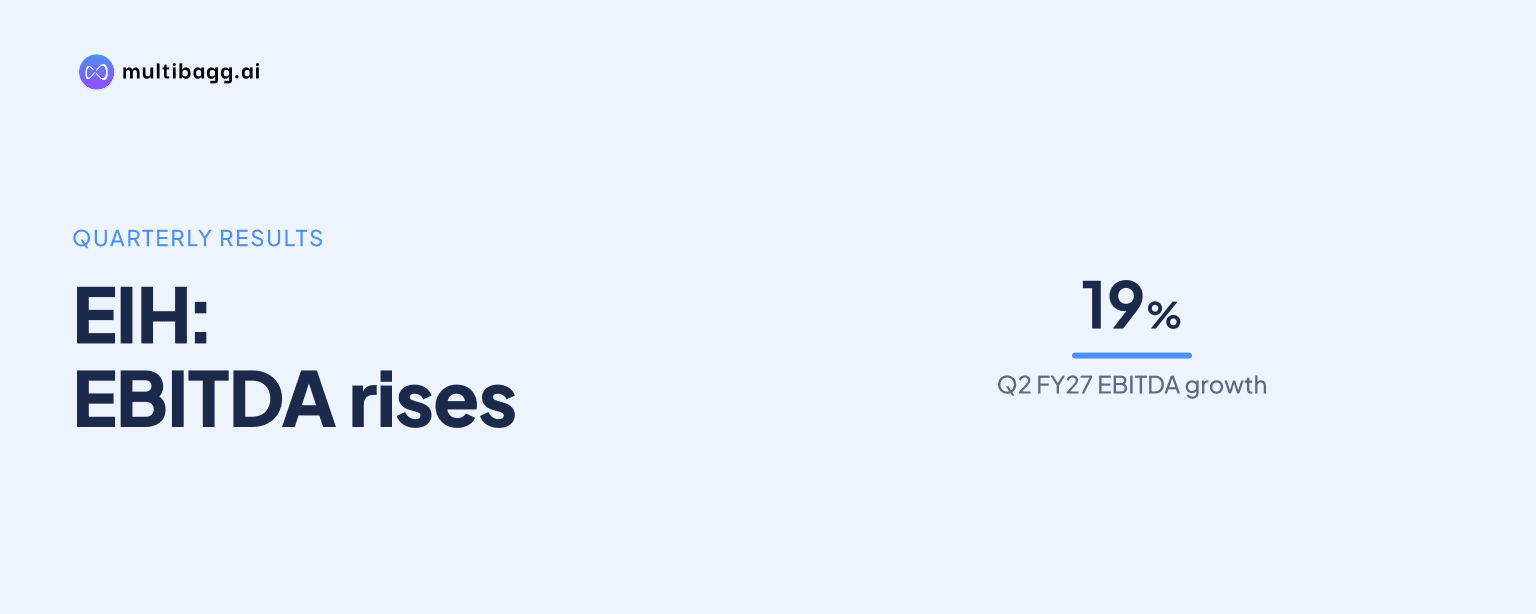
EIH Limited increased consolidated earnings before interest, tax, depreciation and amortisation (EBITDA) by 19% in Q2 FY27 while revenue rose 16%, despite 190 Mumbai rooms being closed for renovation. For the quarter ended September 30, 2026, owned-hotel occupancy was 71%, but EIH said it would have been 76% on reduced available inventory.
Know EIH inside out
Results, valuation, peers and who's buying, in one view.
How did EIH’s Q2 FY27 financial performance change?
EIH reported consolidated revenue growth of 16%, EBITDA growth of 19% and profit after tax growth of 21% in Q2 FY27. Net profit after tax reached Rs 153 crore, compared with Rs 142 crore in Q2 FY26, an increase of Rs 11 crore. Management said expenses were broadly in line with revenue growth, supporting the quarter’s profit increase.
EIH’s standalone revenue and EBITDA each rose 16% in Q2 FY27. Consolidated EBITDA therefore grew 3 percentage points faster than standalone EBITDA, reflecting the performance of EIH’s consolidated operations rather than a separately disclosed change in the hotel operating metrics.
Management said industry occupancy was 1% to 3% above the prior-year level in Q2, while average room rates, or ARR, increased 8% to 10%. It said domestic air traffic contracted because of higher airfares, but hotel demand remained buoyant enough to support gains in both occupancy and ARR.
How did EIH’s RevPAR compare with its market segments?
EIH outpaced the luxury and upper-upscale segment growth rates cited by management in Q2 FY27. Revenue per available room, or RevPAR, at Oberoi hotels rose 20.9%, exceeding the luxury segment’s 18.2% growth by 2.7 percentage points.
Trident hotels delivered 14.8% RevPAR growth in Q2 FY27, compared with 10.1% for the upper-upscale segment. The 4.7-percentage-point difference came while rooms were unavailable for renovation in both the Oberoi and Trident portfolios, according to Managing Director and Chief Executive Officer Vikram Oberoi.
EIH’s revenue generation index rose to 130% in Q2 from 121% a year earlier, as its occupancy and average-rate indices improved against its competition set. The company said 13 of its 15 hotels ranked first or second in STR benchmarking, indicating that the relative performance covered most of the measured portfolio.
The Q2 gains were led by rate growth rather than a reported occupancy increase. Across all domestic hotels, including managed units, RevPAR rose 18.3% despite reported occupancy declining to 71% from 72%, as higher ARR offset the one-percentage-point decline.
Got a follow-up? Ask IRIS
How much did Mumbai closures affect EIH occupancy and RevPAR?
Mumbai renovations reduced the inventory available for sale and lowered EIH’s reported occupancy figures in Q2 FY27. Across domestic hotels including managed units, occupancy was 71% against 72% a year earlier, but EIH said it would have been 74% on reduced inventory, with RevPAR of Rs 14,129.
The effect was greater in owned hotels, where EIH closed 30 rooms at Oberoi Mumbai, 80 rooms at Trident Nariman Point and 80 rooms at Trident Bandra Kurla. Reported owned-hotel occupancy declined to 71% from 74%; on the reduced inventory base, management said occupancy would have been 76%.
Owned-hotel RevPAR nevertheless increased 22% in Q2 FY27 because of higher ARR. EIH said its National Capital Region hotels benefited from the BRICS summit in September, while Jaipur and Ranthambore benefited from Vanyavilas remaining open for two of the three months when the park is normally shut and from higher off-season rates at Rajvilas.
What changed in EIH’s booking mix, cash position and capacity plans?
EIH reported year-on-year growth in room nights across segments in Q2 FY27, while the meetings, incentives, conferences and exhibitions, or MICE, share of room revenue increased to 16% from 12%. The direct segment’s share declined to 45% from 48%, changing the mix even as management said the major segments recorded healthy room-night growth.
EIH held cash reserves of more than Rs 1,100 crore as of September 30, 2026. Management said capital expenditure in the first six months was mainly for Hyderabad land acquisition, Oberoi Grand spending and Mumbai renovation projects, while cash flow from operations largely offset the outlay and resulted in only a small reduction in total funds.
Management’s disclosed owned-hotel pipeline calls for almost 1,100 additional keys by 2030, including roughly 7.63 lakh square feet of commercial space in Bengaluru. The managed-hotel pipeline is planned to add 1,893 keys by 2031, mainly in India and with some international units.
EIH also disclosed that the Hyderabad site is freehold land intended for a 300-key Trident hotel. On Q2 finance cost, Chief Financial Officer Vineet Kapur said a settlement related to lease costs at Oberoi Delhi, including prior periods, was a one-time impact that should normalise in upcoming quarters.
Conclusion
EIH’s Q2 FY27 performance showed that rate growth and relative RevPAR gains offset the reported effect of temporarily closed Mumbai rooms. Consolidated revenue rose 16%, EBITDA increased 19% and net profit after tax reached Rs 153 crore, while Oberoi and Trident RevPAR growth of 20.9% and 14.8%, respectively, exceeded the segment rates cited by management.
The next areas to watch are completion of the remaining Bengaluru renovation work and the return of room inventory following the Mumbai projects. Management said foreign bookings were increasing in Q2 and expected healthier growth in Q3, while noting that the outcome depends on geopolitical conditions; its longer-term execution targets remain almost 1,100 owned keys by 2030 and 1,893 managed keys by 2031.