








Eleganz defers Khopoli factory to avoid debt-funded capex
MAX Plan at ₹4,999/yr

Find your next multibaggerBe a Pro Investor
Research stocks and track your picks on the go. Download the app.
Key highlights
- Eleganz will revisit the deferred Khopoli factory in a couple of years, probably with a main-board move and another fundraise.
- Eleganz said advances to suppliers and contractors increased by about Rs 38.95 crore for project requirements.
- Receivables beyond 90 days were about Rs 15 crore to Rs 20 crore out of Rs 117 crore, according to management.
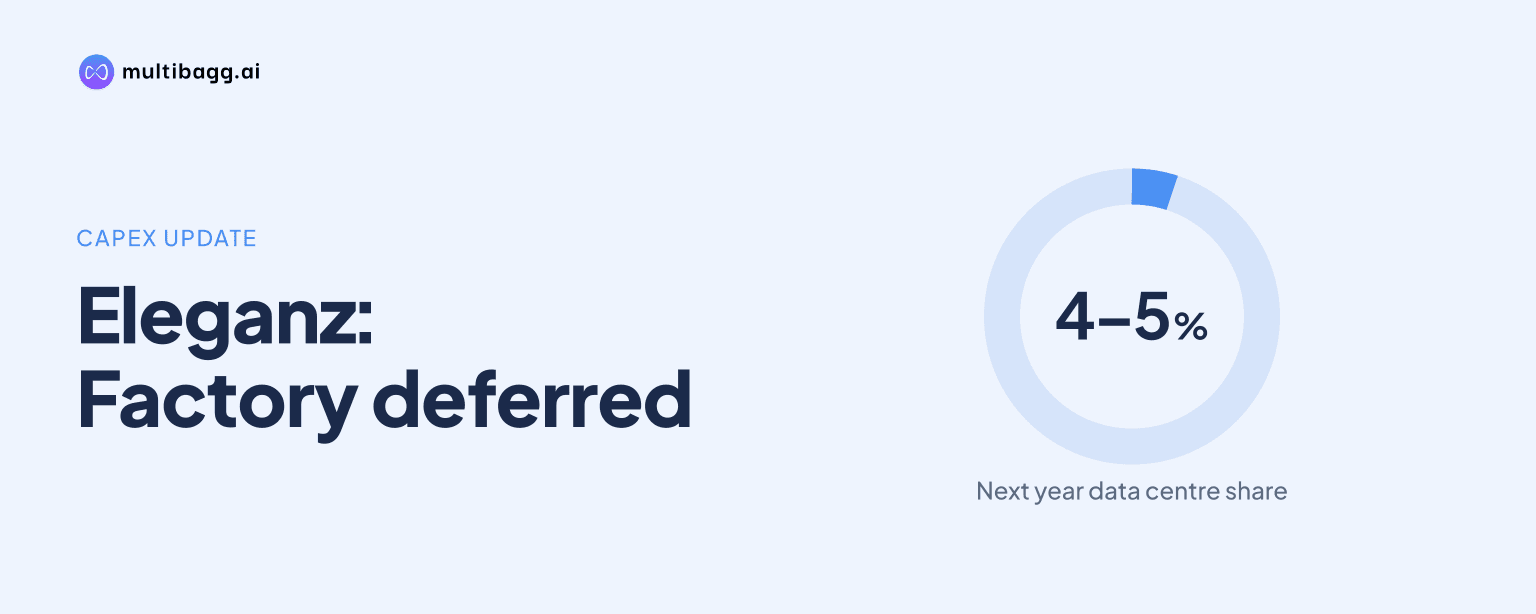
- Eleganz expects data centres to contribute at least 4% to 5% of turnover in the coming year.
powered by IRIS
Eleganz has put construction and equipment investment for its Khopoli automated modular-production facility on hold, saying it will revisit the project in a couple of years, probably alongside a main-board move and another fundraise, because it wants to avoid structuring debt for the undisclosed capital expenditure.
Know Eleganz Interiors inside out
Results, valuation, peers and who's buying, in one view.
Why did Eleganz defer the Khopoli factory project?
Eleganz deferred the Khopoli factory because management does not want to finance the planned capital expenditure with debt. Sammeer Pakvasa said the company had decided against taking the capital expenditure “on our heads” at present, since it would need to structure debt for the project. Management did not disclose the proposed investment amount, so there is no stated budget against which the size of the deferral can be assessed.
The revised timetable differs from the earlier intention to begin construction and deploy equipment after acquiring the land. Management said it would revisit the facility in “a couple of years,” probably when it moves to the main board and undertakes another raise. That makes a future equity-linked funding event, rather than current borrowing, the stated condition for reassessing construction and machinery spending.
The decision retains the land asset while postponing the manufacturing build-out. Pakvasa said Eleganz had bought the Khopoli land at what he described as a good price and would keep it, but did not give the land cost, acreage, planned production capacity or commissioning date. The transcript therefore establishes the funding rationale but not the potential output or financial return of the facility.
What work had Eleganz completed on the modular-factory plan?
Eleganz had acquired the Khopoli land and conducted factory visits in Germany for the proposed machines before pausing the next phase. Management said the original plan was to start building the factory and deploy the equipment, indicating that preparatory work had progressed beyond identifying a location. It did not identify machine suppliers, specify automation features or disclose equipment quotations.
The project was described as a fully automated modular production facility, but its proposed capacity remains unspecified. Management also said the capital-expenditure number would change and therefore would not be disclosed. Compared with the prior plan of construction and equipment deployment, the current plan is limited to holding the land and waiting for a possible fundraise, with no announced intermediate construction milestone.
This distinction matters because the deferral is not a cancellation of the Khopoli concept. The land remains with Eleganz, while the factory, equipment purchase and commissioning timetable have been delayed. Management’s wording leaves open a restart after a main-board transition and fresh capital raise, but it gave no commitment on the timing, size or successful completion of either event.
How does the capex pause fit Eleganz's current financial priorities?
Eleganz’s decision to avoid debt-funded factory spending comes while it is managing higher working capital tied to projects in progress. Kanchan Rajput said advances to suppliers and contractors increased by about Rs 38.95 crore because of project requirements. An analyst referred to a working-capital outflow of around Rs 55.8 crore, while management attributed the increase in working-capital days to higher inventory and trade-receivable ratios.
Management said there was no material delay in collections from large corporate customers despite the rise in working capital. It put receivables outstanding for more than 90 days at about Rs 15 crore to Rs 20 crore out of Rs 117 crore. That comparison indicates that the stated working-capital pressure was linked to execution-stage projects, supplier advances, stock and receivables rather than a disclosed deterioration in collections from major clients.
The company is also pursuing growth that requires execution funding. Management said there would be a Rs 230 crore spillover from the current order book, although it said less than Rs 300 crore would be executed from that order book. It agreed that an opening order book of Rs 400 crore to Rs 500 crore for the next financial year should be the expected range, alongside projects won and partly executed within the year.
By deferring the factory, Eleganz is separating the funding of ongoing project delivery from a large, as-yet-undisclosed manufacturing investment. This is an interpretation of management’s comments rather than a quantified cash-allocation forecast, as management gave neither a cash balance nor a borrowing figure in this discussion. It did state that it preferred not to add debt for Khopoli while project-related current assets had increased.
Got a follow-up? Ask IRIS
What growth initiatives will Eleganz pursue while Khopoli is deferred?
Eleganz will continue pursuing project-led growth, including data-centre work, rather than relying on the deferred factory to support near-term revenue. Management said it expects data centres to contribute at least 4% to 5% of turnover in the coming year and about 10% to 15% in the following year. Around 20% of the company’s pipeline was data-centre bids, though management said those opportunities were still at the bidding stage.
The company’s stated overall revenue aspiration is a 25% compound annual growth rate, or CAGR. Management said information technology remained the largest demand driver, followed by pharma, biosciences and research-and-development facilities, while data centres were a segment it was trying to enter. It cautioned that data-centre growth would be organic because the required team capability must be aligned over time.
Management also linked its margin plan to systems and larger projects rather than to the postponed factory. It said it had begun using Microsoft Dynamics Business Central about four to five months earlier, integrating tendering, project delivery, procurement and finance on one system. Management expects earnings before interest, tax, depreciation and amortisation, or EBITDA, and profit-after-tax margins to increase by about 1 percentage point over the next one to two years, and by 2 percentage points over three to four years.
On project mix, Eleganz said Design & Build represented about 20% of revenue and general contracting about 80%, while Design & Build represented 30% to 40% of the order book. Management said margins can vary within both models and that improvement should come as the company executes more higher-value projects, including Rs 100 crore-plus orders. That operational programme can proceed without an announced Khopoli construction schedule.
Conclusion
Eleganz has retained the Khopoli land but deliberately moved the automated modular-factory project from an active construction and equipment plan to a future option. The combined finding is that management has chosen to avoid debt for an undisclosed factory investment while working capital is elevated by advances, inventory and receivables connected to projects underway.
The next items to watch are management’s possible move to the main board, any subsequent fundraise and whether it then publishes a revised Khopoli capex, capacity and commissioning plan. In the nearer term, investors can track whether the stated Rs 400 crore to Rs 500 crore opening-order-book range, 4% to 5% data-centre turnover ambition and 1-percentage-point margin-improvement plan develop as management outlined.

