










EMS Limited adds Rs 900 crore, book reaches Rs 3,152 crore
Key highlights
- EMS added about Rs 900 crore of orders in Q2 FY27, taking unexecuted work to Rs 3,152 crore as of September 30, 2026.
- The order book comprised Rs 2,619 crore of CAPEX work and Rs 533 crore of O&M work, excluding GST.
- Around Rs 1,600 crore of CAPEX work was under execution, while around Rs 900 crore remained at the L1 or LOA stage.
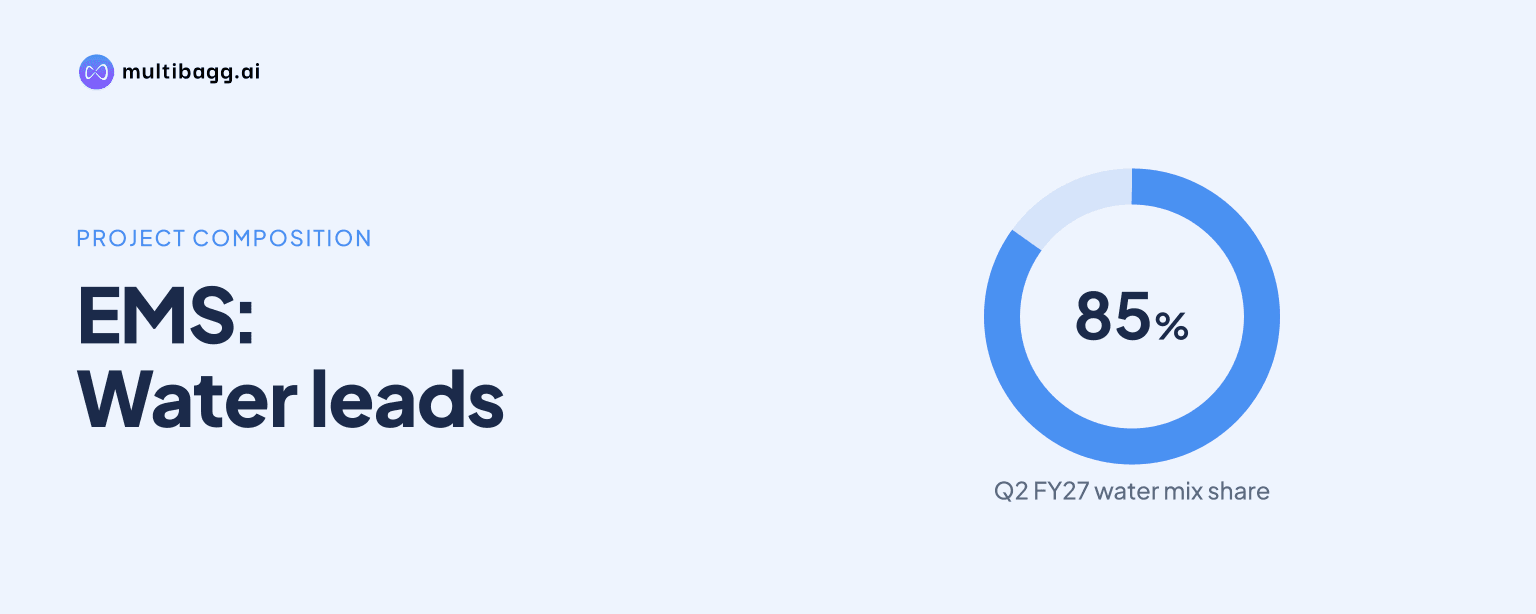
- Water and wastewater projects represented 85% of the order-book mix cited by management.
powered by IRIS
EMS Limited added about Rs 900 crore of orders in Q2 FY27, taking its unexecuted order book to Rs 3,152 crore as of September 30, 2026. Management said around Rs 1,600 crore was already under execution, but the newest orders require engineering and are expected to contribute little during FY27.
Know EMS inside out
Results, valuation, peers and who's buying, in one view.
What is in EMS's Rs 3,152 crore unexecuted order book?
EMS's Rs 3,152 crore unexecuted order book consisted of Rs 2,619 crore of capital expenditure, or CAPEX, work and Rs 533 crore of operation and maintenance, or O&M, work as of September 30, 2026. Management said the total excludes goods and services tax, or GST.
Of the Rs 533 crore O&M book, Rs 191 crore was already under progress and Rs 342 crore is scheduled to begin after the related schemes are concluded. The CAPEX and O&M figures together reconcile to the Rs 3,152 crore total, separating construction work from services that follow project completion.
The approximately Rs 900 crore addition came from Delhi Jal Board, Rajasthan's Public Health Engineering Department and Uttar Pradesh Jal Nigam (Urban), management said on the November 13, 2026 call. EMS described the Rs 3,152 crore as unexecuted work, so it includes both projects underway and the remaining portions of contracts already being delivered.
When will EMS's Rs 900 crore of new orders become revenue?
EMS said the Rs 900 crore of new Q2 FY27 orders will contribute little in FY27 because the projects have not started and still require detailed project reports and engineering. Management said these orders were either at the lowest-bidder, or L1, stage or had recently received letters of acceptance, or LOAs.
Management gave a typical five-to-six-month period between an LOA and project start. In a separate explanation, it said initial revenue generally begins six to eight months after L1 declaration, after agreement formalities, engineering, client approvals, procurement and the first bill; site or client conditions can add another four to six months.
Around Rs 1,600 crore of the CAPEX book was already under execution as of September 30, 2026, compared with around Rs 900 crore at the L1 or recent-LOA stage. Management said a typical water or wastewater project generates about 90% of revenue over two years, with the remaining 10% generally received over a further six months.
O&M revenue generally starts after a one-year defect-liability period, according to management. That timetable means the new wins enlarge EMS's contracted pipeline now, while their more meaningful revenue contribution is weighted beyond FY27 and into FY28.
Got a follow-up? Ask IRIS
Which segments and states make up EMS's pipeline?
Water and wastewater represented 85% of the order-book mix described by EMS, keeping the pipeline centred on municipal water supply and sewage-treatment work. Management cited Rs 2,171 crore of water and wastewater projects, compared with Rs 335 crore of building construction, Rs 66.06 crore of electricity work and Rs 46.98 crore of toll-plaza work.
These segment values broadly correspond to the Rs 2,619 crore CAPEX portion rather than the full Rs 3,152 crore book, which also includes O&M. Management put building construction at 10% of the cited mix, electricity at 2%, and other work at 1.49%, showing that the Q2 FY27 order increase remained concentrated in the core water and sewage business.
Uttar Pradesh accounted for 35% of the order book and Rajasthan for 27%, while Uttarakhand and Kolkata each accounted for 12%, management said. Delhi represented 4%, Bihar and Mumbai 3% each, Madhya Pradesh 3.43%, and Gujarat and Haryana 1% each.
Revenue concentration differed from the order-book distribution: management said Uttarakhand contributed 67% of revenue, Uttar Pradesh 25%, and Mumbai and Maharashtra 6%. It also said rainfall in Uttarakhand had disrupted network-laying work in FY26, although most remaining work there is now campus-based treatment-plant construction, which it said is less exposed to monsoon disruption.
What does the larger order book mean for EMS's FY27 plans?
Management said an order book above Rs 3,000 crore could support about Rs 1,200 crore of revenue over the following 12 months using its industry rule of thumb that annual execution equals around 40% of the order book. It presented this as a typical sector calculation, not as formal revenue guidance, and noted that the Rs 900 crore of new orders would not add much in FY27.
For Q3 FY27, management said it expected standalone operating income to be more than 30% above Q2 FY27, while earnings before interest, tax, depreciation and amortisation, or EBITDA, and profit after tax, or PAT, could increase by about 50%. In Q2 FY27, EMS reported operating income of Rs 160.89 crore, EBITDA of Rs 35.82 crore and PAT of Rs 22.92 crore.
Management said the outlook should be viewed on a standalone basis because an industrial subsidiary contributes revenue but operates at a lower profit percentage. It attributed potential operating-margin improvement to fixed manpower and machinery costs, while cautioning that civil-project billing can vary with milestone completion.
EMS was bidding for around Rs 3,500 crore of work during the next quarter and expected Rs 500 crore to Rs 600 crore of additional order-book inflow by December 2026, according to management. These prospective awards were not included in the Rs 3,152 crore unexecuted book reported for September 30, 2026.
Conclusion
The Q2 FY27 order inflow increased EMS's unexecuted book to Rs 3,152 crore, comprising Rs 2,619 crore of CAPEX work and Rs 533 crore of O&M work. With around Rs 1,600 crore already being executed and water and wastewater representing 85% of the cited project mix, the larger pipeline provides visibility across its main municipal infrastructure activities.
The next issues to watch are whether EMS receives the Rs 500 crore to Rs 600 crore of additional orders it expects by December 2026 and how quickly the recent Rs 900 crore of L1 and LOA-stage projects move into engineering and site execution. Management expects these new contracts to contribute little in FY27, while it has indicated more than 30% sequential operating-income growth for Q3 FY27 from Q2 FY27.