










EMS Says Uttarakhand Exposure Is Lower After Network Work
Key highlights
- EMS said H1 FY27 revenue was Rs 286 crore, compared with Rs 355 crore in H1 FY26.
- Uttarakhand represented 67% of EMS revenue but 12% of its disclosed order book.
- EMS said Uttarakhand network-laying work is completed or almost completed, leaving mainly campus-based projects.
- EMS reported a Q2 EBITDA margin of 22.26% and a PAT margin of 14.25%.
powered by IRIS
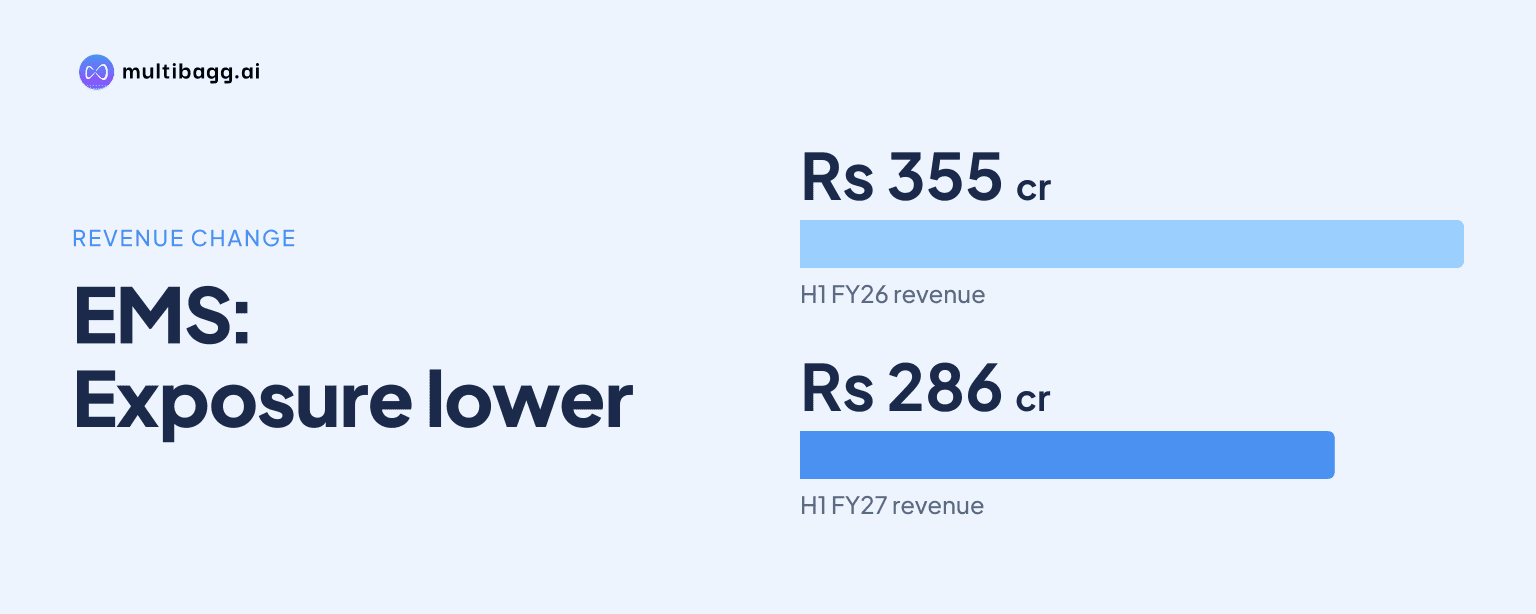
EMS Limited said Uttarakhand monsoon exposure has fallen because its road-side sewer and water-network laying work is completed or almost completed, leaving mainly campus-based construction. Management linked the prior disruption to H1 FY27 revenue of Rs 286 crore, compared with Rs 355 crore in H1 FY26, and said remaining work should be less exposed to rainfall.
Know EMS inside out
Results, valuation, peers and who's buying, in one view.
Why was EMS revenue lower in H1 FY27?
EMS said H1 FY27 revenue was lower because unusually heavy rainfall in Uttarakhand during Q2 FY26 halted sewer and water-supply network laying along roads for almost two to three months. Management said the administration and government departments stopped the work because excavation and construction during heavy rain could create a public hazard.
The interruption extended beyond the rainfall period, according to management. EMS said halted projects required restoration and reorganisation, while some detailed project reports needed engineering changes and fresh permissions from clients and funding agencies. Those processes affected Q3 and Q4 after the Q2 FY26 disruption, and management said Q1 FY27 was particularly weak.
EMS described the prior monsoon as unprecedented, distinguishing it from normal rainfall interruptions that it said usually last only a few days. Management attributed the Rs 69 crore difference between the two half-year periods to the execution setback rather than to any disclosed reduction in orders or a change in its water and wastewater business.
Has EMS reduced its Uttarakhand monsoon exposure?
EMS said it has reduced Uttarakhand monsoon exposure by completing or nearly completing its network-laying activity, which was the work most affected by the Q2 FY26 rainfall. The remaining work is mainly campus-based construction, including sewage treatment plants, or STPs, and water treatment plants, or WTPs.
Management said campus works continued during the earlier rainfall disruption, unlike road-side network work. It did not say the remaining construction would be immune from weather; instead, it estimated that rainfall might affect campus activity by 10% to 20%, compared with the roughly 80% erosion it cited for the previously exposed network work.
Uttarakhand nevertheless remained a major revenue source in the distribution disclosed on the call. EMS said Uttarakhand accounted for 67% of revenue, against 25% for Uttar Pradesh and 6% for Mumbai and Maharashtra. In the order book, Uttarakhand represented 12%, below Uttar Pradesh at 35% and Rajasthan at 27%, showing that its current revenue concentration exceeded its share of unexecuted work.
What recovery does EMS expect through FY27?
EMS expects sequential recovery in FY27, with management targeting Q3 operating income 30% to 35% above Q2 and Q4 another 30% to 35% above Q3. Management said that progression could enable EMS to match its FY25 figure by the end of FY27, after FY26 was lower following the monsoon disruption.
The company said stand-alone operating income increased about 30% from Q1 to Q2, while earnings before interest, tax, depreciation and amortisation, or EBITDA, and profit after tax, or PAT, increased by about 50%. EMS reported a Q2 EBITDA margin of 22.26% and a PAT margin of 14.25%.
Management attributed the difference between revenue and profit growth to fixed manpower and machinery costs, citing a workforce of 480 people. It also said its comments on operating-income and profit growth should be assessed on a stand-alone basis, because a flax factory within the consolidated structure generates revenue with only about 2% to 4% profit.
Got a follow-up? Ask IRIS
When will EMS's recent orders start producing revenue?
EMS said its recent Rs 900 crore of orders will not contribute much in the current year because they need engineering, approvals and mobilisation before execution begins. Management said this work was either at the lowest-bidder, or L1, stage or had recently received a letter of award, or LOA, as of September 30, 2026.
The company said L1 status is generally followed by LOA and agreement formalities in about two months, followed by three to four months of engineering and client approval. After work starts, initial billing can take another one to two months, meaning revenue generally begins six to eight months after L1 declaration, depending on client and site conditions.
EMS said it typically achieves about 90% of project revenue within two years, with the remaining 10% taking another six months, excluding retention money. Management said water and wastewater projects commonly take two to two-and-a-half years, which supports its rule of thumb that annual revenue can equal about 40% of the order book.
What supports EMS's execution pipeline and margins?
EMS said about Rs 1,600 crore of its unexecuted order book was already under execution as of September 30, 2026, alongside the Rs 900 crore of new or early-stage work. Management said an order book above Rs 3,000 crore could support about Rs 1,200 crore of annual revenue under its 40% execution formula, although this was presented as an industry rule of thumb rather than a forecast.
Management said it was bidding for around Rs 3,500 crore of work in the next quarter and expected an additional Rs 500 crore to Rs 600 crore in order book by December. It said the company sought to maintain an order book of about Rs 3,000 crore, while acknowledging that new wins face the stated six-to-eight-month revenue-start cycle.
EMS reported that project-specific engineering, soil exploration and design work related to Rs 900 crore of new orders had increased other expenses in the quarter. Management called those costs one-time and project-based rather than routine, and said they could decline in the next half year or quarter.
Conclusion
EMS's recovery case rests on a change in the type of work left in Uttarakhand: the road-side network laying that management said was heavily disrupted in Q2 FY26 is largely finished, while the remaining STP and WTP campus projects have lower stated exposure to rain. That shift accompanies a Rs 286 crore H1 FY27 revenue outcome versus Rs 355 crore a year earlier and a reported Q2 EBITDA margin of 22.26%.
The next measures to watch are whether Q3 operating income rises 30% to 35% from Q2 and Q4 rises another 30% to 35%, as management expects. Investors can also track whether the Rs 900 crore of recent orders moves through engineering and approvals, and whether bidding for Rs 3,500 crore of work results in the Rs 500 crore to Rs 600 crore order-book addition management expected by December.