










Energy In Motion Limited targets 500 electric freight vehicles
Key highlights
- EIM and Sorigin Green Mobility plan to deploy 500 e-HCVs over two years.
- The first disclosed deployment is 18 e-HCVs in the JNPA ecosystem.
- EIM will supply Ashwa 55-tonne electric tractors with charging and battery-swapping support.
- Sorigin Green Mobility says it already operates an EIM tractor at locations including Tuticorin Container Terminal.
powered by IRIS
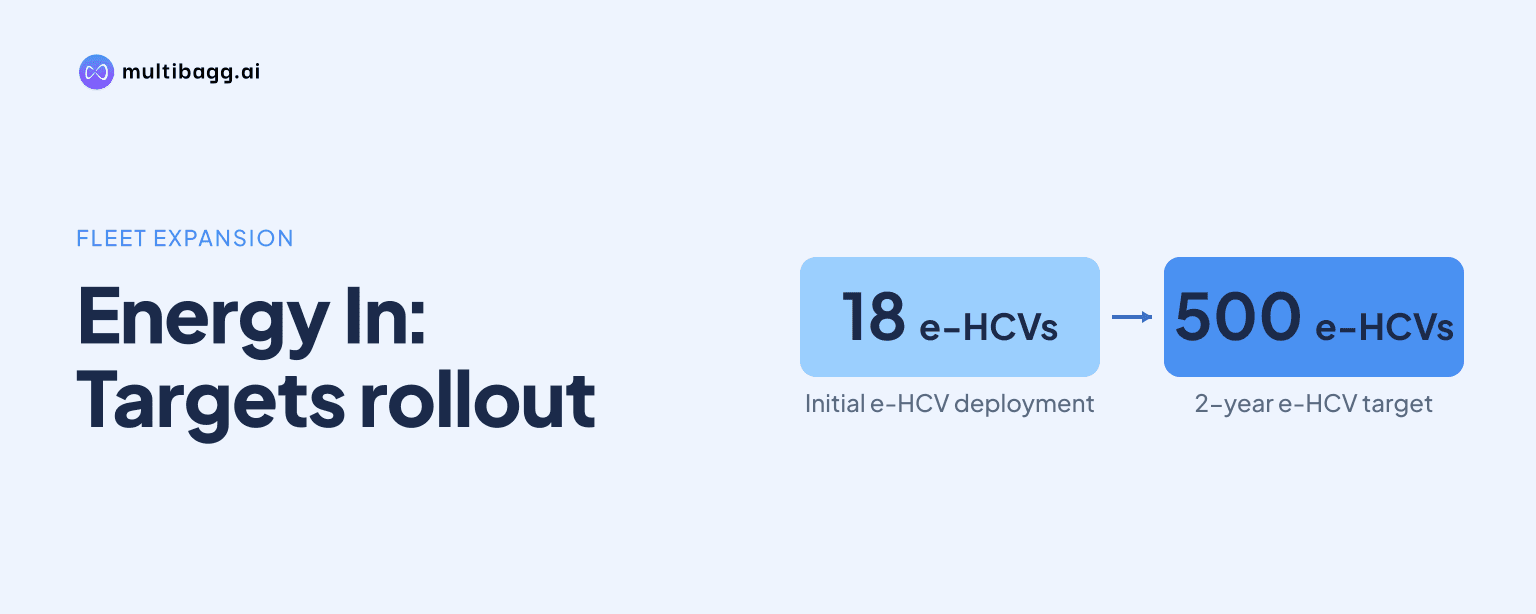
Energy In Motion Limited signed a 3 November 2026 MoU with Sorigin Green Mobility Private Limited to deploy 500 electric heavy commercial vehicles over two years, starting with 18 within the Jawaharlal Nehru Port Authority ecosystem. EIM will provide Ashwa 55-tonne electric tractors, charging, battery-swapping networks and energy-management solutions.
Know Ravindra Energy inside out
Results, valuation, peers and who's buying, in one view.
What does EIM’s MoU with Sorigin Green Mobility cover?
EIM’s memorandum of understanding, or MoU, with Sorigin Green Mobility Private Limited covers a proposed two-year programme to deploy 500 electric heavy commercial vehicles, or e-HCVs, on major Indian freight corridors. Announced on 3 November 2026, the arrangement is intended to expand electric heavy-duty freight transport and support lower-emission logistics and supply-chain operations.
The proposed deployment focuses on routes with significant cargo movement, including the Jawaharlal Nehru Port Authority, or JNPA, port ecosystem. EIM said these cargo-intensive routes were selected because vehicle utilisation, energy costs and operating efficiency are material considerations in heavy freight operations. The filing does not state a vehicle-by-vehicle rollout schedule beyond the initial 18-vehicle deployment.
The agreement begins with deployment rather than only a pilot, according to Sorigin Green Mobility, which said it already operates an EIM tractor at two locations, including Tuticorin Container Terminal. Sorigin Green Mobility said those operations allow the programme to start with deployments, although the announcement gives no date for the remaining vehicles after the first 18.
How will EIM deploy its first electric freight vehicles?
EIM expects implementation under the MoU to commence immediately, with 18 e-HCVs initially planned for the JNPA ecosystem. That initial fleet is the disclosed first phase of the 500-vehicle, two-year programme, placing the first stated operational emphasis on port-linked cargo movement rather than a nationwide launch at one time.
The first deployment is designed for heavy freight activity around JNPA, where EIM identified cargo volumes, turnaround requirements and energy costs as operating factors. The source does not provide expected kilometres travelled, freight volumes, charging locations, contract values, revenue, capital expenditure or emissions reductions for either the 18 vehicles or the full 500-vehicle programme.
Sorigin Green Mobility’s stated model is to finance, deploy, operate and maintain the fleet, with customers paying for freight moved rather than owning the vehicles. It said the service includes uptime commitments and no upfront capital expenditure for customers. These are features of Sorigin Green Mobility’s offering, rather than financial terms disclosed for the 3 November 2026 MoU.
What equipment and infrastructure will EIM provide?
EIM will provide its Ashwa 55-tonne electric tractors alongside charging infrastructure, battery-swapping networks and energy-management solutions. The 55-tonne tractor is the named vehicle product in the announcement, while the integrated equipment and energy platform is intended to support large-scale deployment on selected freight corridors.
EIM said the combination of charging and battery swapping is intended to reduce refuelling-related downtime and support vehicle utilisation. Managing Director Narendra Murkumbi said the approach is meant to address fleet-operator requirements including utilisation, turnaround time and energy costs, rather than relying on vehicle availability alone.
Battery swapping and charging are the two separately identified energy-delivery mechanisms in the announcement. EIM did not disclose the number, capacity or location of charging points and swapping stations for the initial 18 vehicles or the planned 500 e-HCVs. It also did not disclose a timetable for commissioning infrastructure alongside the two-year deployment programme.
Got a follow-up? Ask IRIS
What role will Sorigin Green Mobility have in EIM’s plan?
Sorigin Green Mobility will bring fleet operations to the 500-vehicle collaboration, while EIM will supply the Ashwa 55-tonne tractor and associated energy solutions. The announcement describes Sorigin Green Mobility as an original equipment manufacturer, or OEM, agnostic full-stack electric-vehicle trucking platform that owns and operates 55-tonne electric trucks under long-term contracts.
Its managed service covers vehicles and trailers matched to duty cycles, trained drivers for 24-hour operations, on-site supervision, OEM-backed maintenance, insurance and connected-fleet tracking. Sorigin Green Mobility also said customers receive emissions reporting and that charging can be delivered through battery swapping or on-site infrastructure. The filing gives no customer names, contract tenure or pricing for the 500 planned e-HCVs.
The stated model separates vehicle-and-energy provision from fleet execution. Sorigin Green Mobility said it aims to make zero-emission freight the default option for ports and industrial supply chains, but that is management’s objective for the programme and not a reported outcome as of the 3 November 2026 announcement.
How does EIM fit within Ravindra Energy Limited?
EIM is a jointly controlled company of Ravindra Energy Limited, which made the 4 November 2026 stock-exchange announcement. Ravindra Energy Limited is listed on the National Stock Exchange of India and BSE Limited under the symbol RELTD, according to the filing.
EIM describes itself as a provider of integrated electric-mobility solutions for long-haul freight transportation. Its stated proposition combines heavy-duty electric trucks with battery swapping and charging infrastructure, matching the 500 e-HCV MoU’s focus on vehicle deployment and the energy systems needed to support freight operations.
The announcement identifies EIM as the party providing Ashwa 55-tonne electric tractors and energy-management capabilities, while Sorigin Green Mobility handles the managed fleet offering. It does not quantify EIM’s ownership structure, disclose commercial consideration under the MoU, or specify how the initiative will affect Ravindra Energy Limited’s financial results.
Conclusion
The 3 November 2026 MoU sets a proposed target of 500 e-HCVs over two years, with an initial 18 vehicles planned at JNPA. EIM’s role combines its Ashwa 55-tonne tractor with charging, battery swapping and energy management, while Sorigin Green Mobility’s stated role covers financing, operating and maintaining fleets for freight customers.
The next disclosed milestone is immediate implementation of the 18-vehicle JNPA deployment. Progress on the remaining planned vehicles, the locations and scale of charging or swapping infrastructure, and any future disclosure of commercial terms or operating outcomes will determine how the two-year programme develops.