










Enser increases long-term debt as half-year cash edges up
Key highlights
- Enser’s long-term borrowings rose Rs 6.42 crore to Rs 23.72 crore at September 30, 2026.
- Enser’s short-term borrowings declined Rs 4.12 crore to Rs 20.19 crore from March 31, 2026.
- Enser reported Rs 3.50 crore of net financing cash inflow after Rs 2.26 crore of interest paid.
- Enser’s cash and bank balance increased Rs 1.10 lakh to Rs 87.45 lakh in the half year.
powered by IRIS
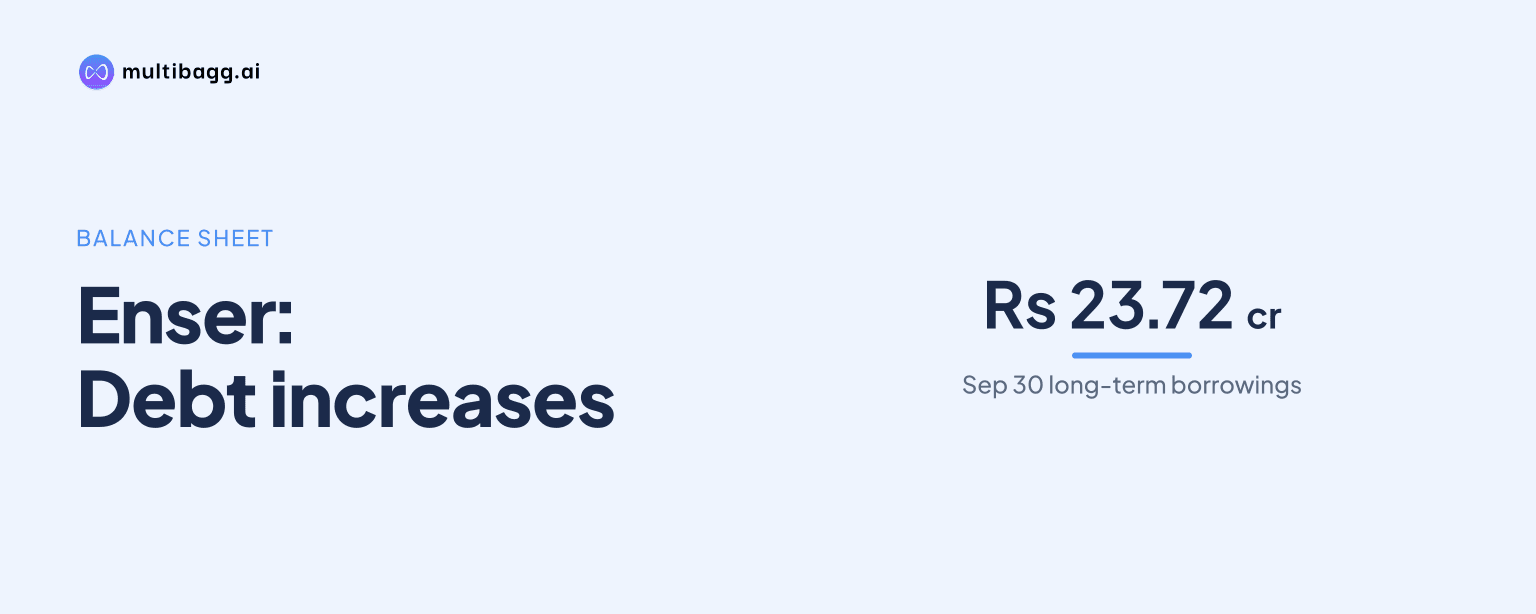
Enser Communications Limited increased consolidated long-term borrowings by Rs 6.42 crore to Rs 23.72 crore in the half year ended September 30, 2026, while its cash and bank balance rose Rs 1.10 lakh to Rs 87.45 lakh. Short-term borrowings declined by Rs 4.12 crore, changing the reported debt mix toward longer-term funding.
Know Enser Communications inside out
Results, valuation, peers and who's buying, in one view.
Why did Enser’s borrowing mix change?
Enser’s reported borrowing mix changed because long-term borrowings rose to Rs 23.72 crore at September 30, 2026 from Rs 17.30 crore at March 31, 2026, while short-term borrowings fell to Rs 20.19 crore from Rs 24.31 crore. The movements made long-term borrowings Rs 3.53 crore higher than short-term borrowings at the half-year date.
The consolidated cash-flow statement records a Rs 6.42 crore increase in long-term borrowings during the half year and a Rs 66.40 lakh decrease in short-term borrowings in financing activities. The balance-sheet decline in short-term borrowings, at Rs 4.12 crore, differs from the financing cash-flow line, which reports a Rs 66.40 lakh decrease; the filing does not provide a reconciliation between those two reported movements.
Enser’s total reported borrowings, comprising the two balance-sheet categories, increased Rs 2.30 crore to Rs 43.91 crore during the half year. At March 31, 2026, short-term borrowings exceeded long-term borrowings by Rs 7.01 crore; by September 30, 2026, the position had reversed, with long-term borrowings exceeding short-term borrowings by Rs 3.53 crore.
Did Enser generate cash from operations?
Enser did not generate net operating cash in the half year ended September 30, 2026, reporting a Rs 1.44 crore cash outflow from operating activities. This followed profit before tax of Rs 5.00 crore and operating profit before working-capital changes of Rs 9.35 crore in the consolidated cash-flow statement.
Trade receivables released Rs 7.89 crore of cash during the half year, but this was more than offset by a Rs 11.85 crore decrease in trade payables. The statement also records a Rs 2.39 crore increase in current investments, a Rs 76.53 lakh decrease in other current liabilities and a Rs 40.35 lakh increase in short-term loans and advances.
The Rs 1.44 crore operating outflow was lower than the Rs 5.92 crore outflow reported for the year ended March 31, 2026. The comparison is not like-for-like because the current figure covers six months, whereas the earlier figure covers a full year; nevertheless, both periods recorded net cash use from operating activities.
Got a follow-up? Ask IRIS
How did Enser’s cash and bank balance increase?
Enser’s cash and bank balance increased Rs 1.10 lakh because its Rs 3.50 crore financing cash inflow exceeded the combined Rs 3.48 crore used in operations and investing activities. Cash and bank balance rose from Rs 86.36 lakh at the start of the half year to Rs 87.45 lakh at September 30, 2026.
Financing activities produced Rs 3.50 crore of net cash, led by the Rs 6.42 crore increase in long-term borrowings. This was reduced by Rs 2.26 crore of interest paid and Rs 66.40 lakh of lower short-term borrowings, with no share-capital or share-premium proceeds reported in the half year.
Investing activities used Rs 2.04 crore, including Rs 3.28 crore spent on fixed assets and Rs 10.56 lakh added to long-term loans and advances. Those uses were partly offset by a Rs 1.05 crore decrease in other bank balances and Rs 28.47 lakh of interest income.
What else changed on Enser’s balance sheet?
Enser’s consolidated balance-sheet total declined to Rs 110.00 crore at September 30, 2026 from Rs 115.33 crore at March 31, 2026. Trade receivables fell Rs 7.41 crore to Rs 38.66 crore, which aligns with the Rs 7.89 crore cash release from receivables reported in operating cash flow.
Capital work in progress rose from nil at March 31, 2026 to Rs 5.22 crore at September 30, 2026. At the same time, tangible assets declined to Rs 14.87 crore from Rs 16.27 crore and intangible assets declined to Rs 5.50 crore from Rs 6.43 crore, despite the Rs 3.28 crore fixed-asset purchase reported in investing cash flow.
Trade payables owed to parties other than micro and small enterprises fell to Rs 4.25 crore from Rs 15.38 crore. Other current liabilities declined to Rs 7.15 crore from Rs 7.91 crore, while reserves and surplus increased Rs 3.54 crore to Rs 30.24 crore and share capital remained Rs 17.43 crore.
The balance sheet separately lists cash and cash equivalents of Rs 13.63 crore at September 30, 2026, compared with Rs 14.68 crore at March 31, 2026. This differs from the cash-flow statement’s Rs 87.45 lakh closing cash and bank balance, and the filing does not explain the difference between these labels and amounts.
Conclusion
Enser’s September 2026 half-year filing shows a shift in reported borrowing maturities rather than a reduction in overall debt: long-term borrowings increased Rs 6.42 crore, short-term borrowings declined Rs 4.12 crore and combined borrowings rose Rs 2.30 crore. Financing cash of Rs 3.50 crore covered Rs 1.44 crore of operating cash use and Rs 2.04 crore of investing cash use.
The next disclosures should clarify whether the Rs 5.22 crore capital work-in-progress balance moves into operating assets and whether receivables remain below the Rs 38.66 crore reported at September 30. Investors can also watch for resolution of the auditor’s noted delays in depositing certain undisputed statutory dues, for which the financial impact was not ascertainable in the review report.