










Ethos faces ₹117.58 crore GST demand on Chandigarh appeal
Key highlights
- Ethos faces ₹117.58 crore of confirmed GST tax demands under two Chandigarh appellate orders dated November 19, 2026.
- Customer advances account for ₹112.22 crore, or about 95%, of Ethos’s aggregate tax demand.
- Order 127-128 confirmed ₹87.94 crore of tax and ₹0.22 crore of standalone interest.
- Ethos said it will pursue legal remedies and does not expect a material financial impact.
powered by IRIS
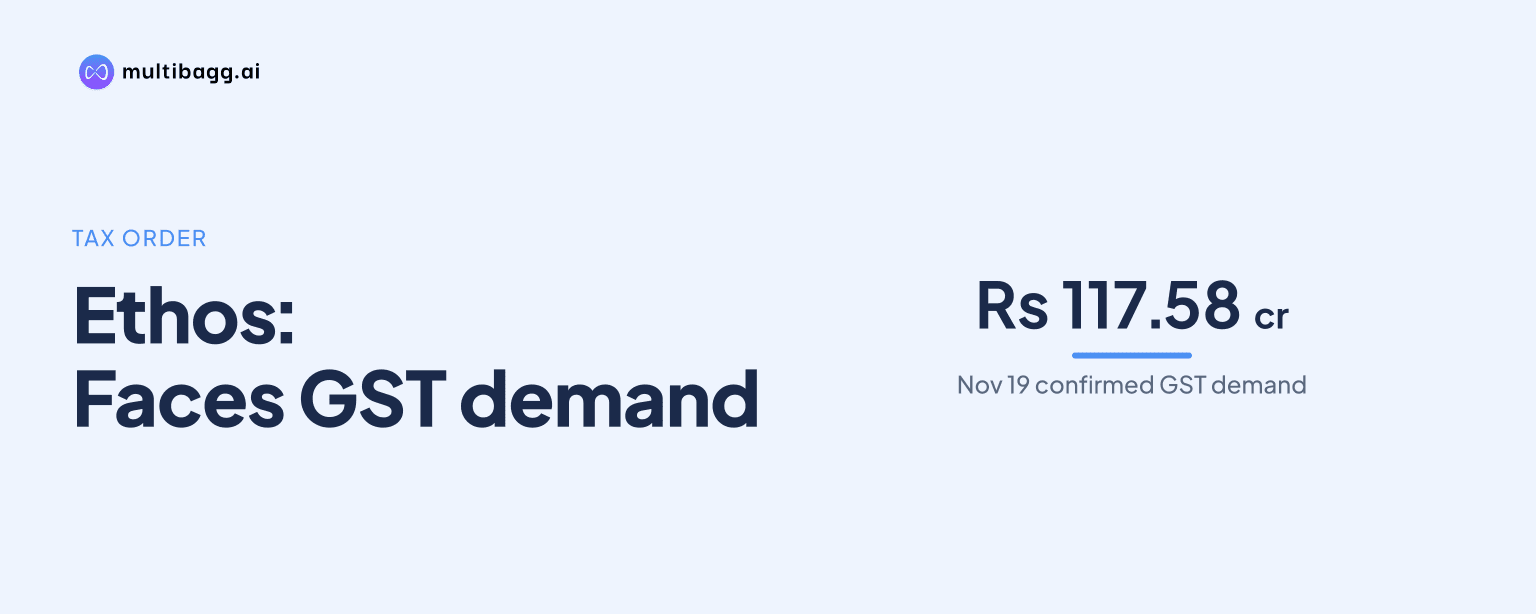
Ethos Limited faces a confirmed ₹117.58 crore goods and services tax (GST) demand after two Chandigarh appellate orders dated November 19, 2026 allowed departmental appeals against earlier relief. Ethos said ₹112.22 crore, about 95% of the tax demand, concerns customer advances and that it expects no material financial impact.
Know Ethos inside out
Results, valuation, peers and who's buying, in one view.
What did the Chandigarh appellate orders demand from Ethos?
The two Orders-in-Appeal confirmed ₹117.58 crore of tax demands for periods running from July 2017 to March 2021. Order 127-128, covering July 2017 to March 2020, confirmed ₹87.94 crore of tax plus a separate standalone interest demand of ₹0.22 crore. Order 129-130, for April 2020 to March 2021, confirmed ₹29.64 crore of tax.
The ₹117.58 crore aggregate excludes consequential interest under Section 50 of the Central Goods and Services Tax Act, 2017, because the orders did not quantify that amount. The orders also direct applicable statutory penalties under Section 73 or Section 74 of the Act on sustained components. Ethos disclosed that no operational restriction or sanction was imposed.
The Commissioner (Appeals), Central Goods and Services Tax Appeals Commissionerate, Chandigarh, issued both orders on November 19, 2026, and Ethos received them by email on November 20, 2026. Each order disposed of cross-appeals filed by Ethos and the department against original adjudication orders dated January 31, 2025 and February 25, 2025.
How did the appellate outcome change the earlier GST rulings?
The appellate decisions changed the outcome by allowing departmental appeals on demands the original adjudicating authority had dropped. Under Order 127-128, the January 2025 original order dropped ₹86.84 crore and confirmed ₹3.21 crore. The appellate order set aside ₹1.02 crore on one issue in Ethos’s favour but sustained a contested tax demand of about ₹87.94 crore.
Under Order 129-130, the February 2025 original order dropped ₹32.26 crore and confirmed ₹3.77 crore, including ₹3.07 crore already discharged in monthly returns and verified before the appeal. The appellate order set aside ₹0.19 crore on one issue for Ethos but sustained a net contested tax and input tax credit demand of about ₹29.64 crore. Input tax credit is credit claimed for GST paid on eligible business inputs.
The comparison shows that the main change came from reversal of relief on demands dropped by the original authority, rather than from the matters where Ethos obtained relief. The two appellate tax demands add to ₹117.58 crore, while the separate ₹0.22 crore standalone interest demand applies only to Order 127-128.
Got a follow-up? Ask IRIS
Why do customer advances account for most of Ethos’s demand?
Customer advances account for ₹112.22 crore, or about 95%, of the ₹117.58 crore tax demand confirmed in the two orders. This includes ₹83.23 crore under Order 127-128 and ₹28.99 crore under Order 129-130. The remaining ₹5.36 crore across both orders relates to other matters, including alleged input tax credit reconciliation differences.
The principal dispute concerns advances received from customers at Ethos stores across India, which the orders treat as vouchers. The tax demand seeks GST at Ethos’s Chandigarh registration when those advances were received. Ethos said applicable GST on goods supplied against the advances had already been discharged by its respective GST registrations when goods were supplied and tax invoices were issued.
Ethos’s position is that the demand would subject the same value to tax twice: at the Chandigarh registration on receipt of an advance and at the registration that invoiced the supply of goods. The original adjudicating authority had dropped this customer-advance demand for registrations outside Chandigarh, but the Commissioner (Appeals) took a different view while allowing the department’s appeals.
The filing identifies alleged input tax credit reconciliation differences and other items within the ₹5.36 crore balance beyond customer advances. It does not provide a further item-by-item monetary split of that balance across Order 127-128 and Order 129-130. The customer-advance issue therefore represents the central component of the litigation disclosed on November 21, 2026.
What will Ethos do after the ₹117.58 crore GST demand?
Ethos said it is reviewing the two orders and will pursue appropriate legal remedies before competent judicial or appellate forums within statutory timelines. The company said it has a case on merits in both matters and will contest the tax demand, related interest and penalties together.
Ethos said it does not expect the November 2026 orders to have a material impact on its financial, operational or other activities. That is the company’s assessment based on its view of the facts and applicable law, rather than a financial conclusion made by the Commissioner (Appeals).
The quantified interest disclosed is ₹0.22 crore of standalone interest under Order 127-128. Further interest under Section 50 may apply but was not quantified in the orders, while statutory penalties under Section 73 or Section 74 apply to sustained components. Ethos said those interest and penalty consequences will be contested with the underlying tax demand.
No settlement was disclosed for either proceeding as of November 21, 2026. Ethos stated that it would provide further updates in accordance with the Securities and Exchange Board of India listing regulations after taking its next legal steps.
Conclusion
The November 19, 2026 appellate orders materially changed the status of two GST disputes by confirming ₹117.58 crore of tax demands after the original orders had dropped ₹86.84 crore and ₹32.26 crore, respectively. The principal issue is ₹112.22 crore of customer-advance demands, where Ethos says GST was already paid when goods were supplied and invoices issued.
The next development to watch is Ethos’s planned challenge before competent judicial or appellate forums within statutory timelines. Consequential Section 50 interest remains unquantified, statutory penalties will be contested alongside the tax demand, and Ethos has said it will issue further updates under listing regulations.