










Ethos says Rs 112.22 crore GST demand risks double taxation
Key highlights
- Ethos reported Rs 117.58 crore of sustained tax and ITC demand across two GST appeal orders dated November 19, 2026.
- Rs 112.22 crore, or about 95% of the sustained demand, relates to customer advances.
- The July 2017 to March 2020 order includes Rs 87.94 crore of demand and Rs 0.22 crore of standalone interest.
- Ethos said it will pursue legal remedies and does not expect a material financial impact based on its assessment.
powered by IRIS
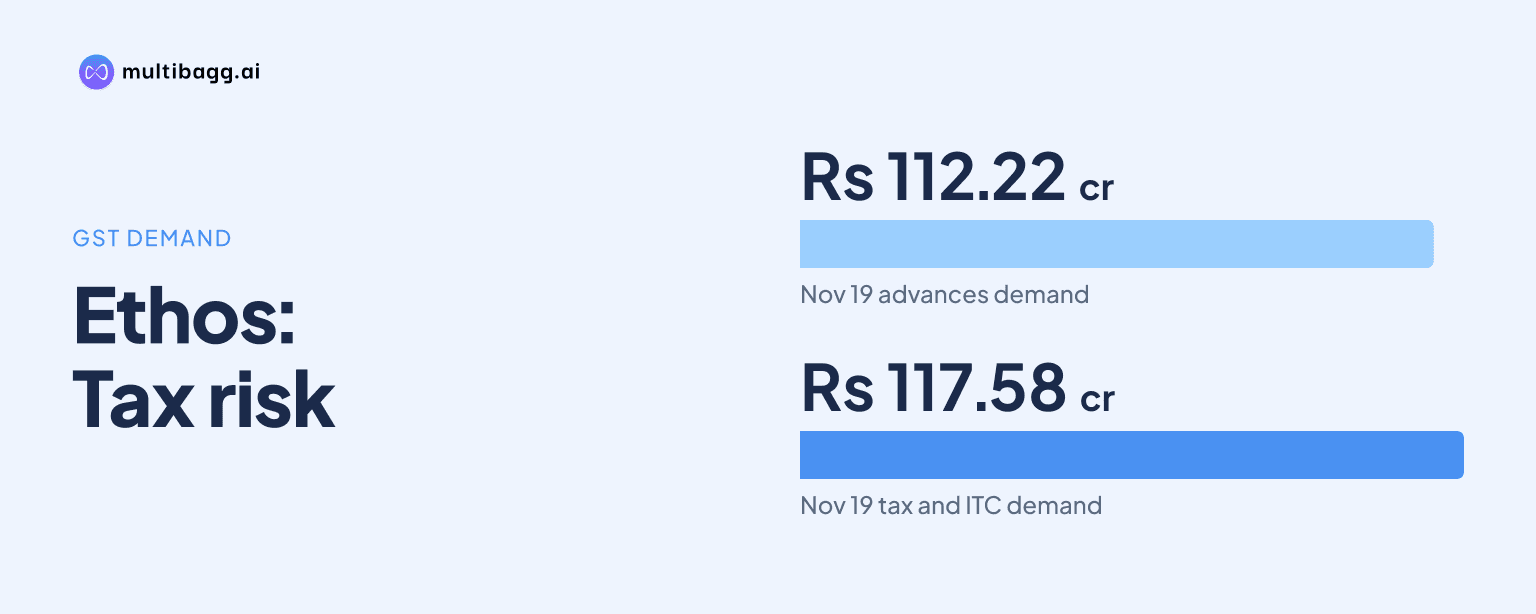
Ethos Limited says Rs 112.22 crore, about 95% of Rs 117.58 crore in Goods and Services Tax (GST) and input tax credit (ITC) demand sustained in two November 19, 2026 appeal orders, risks double taxation because GST was already discharged when goods were supplied and invoiced.
Know Ethos inside out
Results, valuation, peers and who's buying, in one view.
What did the Ethos GST appeal orders decide?
Two appeal orders sustained Rs 117.58 crore of tax and ITC demand against Ethos for periods from July 2017 to March 2021. The Commissioner (Appeals), Central Goods and Services Tax Appeals Commissionerate, Chandigarh issued both Orders-in-Appeal on November 19, 2026, and Ethos received them on November 20, 2026.
Order 127-128/2026-27 covers July 2017 to March 2020 and sustained about Rs 87.94 crore of tax demand, including Rs 83.23 crore linked to customer advances. It also includes a standalone interest demand of Rs 0.22 crore, apart from applicable interest and statutory penalty. The underlying January 31, 2025 Order-in-Original had dropped Rs 86.84 crore and confirmed Rs 3.21 crore.
Order 129-130/2026-27 covers April 2020 to March 2021 and sustained a net Rs 29.64 crore tax and ITC demand, of which Rs 28.99 crore concerns customer advances. Its February 25, 2025 Order-in-Original had dropped Rs 32.26 crore and confirmed Rs 3.77 crore, including Rs 3.07 crore that Ethos said had already been discharged through monthly returns and verified before the appeal.
The July 2017 to March 2020 matter represents Rs 87.94 crore of the combined Rs 117.58 crore demand, compared with Rs 29.64 crore for the following 12-month period. Across both orders, the Commissioner (Appeals) set aside Rs 1.21 crore on one issue in each case in Ethos’s favour, while sustaining the remaining contested components.
Why does Ethos say the customer-advance demand is double taxation?
Ethos says the Rs 112.22 crore customer-advance demand seeks GST at its Chandigarh registration even though tax on the underlying goods was paid by the relevant state GST registrations on supply and invoicing. The orders treated advances received from customers at stores across India as vouchers for the disputed demand.
According to Ethos, the Rs 83.23 crore in the first order and Rs 28.99 crore in the second order relate to advances that were later used for goods supplied to customers. The company says the applicable GST was discharged when those goods were supplied and tax invoices were issued, meaning a further levy at the advance stage in Chandigarh would tax the same value twice.
The latest appeal decisions differ from the earlier adjudication of the advance issue. Ethos said the adjudicating authority had dropped the demand for registrations outside Chandigarh in both cases, but the Commissioner (Appeals) took a different view after the department appealed those dropped demands. The department’s appeals were allowed on those components, while Ethos’s appeals were largely rejected except for relief of Rs 1.02 crore and Rs 0.19 crore.
The dispute concerns the point at which GST is payable and the registration expected to account for it. The authority identified alleged non-payment at the Chandigarh registration when the advances were received, while Ethos says GST was fully paid through the relevant registrations at delivery and invoicing of the goods.
Got a follow-up? Ask IRIS
How much of the Ethos demand is unrelated to customer advances?
Rs 5.36 crore of the Rs 117.58 crore sustained demand is outside the customer-advance issue. The amount is the difference between the combined demand and the Rs 112.22 crore advance component, which Ethos describes as about 95% of the total across the two orders.
For July 2017 to March 2020, Rs 4.71 crore remains after deducting the Rs 83.23 crore advance component from the Rs 87.94 crore demand. Ethos said this balance includes alleged ITC reconciliation differences and other items. ITC is the mechanism under which eligible GST paid on inputs can be credited against tax liability.
For April 2020 to March 2021, Rs 0.65 crore of the Rs 29.64 crore demand is unrelated to customer advances, after deducting Rs 28.99 crore. Ethos described this component as other items, while its disclosure separately identifies alleged ITC reconciliation differences and other matters across the combined proceedings.
The orders also provide for statutory penalties under Section 73 or Section 74 of the Central Goods and Services Tax Act, 2017, on the respective sustained components. Ethos did not disclose a quantified penalty, and it said no operational restriction or sanction was imposed following the November 19, 2026 orders.
What financial impact does Ethos expect from the GST orders?
Ethos does not expect a material financial impact from the Rs 117.58 crore sustained tax and ITC demand, based on its assessment of the merits. The company also said the two orders have no material impact on its financial, operational or other activities.
That view is Ethos’s assessment rather than a settlement of the dispute. The filing records Rs 0.22 crore of standalone interest in the July 2017 to March 2020 order and applicable interest and penalties in both proceedings, but it does not quantify the additional amounts. Ethos said it will contest interest and penalties together with the underlying tax demand.
The November 2026 disclosure reports no payment or settlement by Ethos in relation to the two orders. It also states that the proceedings do not involve litigation against key management personnel, promoters or an ultimate person in control, distinguishing the GST registration dispute from an action against individuals.
What will Ethos do after the GST orders?
Ethos plans to pursue appropriate legal remedies before competent judicial or appellate forums within statutory timelines. The company said it is reviewing the two orders dated November 19, 2026 and intends to safeguard its legitimate interests.
Ethos has not identified the specific forum, a filing date or a hearing date for its next challenge. It said it would provide further updates under listing regulations, leaving the treatment of the Rs 112.22 crore customer-advance component unresolved.
Conclusion
The two appeal orders have sustained Rs 117.58 crore of tax and ITC demand against Ethos, with Rs 112.22 crore arising from customer advances. The central issue is whether GST can be sought from the Chandigarh registration on advances when Ethos says tax was already paid by state registrations once goods were delivered and invoiced.
The next item to watch is Ethos’s planned legal filing within statutory timelines after its November 20, 2026 receipt of the orders. The company has not disclosed a hearing schedule, settlement, payment amount or quantified penalty, while maintaining that it does not expect a material financial impact based on its assessment of the case.