










Evonile Pharma Moves Toward ₹900 Crore Rights Issue Approval
Key highlights
- Evonile Pharma plans to raise up to ₹900 crore through partly paid-up equity shares.
- BSE granted in-principle approval for the draft Letter of Offer on October 30, 2026.
- The board is scheduled to consider the Letter of Offer on November 4, 2026.
- The proposed rights issue shares carry a face value of ₹5 each.
powered by IRIS
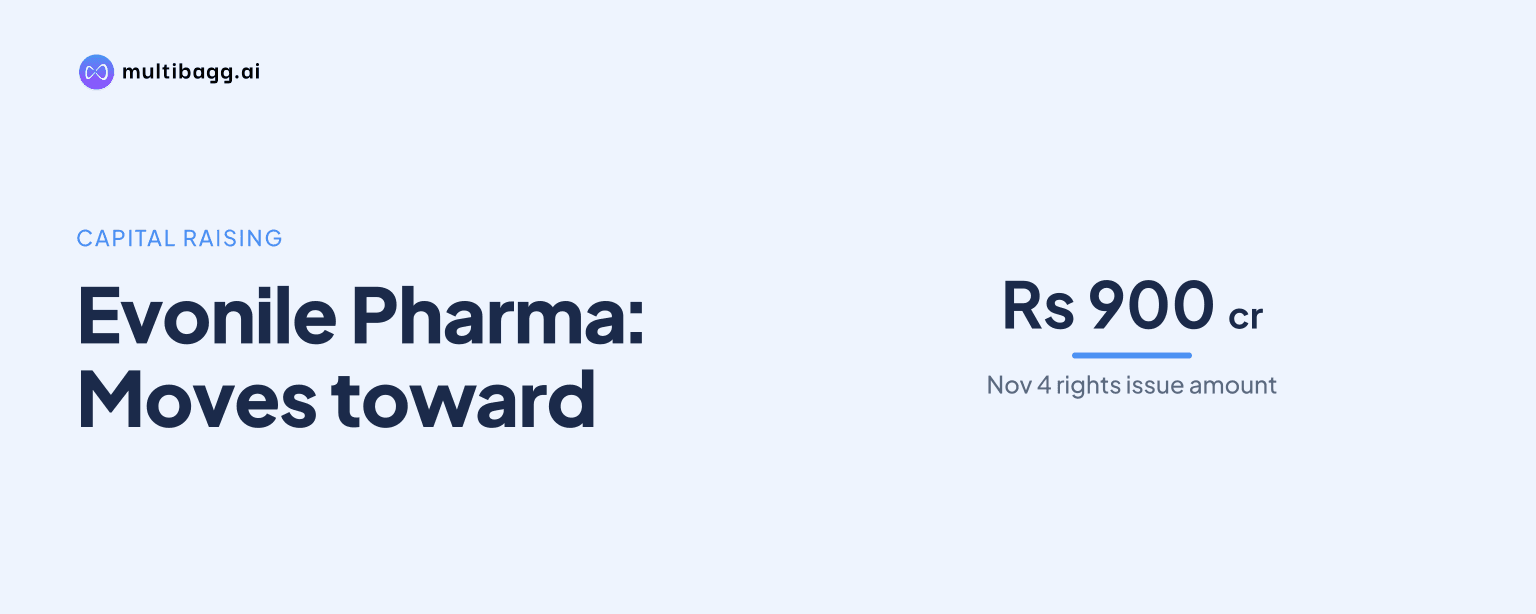
Evonile Pharma Limited, formerly Novartis India Limited, has received BSE's in-principle approval for a rights issue of partly paid-up equity shares worth up to ₹900 crore, while its board and Rights Issue Committee are scheduled to consider the offer terms on November 4, 2026.
Know Novartis India inside out
Results, valuation, peers and who's buying, in one view.
What has Evonile Pharma announced on its ₹900 crore rights issue?
Evonile Pharma has said it plans to raise an aggregate amount not exceeding ₹900 crore through a rights issue to eligible equity shareholders. The proposed shares will be partly paid-up equity shares with a face value of ₹5 each. The fundraise remains subject to applicable statutory, regulatory and shareholder approvals.
The company had earlier approved the proposed fundraising at its board meeting on October 8, 2026. It also constituted a Rights Issue Committee to determine the detailed commercial and procedural terms. Those terms include the issue price, rights entitlement ratio, record date, timing and allotment of shares.
BSE Limited has granted in-principle approval for the draft Letter of Offer, according to the company's November 1 disclosure. This approval is a procedural step in taking the proposed issue forward, but does not by itself disclose how many shares will be offered or the price at which shareholders may subscribe.
What will the November 4 board meeting decide?
Evonile Pharma's board is scheduled to consider and approve the Letter of Offer on November 4, 2026. The same day's Rights Issue Committee meeting is expected to decide and discuss matters connected with the issue, including the price, entitlement ratio, record date and treatment of fractional entitlements.
These details are significant for existing shareholders because they establish who is eligible to participate and the proportion of new shares available against current holdings. The record date has not been announced in the disclosures provided, and neither has the subscription price.
The company had also scheduled an earnings call for November 4, 2026 at 2:30 PM IST. Its board-meeting calendar lists meetings on October 8 for the rights issue proposal, November 3 for quarterly results and November 4 for the rights issue of equity shares.
Why does BSE's in-principle approval matter?
BSE's in-principle approval indicates that the exchange has cleared the draft proposal at this stage, allowing Evonile Pharma to proceed with the next documented steps for the rights issue. The company still needs to complete the processes and approvals referred to in its filings before the shares can be issued and allotted.
A rights issue offers existing shareholders an opportunity to subscribe to new shares, generally in proportion to their existing holdings. In Evonile Pharma's case, the exact entitlement ratio is yet to be fixed, so investors do not yet know the number of shares that may be offered against each existing share held.
The company has stated that the issue is proposed on a rights basis for eligible shareholders. It has also approved a postal ballot notice for shareholder approval. The provided disclosures do not specify the intended use of the ₹900 crore proceeds, and no allocation between operating, acquisition, debt or other purposes has been announced.
Got a follow-up? Ask IRIS
How could the rights issue affect Evonile Pharma shareholders?
The rights issue could affect Evonile Pharma's shareholding structure because new equity shares are proposed to be issued. Existing shareholders will need the eventual issue price, entitlement ratio and record date to assess their subscription options and the implications of not participating.
The shares proposed are partly paid-up, meaning the payment structure will be set through the final issue terms rather than being fully described in the current disclosures. The company has not disclosed the unpaid amount, call schedule or final number of shares in the information provided.
For the market, the relevant confirmed development is the movement of the proposal from board approval to exchange in-principle approval and the pending Letter of Offer. Technical indicators and trading signals mentioned in market commentary do not change the formal terms of the fundraise, which remain to be set by the board and committee.
What is the background to Evonile Pharma's fundraising plan?
Evonile Pharma was formerly known as Novartis India Limited, as stated in the company-related disclosures. The proposed rights issue follows the board's October 8 approval to raise funds through equity shares issued on a rights basis, with the company subsequently seeking the relevant approvals.
The company also disclosed in September 2026 that its board approved the acquisition of the trademarks “Minipress” and “Minipres” from Pfizer Inc. USA and Pfizer Products Inc. USA. However, the supplied information does not link that trademark transaction to the proposed rights issue or state that rights issue proceeds will finance the acquisition.
Conclusion
Evonile Pharma has advanced its proposed equity fundraising after obtaining BSE's in-principle approval for a rights issue of up to ₹900 crore. The fundraising is planned through partly paid-up ₹5 face-value shares offered to eligible shareholders, but the commercial terms needed to assess participation remain undisclosed.
Investors should watch for the outcome of the November 4 board and Rights Issue Committee meetings, particularly the approved Letter of Offer, issue price, entitlement ratio, record date, payment structure and timetable. These announced terms will provide the basis for evaluating the issue's effect on individual holdings and the company's equity base.