










Exide commissions 6 GWh plant, approvals remain underway
Key highlights
- Exide commissioned its 6 GWh Bengaluru lithium-ion gigafactory in September 2026.
- Commercial production has started, while customer validation and qualification remain in progress.
- Exide has operationalised 100% of plant utilities and supplied 5 Ah NMC and 102 Ah LFP cell samples.
- Exide cites estimates of Indian advanced-chemistry battery demand rising from about 25 GWh in 2026 to 140-150 GWh by 2030.
powered by IRIS
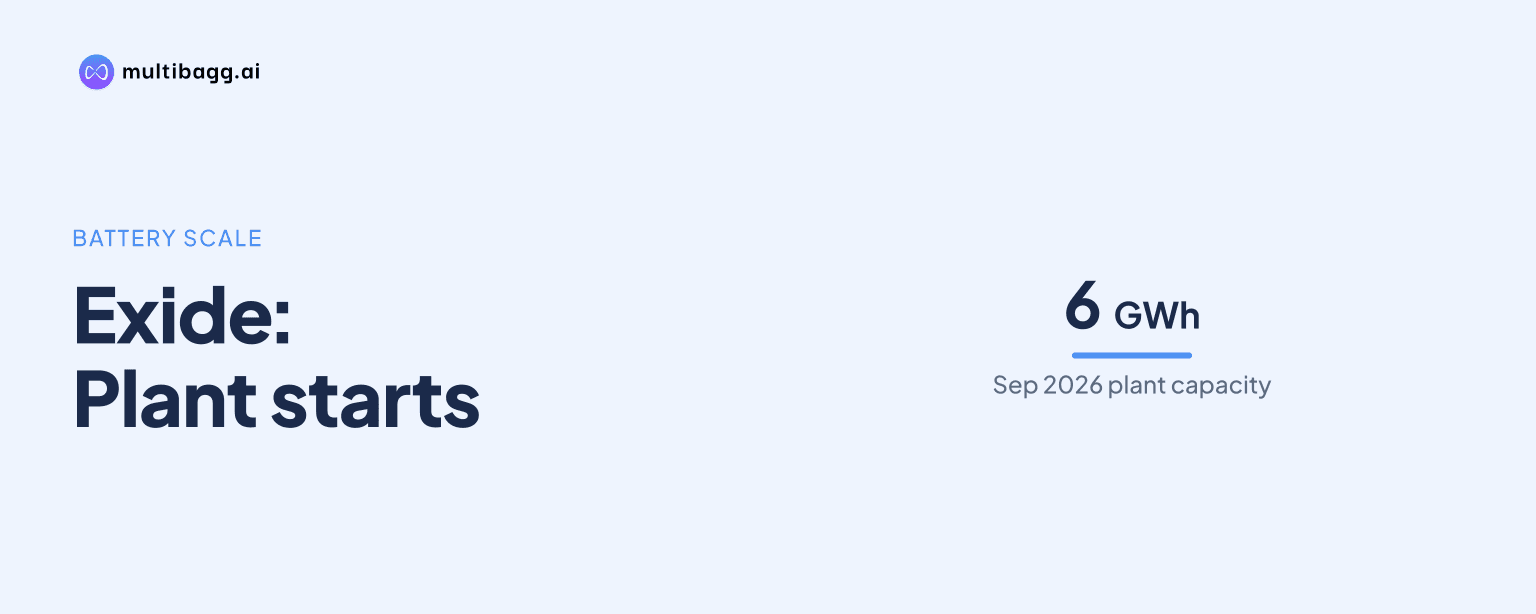
Exide Energy Solutions Limited commissioned its 6 gigawatt-hour (GWh) Bengaluru lithium-ion cell plant in September 2026 and began commercial production, but validation and qualification with leading two-wheeler electric-vehicle (EV) original equipment manufacturers (OEMs) and telecom players remain in progress. The plant has also operationalised 100% of its utilities.
Know Exide Industries inside out
Results, valuation, peers and who's buying, in one view.
What has Exide completed at the Bengaluru gigafactory?
Exide commissioned its 6 GWh Bengaluru gigafactory in September 2026 and says commercial production has started. The presentation identifies commissioning as an achieved September 2026 milestone, while placing customer approval in a separate workstream that remains in progress. This means factory operations have begun, but the disclosed qualification process has not yet been completed.
Exide says 100% of the site’s utilities have been operationalised. The plant includes cylindrical and prismatic production lines, providing two cell form factors within the 6 GWh facility. The company describes the multi-line plant as designed for scale-up, but does not disclose separate capacity for the cylindrical and prismatic lines or their current utilisation.
Which cells is Exide qualifying with customers?
Exide has supplied nickel manganese cobalt (NMC) and lithium iron phosphate (LFP) cell samples to leading two-wheeler EV OEMs and telecom players. The two disclosed products are a 5 ampere-hour (Ah) NMC cell and a 102 Ah LFP cell, representing different chemistries and capacities from the Bengaluru facility. Exide does not name the OEMs or telecom players receiving samples.
Both the 5 Ah NMC and 102 Ah LFP products are listed as certified under IS 16046, IS 16893 and UN 38.3. Exide presents these certifications alongside the sample-supply disclosure, but separately states that customer validation and qualification are still under way. The presentation does not disclose whether either product has received a completed customer approval, an order, or a recurring supply schedule.
How does customer approval compare with plant commissioning?
Exide’s update shows plant readiness has progressed further than market qualification: the 6 GWh plant was commissioned in September 2026, commercial production has started and utilities are 100% operational, while validation and qualification remain in progress. The distinction is material because commissioning establishes manufacturing capability, whereas qualification determines whether the named customer groups can begin using the cells.
Exide says its product approach includes joint development aligned with OEMs, which is the disclosed mechanism for matching cell solutions to customer requirements. It also says solutions can be customised for EV and energy-storage applications. However, the presentation gives no approval target date, production volume, utilisation level, pricing, order book or revenue contribution for the 6 GWh operation.
Got a follow-up? Ask IRIS
What demand backdrop does Exide cite for localized cells?
Exide cites Boston Consulting Group estimates that India’s advanced-chemistry battery market could increase from about 25 GWh in 2026 to 140-150 GWh by 2030. The company describes the 2026 market as largely imported and expects demand to move toward localisation. The 2030 range is about six times the cited 2026 market level, although it is industry context rather than Exide sales guidance.
The presentation estimates that EVs could account for 60-70% of advanced-chemistry battery demand by 2030, with stationary applications forming the balance. It also cites higher expected EV penetration across three-wheelers, two-wheelers and passenger vehicles. The largest indicated increase is in two-wheelers, where penetration is expected to rise from about 11-12% in September 2026 to more than 30% by 2030.
Exide links local production to a shorter working-capital cycle, supply security and closer quality engagement, while noting potential policy support. Its presentation also cites renewable-energy intermittency, grid overload and rising power demand from data centres and artificial-intelligence usage as drivers of energy storage. These factors describe the company’s stated market context, not a forecast of Exide’s market share or output.
How does Exide plan to manufacture and scale its cell offering?
Exide says it intends to address costing through strategic raw-material sourcing partnerships, automation and technology-led manufacturing efficiency. The company also cites a technology partnership with an unnamed global lithium-ion cell player, automated assembly and in-process quality checks. It does not identify the technology partner, raw-material suppliers or the commercial terms of those arrangements.
The 5 Ah NMC and 102 Ah LFP cells illustrate Exide’s disclosed multi-chemistry approach, while cylindrical and prismatic lines provide multiple form factors. The company says it will offer end-to-end products and solutions for EV and energy-storage applications and leverage its market access and after-sales support ecosystem. It has not disclosed a capacity split between NMC and LFP, expected yields, or production allocation by application.
Conclusion
Exide has moved its Bengaluru project from construction into operations, commissioning 6 GWh of lithium-ion cell capacity in September 2026, starting commercial production and operationalising 100% of utilities. Yet the operating milestone does not establish customer conversion: qualification and validation with two-wheeler EV OEMs and telecom players remain unfinished despite sample supplies and certifications for the 5 Ah NMC and 102 Ah LFP products.
The next disclosed development to watch is the outcome of customer qualification, including any announcement of approved customers, commercial supply timing or production volumes. Exide’s stated plan relies on OEM-aligned product development, multi-line scale-up, sourcing partnerships and automation, against an industry demand estimate of 140-150 GWh for India by 2030.