










Exide commissions 6 GWh Bengaluru lithium-ion cell factory
Key highlights
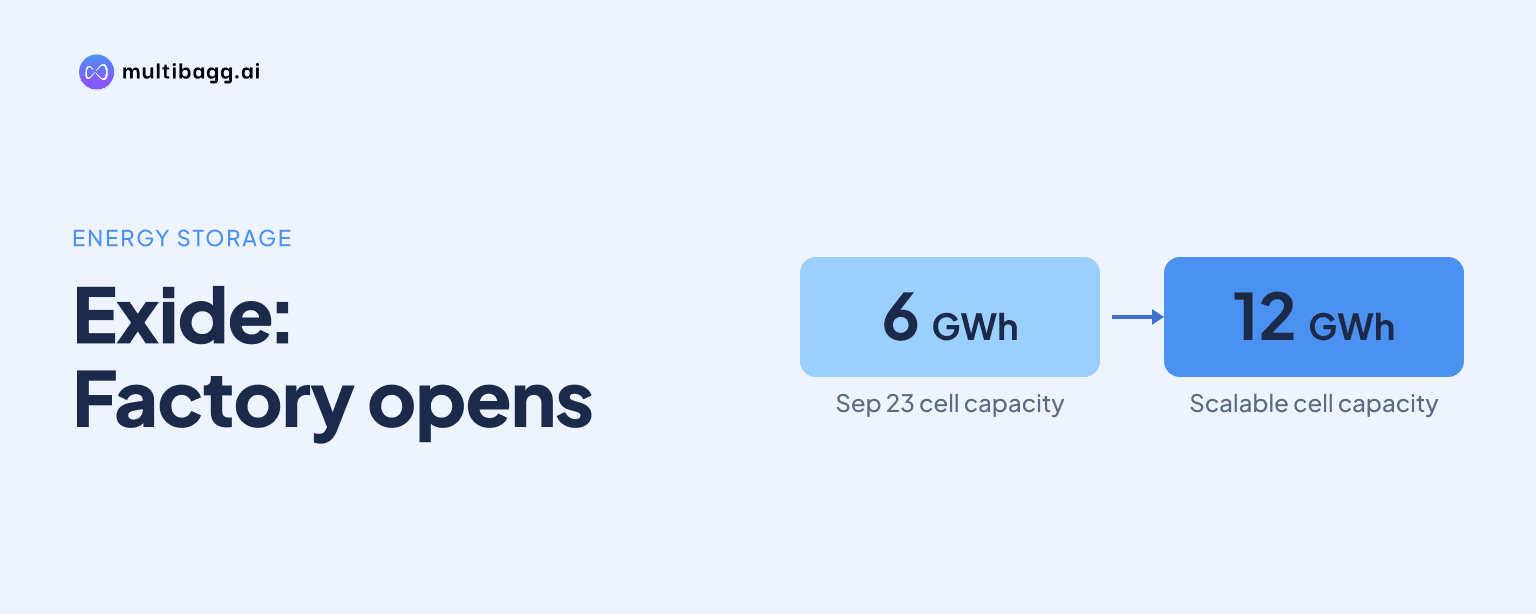
- Exide commissioned 6 GWh of lithium-ion cell capacity in Bengaluru on 23 September 2026.
- Exide’s cumulative equity investment in EESL reached Rs 5,352 crore after a Rs 550 crore infusion between April and October 2026.
- The Bengaluru facility is scalable to 12 GWh and is designed for LFP and NMC cell chemistries.
- Exide reported H1 FY2027 standalone revenue of Rs 10,331 crore, up 18.9%, and profit after tax of Rs 794 crore, up 46.7%.
powered by IRIS
Exide Industries Limited commissioned 6 gigawatt-hours (GWh) of lithium-ion cell capacity in Bengaluru on 23 September 2026, while cumulative equity investment in its material subsidiary Exide Energy Solutions Limited (EESL) reached Rs 5,352 crore after a Rs 550 crore infusion between April and October 2026.
Know Exide Industries inside out
Results, valuation, peers and who's buying, in one view.
What did Exide commission in Bengaluru?
Exide commissioned a 6 GWh lithium-ion cell manufacturing facility at Devanahalli, Bengaluru, Karnataka, through EESL on 23 September 2026. The facility is intended to make advanced lithium-ion cells across multiple chemistries and form factors for mobility and energy-storage applications.
The Bengaluru project is a greenfield facility designed to serve India’s electric-mobility and stationary energy-storage markets. Exide disclosed the commissioning in its half-year results approved by its board on 4 November 2026.
The announcement does not disclose commercial production volume, utilisation, cell sales or revenue from the 6 GWh site. Management instead identified line stabilisation, yield improvement and customer qualifications as the priorities for the coming quarters after the September commissioning.
How much has Exide invested in EESL?
Exide’s cumulative equity investment in EESL reached Rs 5,352 crore after it infused Rs 550 crore between April 2026 and October 2026. The source identifies EESL as a material subsidiary and the vehicle through which Exide has established the Bengaluru cell facility.
The group’s consolidated balance sheet records a substantial shift between capital work-in-progress and completed property, plant and equipment at 30 September 2026. Property, plant and equipment rose by Rs 4,035.53 crore from 31 March 2026, while capital work-in-progress fell by Rs 3,771.06 crore; Exide does not separately assign those movements to EESL.
Total consolidated assets were Rs 21,191.37 crore at 30 September 2026, compared with Rs 21,219.88 crore at 31 March 2026. The source provides no separate EESL asset balance, debt balance or capital-expenditure figure for the Bengaluru project.
What capacity and technologies can Exide’s plant support?
Exide says the Bengaluru facility is scalable to 12 GWh, double the 6 GWh capacity commissioned on 23 September 2026. The disclosed 12 GWh figure is a scalability level, not an announced date or commitment for a second 6 GWh commissioning phase.
The facility is designed to cater to lithium iron phosphate (LFP) and nickel manganese cobalt (NMC) chemistries. EESL also says it can manufacture advanced lithium-ion cells in multiple form factors, supporting the stated mobility and stationary-storage markets.
Exide’s existing lithium-ion operation at Prantij, Gujarat, is a module and pack facility rather than a cell-manufacturing site. The company says the Prantij operation has helped build early market presence and customer engagement, but it does not disclose its capacity, revenue or customer count.
Got a follow-up? Ask IRIS
What must Exide achieve after commissioning the factory?
Exide’s stated focus for the coming quarters is stabilising the Bengaluru lines, improving yields and completing customer qualifications. Management gave those three milestones after the 6 GWh facility was commissioned on 23 September 2026.
The company has not provided a production target, yield target, qualification timetable or number of customers for the new factory. It also has not disclosed a funding plan or commissioning schedule for expanding the site from 6 GWh to its stated scalable capacity of 12 GWh.
The qualification work is relevant to the facility’s intended markets because EESL plans to serve electric mobility and stationary energy storage. The source does not identify individual vehicle programmes, storage projects or offtake agreements linked to the Bengaluru cells.
What was Exide’s business backdrop at commissioning?
Exide reported standalone revenue of Rs 10,331 crore for the first half of financial year (H1 FY) 2027, up 18.9% from Rs 8,688 crore in H1 FY2026. Profit after tax increased 46.7% to Rs 794 crore from Rs 541 crore over the same comparison.
Earnings before interest, tax, depreciation and amortisation margin was 12.2% in H1 FY2027, compared with 10.9% in H1 FY2026, an increase of 130 basis points. Exide attributed the improvement to cost optimisation, calibrated price increases and volume growth.
In the second quarter of FY2027, automotive original-equipment manufacturer business grew by more than 25% year on year for a fourth consecutive quarter. Home inverters and solar, as well as exports, each grew by more than 20% year on year for a second consecutive quarter, while exports were measured against a low base.
Conclusion
The 23 September 2026 commissioning gives Exide a 6 GWh lithium-ion cell manufacturing asset in Bengaluru and extends its lithium-ion presence beyond the Prantij module and pack facility. The project is supported by Rs 5,352 crore of cumulative EESL equity investment and is designed for LFP and NMC cells serving mobility and stationary-storage applications.
The next disclosed measures are line stabilisation, yield improvement and customer qualifications over coming quarters. Exide has also stated that the Bengaluru site is scalable to 12 GWh, but has not disclosed a second-phase timetable, funding commitment, customer qualification date or production target.