








Force Motors’ Chakan venture is sole Series 1600 producer
Max Plan at ₹4,999/yr₹8,999

Find your next multibaggerBe a Pro Investor
Research stocks and track your picks on the go. Download the app.
Key highlights
- Force Motors says its 2018 FMTU facility in Chakan is the world’s only plant producing Series 1600 engines.
- Force Motors owns 51% of FMTU and Rolls-Royce Power Systems AG owns 49%.
- Force Motors commissioned its BMW India engine and cooling-module facility in Chennai in 2015.
- Force Motors describes Pithampur as a more-than-300-acre integrated mother plant.
powered by IRIS
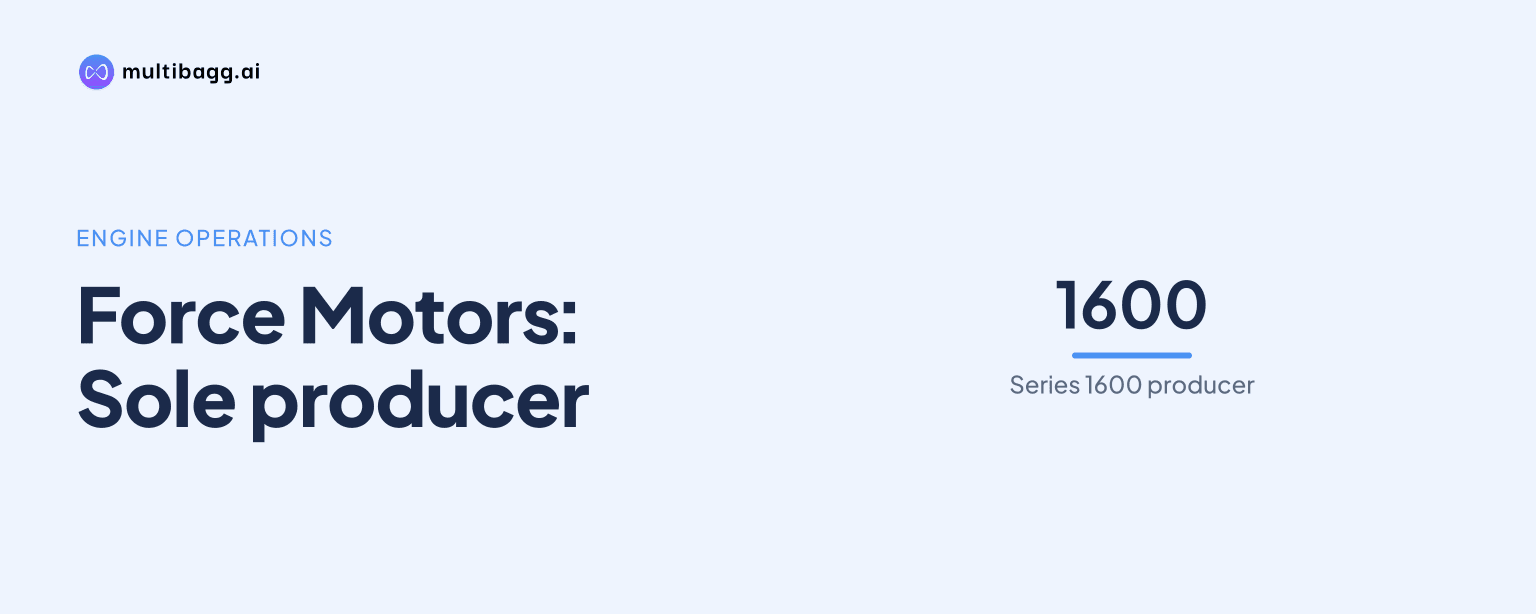
Force Motors says its Chakan, Pune facility operated by Force MTU Power Systems Pvt. Ltd. is the world’s only manufacturing plant producing Series 1600 engines and supplying global markets. The joint venture, established in 2018, is owned 51% by Force Motors and 49% by Rolls-Royce Power Systems AG.
Know Force Motors inside out
Results, valuation, peers and who's buying, in one view.
Why is Force Motors’ Chakan joint venture globally distinctive?
Force Motors’ Chakan joint venture is globally distinctive because the company identifies it as the only manufacturing plant in the world producing Series 1600 engines. Force MTU Power Systems Pvt. Ltd., abbreviated as FMTU, was established in 2018 in Chakan, Pune, and supplies the engine range to global markets.
The stated exclusivity applies specifically to Series 1600 engines, rather than to all mtu products or industrial engines. In its high-tech aggregate business portfolio, Force Motors lists Series 1600 MTU Engines and Series 1600 Diesel Generators under mtu, described as a Rolls-Royce solution.
Force Motors does not disclose FMTU’s annual production capacity, engine output, revenue, customer base, export volumes or destination countries. The presentation therefore supports the plant’s sole-production status and global supply role, but not a quantified assessment of its operating scale.
Who owns Force Motors’ FMTU operation?
Force Motors owns 51% of FMTU, while Rolls-Royce Power Systems AG owns the remaining 49%. The presentation identifies the 51:49 ownership structure for the Chakan venture established in 2018.
The ownership disclosure distinguishes FMTU from Force Motors’ other dedicated aggregate facilities. The company says its Chennai unit was commissioned in 2015 for BMW India, while its separate Chakan facility was commissioned in 2016 for Mercedes-Benz; it does not provide ownership percentages for either arrangement.
FMTU is one of four locations shown in Force Motors’ plant-location overview, alongside Akurdi, Chennai and another Chakan facility. The presentation separately labels the FMTU site as Force MTU Power Systems, Chakan, Pune, underscoring that it is distinct from the Mercedes-Benz-focused Chakan operation.
What Series 1600 products does Force Motors list?
Force Motors lists Series 1600 MTU Engines and Series 1600 Diesel Generators in its high-tech aggregate business portfolio. However, the FMTU facility disclosure specifically identifies Series 1600 engines as the products manufactured at the sole global plant.
The presentation does not state that FMTU is the only global producer of Series 1600 diesel generators. The global exclusivity statement is limited to engines, so the generator listing does not establish a comparable worldwide manufacturing claim for diesel generator sets.
Force Motors’ aggregate portfolio also includes products for BMW and Mercedes. For BMW, it lists four-cylinder and six-cylinder petrol and diesel engines plus condenser radiator fan modules; for Mercedes, it lists four-cylinder and six-cylinder petrol and diesel engines plus axles.
Got a follow-up? Ask IRIS
How does FMTU compare with Force Motors’ other plants?
FMTU differs from Force Motors’ BMW and Mercedes facilities because it is described as supplying Series 1600 engines to global markets, while the other two dedicated plants support vehicles made in India. The Chennai facility was commissioned in 2015, followed by the Mercedes-Benz-focused Chakan facility in 2016 and FMTU in 2018.
Force Motors’ Pithampur site has a broader manufacturing role than the dedicated aggregate plants. The company describes Pithampur as a fully integrated mother plant spanning more than 300 acres, covering stamping, body welding, painting, powertrain assembly and final assembly, as well as in-house engines, gearboxes and axles.
The comparison shows a split between vehicle manufacturing and customer- or programme-specific aggregate production. Force Motors’ vehicle range includes Traveller, Urbania, Monobus, Trax and Gurkha, whereas the high-tech aggregate business covers BMW, Mercedes and mtu-related Series 1600 products.
What does Force Motors’ wider manufacturing footprint include?
Force Motors’ manufacturing footprint combines its own vehicle production with facilities dedicated to BMW, Mercedes and the FMTU Series 1600 programme. The company identifies Akurdi, Chennai, Chakan and FMTU Chakan among its listed plant locations.
Within the vehicle business, Force Motors says Traveller has more than 70% market share in its segment and is offered for school-bus, ambulance, delivery-van and other special applications. Urbania is offered in 9+D, 10+D, 12+D, 13+D and 16+D configurations, while Monobus is presented as a 31- and 44-seater monocoque bus platform.
Force Motors also reports an export presence in more than 25 countries, although it does not say whether those countries overlap with FMTU’s Series 1600 engine destinations. The presentation describes FMTU as supplying global markets but does not identify export regions, customers or shipment volumes.
The company has separately launched Project DigiForce, a Rs 150 crore digital-transformation programme spanning two years. The plan includes digitising sales, service, marketing and dealer operations, with integration across more than 200 dealerships and 70 service centres, but Force Motors does not connect the programme directly to FMTU production.
Conclusion
Force Motors presents FMTU as a distinct part of its manufacturing base: a 51:49 venture with Rolls-Royce Power Systems AG that operates the sole global plant producing Series 1600 engines. Its global supply role differs from the India-focused BMW and Mercedes dedicated facilities and from the integrated, more-than-300-acre Pithampur mother plant.
What to watch next is whether Force Motors provides operating data for FMTU, such as capacity, production volumes, export markets or financial contribution. The presentation also says Project DigiForce will run for two years, with planned deployment across more than 200 dealerships and 70 service centres, though it gives no stated connection between that programme and Series 1600 manufacturing.

