








Force Motors cuts GHG intensity 21% as renewables reach 31%
Max Plan at ₹4,999/yr₹8,999

Find your next multibaggerBe a Pro Investor
Research stocks and track your picks on the go. Download the app.
Key highlights
- Force Motors reported a 21% reduction in GHG-emissions intensity in 2025–26, against a 50% target for 2030.
- Renewable electricity represented 31% of Force Motors’ usage in 2025–26, with a 50% target set for 2027.
- Force Motors diverted 85% of waste from landfill and reduced water use per equivalent vehicle by 10% in 2025–26.
- Women represented 9% of Force Motors’ workforce in 2025–26, up from 3% in FY 2023–24.
powered by IRIS
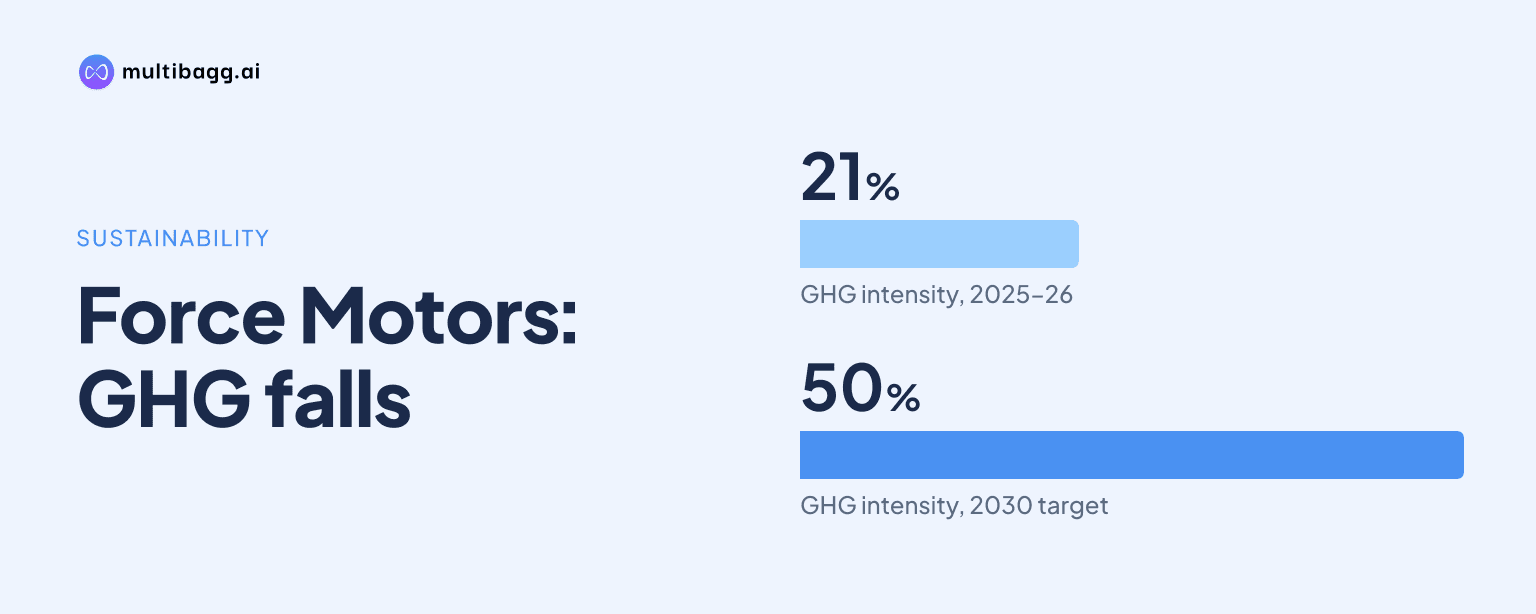
Force Motors reported a 21% reduction in greenhouse-gas (GHG) emissions intensity in 2025–26, while renewable electricity accounted for 31% of usage against its 50% target for 2027. The company also disclosed 85% waste diversion from landfill, a 10% reduction in water use per equivalent vehicle, and 9% women’s workforce representation.
Know Force Motors inside out
Results, valuation, peers and who's buying, in one view.
How far has Force Motors reduced GHG emissions intensity?
Force Motors said its GHG-emissions intensity declined 21% in 2025–26, compared with its stated target of a 50% reduction by 2030. The presentation reports the result as an intensity measure, rather than as absolute emissions, and does not disclose the baseline year, total emissions or calculation method for the 21% reduction.
The reported 21% reduction is 29 percentage points short of the 50% 2030 objective when the two percentages are directly compared. Force Motors has not provided annual emissions-intensity milestones between 2025–26 and 2030, so the presentation does not indicate the pace required to meet the target. Its 31% renewable-electricity share is the disclosed power-sourcing metric alongside the emissions result.
Force Motors also reported that emissions avoided improved 2.4 times over 2024–25 and 10 times since FY 2023–24. The company did not provide the quantity of emissions avoided, the unit of measurement, the underlying projects or the base values. Those comparisons therefore show the relative improvement reported by Force Motors but cannot be translated into an absolute emissions amount.
How close is Force Motors to its renewable-electricity target?
Force Motors reported that renewable sources supplied 31% of its electricity usage in 2025–26, against a target of 50% renewable electrical energy by 2027. The stated renewable share is 19 percentage points below the 2027 target. The presentation does not identify the renewable sources, the facilities covered or total electricity consumption.
The 2027 renewable-electricity target is due before Force Motors’ 2030 GHG-intensity target. Renewable electricity may affect emissions associated with purchased power, but Force Motors does not quantify how much of its 21% intensity reduction resulted from renewable procurement. It also does not disclose a 2026 renewable-power milestone, capacity plan or procurement schedule.
The two measures use different bases: one is a reduction in emissions intensity and the other is renewable electricity’s share of usage. Force Motors does not provide absolute electricity consumption or GHG emissions for 2025–26. As a result, the presentation supports tracking the stated percentages against their separate targets, but not calculating an emissions reduction from the renewable share.
What resource-efficiency measures did Force Motors report?
Force Motors reported that 85% of waste was diverted from landfill in 2025–26 under its zero-waste-to-landfill initiative. The figure represents waste diversion, not confirmation that no waste reached landfill. The presentation does not disclose waste generated, recycled, recovered or sent to landfill in tonnes or any other unit.
Force Motors also reported a 10% reduction in water use per equivalent vehicle in 2025–26. This measures water efficiency relative to equivalent vehicle output, but the company did not state total water use, equivalent vehicle volumes or the comparison baseline. No future water-efficiency target or target date appears in the sustainability disclosure.
The 85% waste-diversion figure and 10% water-use reduction are separate operating measures and cannot be combined into a single environmental result. Force Motors did not disclose a date for moving from 85% diversion to full diversion. It likewise did not give an absolute water-withdrawal number for the 10% per-equivalent-vehicle reduction.
Got a follow-up? Ask IRIS
What did Force Motors disclose about suppliers and workforce diversity?
Force Motors said 43.5% of its suppliers were screened on environmental, social and governance (ESG) criteria in 2025–26. The company did not define the screening criteria, state the number of suppliers covered or provide a prior-year supplier-screening percentage. The 43.5% figure therefore establishes reported coverage for the year without showing a year-on-year change.
Women represented 9% of Force Motors’ workforce in 2025–26, up from 3% in FY 2023–24. That is a 6-percentage-point increase across the disclosed period and three times the earlier representation level. Force Motors did not disclose workforce headcount, hiring data, a grade-wise split or a future target for women’s representation.
The supplier and workforce measures cover different parts of Force Motors’ sustainability update: 43.5% concerns supply-chain screening, while 9% concerns employee representation. The presentation gives a multi-year comparator only for women’s representation, from 3% in FY 2023–24 to 9% in 2025–26. It does not provide a comparable historical series for ESG-screened suppliers.
What workforce-development target has Force Motors set?
Force Motors reported 22 training hours per employee in 2025–26 and set a target of 32 hours per employee by 2030. The reported level is 10 hours below the 2030 objective. The sustainability page provides an average per employee but does not state the number of employees covered or total training hours delivered.
The company links workforce development to Project Lakshya, its human-resources transformation programme, and to the DigiForce Digital Capability Training Programme. Project DigiForce is a Rs 150 crore, two-year digital-transformation initiative covering customer-facing and core operations. However, Force Motors does not give programme-level training attendance, expenditure or a date for reaching the 32-hour target.
Force Motors’ workforce disclosures therefore include a 22-hour training average, 9% women’s representation and a 32-hour training target for 2030. The presentation provides a prior comparison for women’s representation, from 3% in FY 2023–24, but not for training hours. It also does not disclose interim training-hour targets before 2030.
Conclusion
Force Motors’ 2025–26 sustainability update reports progress through quantified operating measures rather than only broad commitments. Its headline indicators include a 21% reduction in GHG-emissions intensity, 31% renewable electricity usage, 85% waste diversion, a 10% reduction in water use per equivalent vehicle and 9% women’s workforce representation, up from 3% in FY 2023–24.
The next disclosed target is 50% renewable electrical energy by 2027, followed by a 50% GHG-intensity reduction and 32 training hours per employee by 2030. Future Force Motors disclosures may clarify the baselines, absolute quantities and annual milestones behind the 21% emissions-intensity reduction, the 2.4-times increase in emissions avoided and the 31% renewable-electricity share.

