










Fractal.ai reports 115% net revenue retention in Q2 FY27
Key highlights
- Fractal.ai reported 115% NRR in Q2 FY27, with 15% growth from existing clients and 0% churn.
- Fractal.ai’s clients contributing more than US$1 million rose to 58 in TTM Sep-26 from 52 in TTM Sep-25.
- Clients contributing more than US$20 million increased to six in TTM Sep-26 from four a year earlier.
- Fractal Group’s Q2 FY27 revenue from operations was Rs 956.5 crore, up 20% year on year.
powered by IRIS
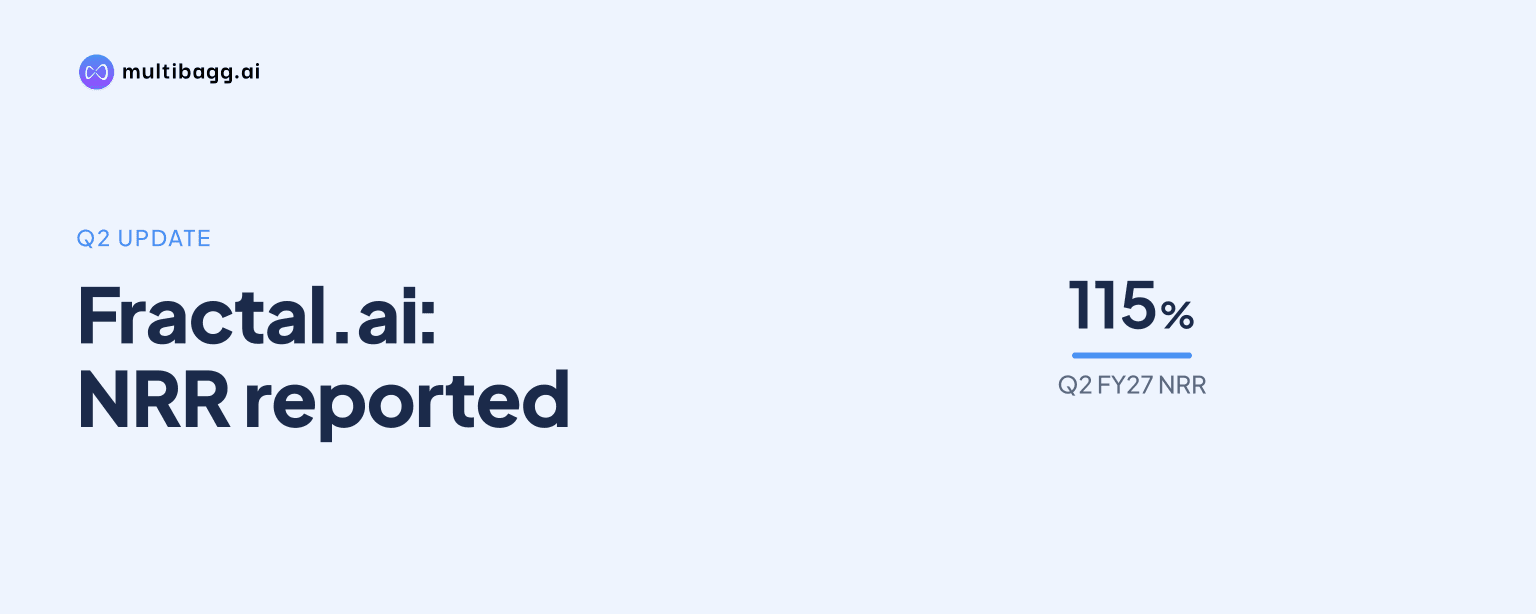
Fractal.ai reported net revenue retention of 115% in Q2 FY27, with revenue from existing clients increasing 15%, new clients contributing 5% growth and reported churn at zero. The result indicates that expansion within the client base was the principal disclosed component of the segment’s 21% growth calculation.
Know Fractal Analytics inside out
Results, valuation, peers and who's buying, in one view.
How did Fractal.ai reach 115% net revenue retention?
Fractal.ai reached 115% net revenue retention, or NRR, in Q2 FY27 because clients that were already active at the beginning of the measured period spent 15% more, while the company reported no churn. NRR measures revenue retained and expanded from the starting client cohort in Indian rupees, including upselling, cross-selling and contractions.
The presentation separates the disclosed 21% growth calculation into 15% from existing clients, 5% from new clients and 0% churn. The displayed components total 20%, while the table shows 21% growth; nevertheless, existing-client expansion was three times the disclosed contribution from new clients.
NRR above 100% means the revenue contribution from the cohort of clients in place at the start of the period increased after accounting for expansion and contractions. In Fractal.ai’s Q2 FY27 presentation, the 115% measure is explicitly calculated in Indian rupees rather than a constant-currency measure, unlike Fractal Group’s reported 10% constant-currency revenue growth.
Is Fractal.ai adding larger client relationships?
Fractal.ai is adding larger client relationships: the number of clients contributing more than US$1 million in trailing-12-month revenue rose to 58 in TTM Sep-26 from 52 in TTM Sep-25. The count of clients above US$5 million increased to 20 from 17, while the number above US$20 million rose to six from four.
The broader US$1 million-plus group increased by six accounts, or about 12% from the prior trailing-12-month period. Growth was also visible at the higher thresholds: US$5 million-plus accounts rose by three and US$20 million-plus accounts by two, suggesting that the expansion reported in NRR coincided with a larger number of sizeable relationships.
The thresholds are nested, so the six clients above US$20 million are included within the eight above US$10 million and the 20 above US$5 million. The presentation does not disclose revenue from each cohort or identify the clients, so it does not establish how much of the 15% existing-client expansion came from any one spending tier.
How does client expansion fit Fractal Group’s revenue growth?
Client expansion at Fractal.ai coincided with Fractal Group reporting its first quarter with revenue above US$100 million and revenue from operations of Rs 956.5 crore in Q2 FY27, up 20% year on year. The group reported 10% constant-currency growth and stated that all reported revenue growth was organic.
Industry trends were uneven despite the group’s 20% total growth. Healthcare and life sciences, or HLS, grew 79% year on year and represented 25.1% of Q2 FY27 revenue; banking, financial services and insurance, or BFSI, grew 30% and represented 13.6%. Consumer packaged goods and retail, or CPGR, remained the largest industry at 34.7% of revenue but grew 11%, while technology, media and telecom, or TMT, represented 17.9% and declined 18%.
Geographically, the Americas accounted for 67.3% of Q2 FY27 revenue and grew 22% year on year. Europe represented 21.5% and grew 20%, while Asia-Pacific and other markets made up 11.2% and grew 7%; the company assigns geography using the client billing location. These group-level figures provide context for the retention result, but Fractal.ai’s NRR is a segment metric and should not be read as an NRR figure for every Fractal Group business.
Got a follow-up? Ask IRIS
What does the client satisfaction data show?
Fractal.ai’s Net Promoter Score, or NPS, was 76 in Q2 FY27, down one point from 77 in Q1 FY27 and two points from 78 in Q2 FY26. NPS is Fractal.ai’s measure of client satisfaction and advocacy, calculated as the percentage of promoters minus the percentage of detractors.
The Q2 FY27 score sits within a relatively narrow recent range. Fractal.ai recorded an NPS of 81 in Q4 FY26, 77 in Q1 FY27 and 76 in Q2 FY27; its quarterly history shown in the presentation ranges from 73 in Q1 FY24 and Q1 FY26 to 81 in Q2 FY24 and Q4 FY26.
Clients give NPS ratings on a 10-point willingness-to-recommend scale. Fractal.ai defines promoters as clients scoring nine or above and detractors as those scoring six or below. The company presents the NPS result alongside its retention data, but it does not quantify a direct relationship between the score of 76 and the 15% increase in existing-client spending.
What accompanying financial changes matter for retention?
Fractal Group’s Q2 FY27 profitability rose while gross margin declined, a contrast relevant to management’s description of investment in artificial-intelligence engineering talent. Adjusted earnings before interest, tax, depreciation and amortisation, or adjusted EBITDA, were Rs 154.9 crore, up 30% year on year, and the adjusted EBITDA margin increased to 16.2% from 15.0%.
Gross margin was Rs 420.5 crore in Q2 FY27, up 14% from Rs 369 crore in Q2 FY26, but the gross-margin percentage fell to 44.0% from 46.2%, a 225-basis-point decline. Management attributed the short-term gross-margin effect to investment in AI engineering talent, while describing the adjusted EBITDA improvement of 123 basis points as driven by operating leverage.
Net income increased 139% year on year to Rs 79.2 crore, and net income excluding the associate was Rs 102.4 crore. Cash flow from operations was Rs 79.3 crore for the quarter, versus Rs 107.4 crore in the prior-year quarter, while trailing-12-month cash flow increased to Rs 406.7 crore from Rs 367.8 crore.
Conclusion
Fractal.ai’s Q2 FY27 retention data show that deeper activity among existing clients was the largest disclosed source of growth: spending from that base rose 15%, NRR reached 115% and churn was reported as zero. The increase from 52 to 58 clients above US$1 million, including six clients above US$20 million, coincided with expansion in the larger relationship tiers over TTM Sep-25 to TTM Sep-26.
The key unresolved item in subsequent disclosures is whether management’s stated short-term gross-margin impact from investment in AI engineering talent persists. In Q2 FY27, gross margin fell 225 basis points to 44.0%, while adjusted EBITDA margin rose 123 basis points to 16.2% through operating leverage.