










Gaudium targets Rs 10 crore receivables after 165 days
Key highlights
- Gaudium's consolidated receivables fell by Rs 8.07 crore to Rs 45.30 crore between March 31 and September 30, 2026.
- Gaudium reported 165 receivable days at September 30, 2026.
- Management said its financial-year plan was to reduce receivables to roughly Rs 10 crore.
- Gaudium's NBFC aggregator generated about Rs 4 crore of business in the quarter discussed.
powered by IRIS
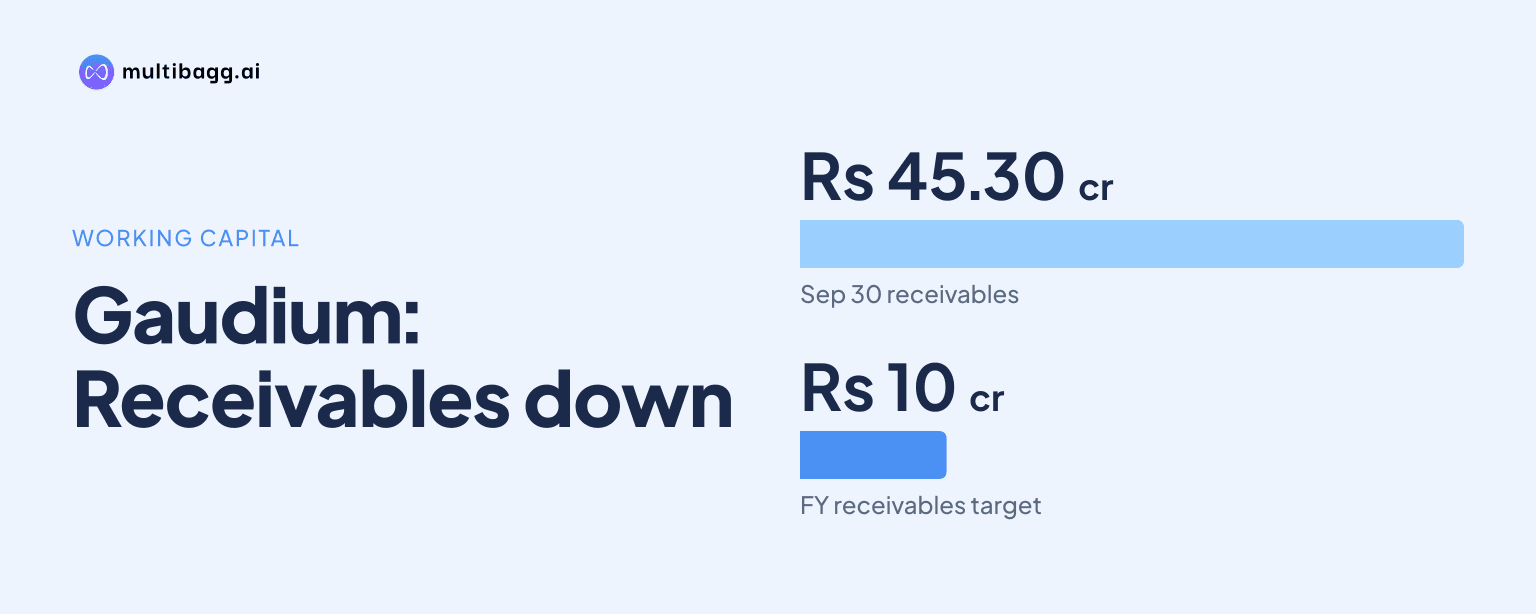
Gaudium IVF and Women Health Limited reported Rs 45.30 crore of consolidated receivables and 165 receivable days at September 30, 2026, while management said its plan was to bring receivables to roughly Rs 10 crore during the financial year. The balance had declined from Rs 53.37 crore at March 31, 2026.
Know Gaudium IVF and Women Health inside out
Results, valuation, peers and who's buying, in one view.
How much did Gaudium's receivables fall?
Gaudium's standalone receivables fell by Rs 9.77 crore to Rs 32.83 crore between March 31, 2026, and September 30, 2026, while consolidated receivables declined by Rs 8.07 crore to Rs 45.30 crore. The reported reduction came before management's stated plan to bring receivables to roughly Rs 10 crore during the financial year.
Management did not specify whether the roughly Rs 10 crore objective referred to standalone or consolidated receivables. It said almost Rs 10 crore had been collected in the preceding few months as patient cycles were completed, linking the reduction in outstanding balances to patients returning for the next stage of treatment.
Dr. Manika Khanna said Gaudium's calling team was encouraging patients to come back for embryo transfers. Management said complete dues are collected before an embryo transfer, so the timing of transfers is a mechanism determining when certain patient balances become collections.
Why were Gaudium's receivable days 165?
Gaudium reported 165 receivable days at September 30, 2026 because the book included both clinically delayed treatments and patients using deferred-payment plans. Management said these were distinct reasons for outstanding balances rather than one uniform form of patient credit.
For clinical cases, management cited egg collection before chemotherapy for a patient with early cancer. The patient may return for embryo transfer after cancer treatment lasting one year or 1.5 years. It also cited uncontrolled diabetes, where transfer must wait until the patient is medically ready, while full payment is collected before the transfer.
The financial cases involved patients who could not arrange the treatment amount upfront and received a deferred-payment plan. Dr. Khanna said Gaudium was pursuing these patients and encouraging them to undertake transfers sooner. Management described the arrangement as a way to make treatment accessible and acquire more patients.
Management also said embryos and gametes remain with Gaudium while treatment is pending and cited the Assisted Reproductive Technology, or ART, law in saying embryos cannot simply be moved between providers. That was management's rationale for expecting patients with pending transfers to return, although it did not provide a collection schedule for the 165-day balance.
Is Gaudium shifting patient financing to NBFC partners?
Gaudium said new patients seeking deferred payments can be accommodated through several non-banking financial companies, or NBFCs, and an aggregator linked to about 10 NBFCs. Management presented the partner network as a means to support patients seeking finance while limiting new credit activity originated by Gaudium.
In the quarter discussed, management said Gaudium did not undertake credit business at its own end, apart from roughly Rs 60 lakh to Rs 80 lakh of business it described as floated by Gaudium. The NBFC aggregator channel generated about Rs 4 crore of business, a larger amount than the limited direct activity disclosed for the quarter.
Deferred payments began in FY20 during the COVID period as a one-year support scheme, according to management. Rakesh Sharma said recoveries in that initial period were 100%, except for a few cases with payments deferred by roughly three to four months. Management said it later continued the facility because of patient demand and growth in the patient base.
Dr. Khanna said other fertility providers also use deferred-payment plans. Gaudium has also recently begun communicating a private-insurance model for a three-cycle package, under which an insurer covers the patient at a stated premium and returns an amount to the patient in specified circumstances. Management did not disclose patient uptake, revenue or the financial terms of that arrangement.
Got a follow-up? Ask IRIS
Can Gaudium improve collections while expanding hubs?
Gaudium is pursuing collections while ramping two new hubs, South Ex and Gurgaon, which were live by the Q2 discussion. Management said expansion costs are front-loaded and expected historical margins to be maintained by year-end, while acknowledging temporary pressure during hub launches.
A new hub incurs costs before it begins generating a full patient flow because doctors and embryologists receive one month of training before opening, management said. Marketing begins before revenue is established, and management identified professional, employee and marketing costs as the main sources of interim margin pressure.
Management said a new hub typically requires Rs 2.50 crore of capital expenditure, of which Rs 1.50 crore is for the laboratory and operating theatre. It expects break-even at five cycles, a ramp to 25 cycles in one to 1.5 years, and capital payback in 1.5 to two years. These are management expectations rather than reported hub results.
What operating trends could affect Gaudium's collection plan?
Gaudium's patient volumes and hub ramp-up could affect how quickly treatment-linked balances convert into collections. The company reported 889 pickup cycles in the quarter, while management said Mumbai was handling 50 to 70 cycles a month and Bangalore 30 to 40 cycles a month.
For H1 FY27, management said existing centres in Mumbai, Delhi and Bengaluru grew roughly 28%. Broader growth was 18.5% in H1 FY27 and 22% in Q2 FY27 after operations were temporarily halted during the relocation of the Patna centre to a larger site. The comparison shows that relocation disruption reduced the growth rate reported across the wider network.
Management's second-half focus is to ramp South Ex and Gurgaon and bring new centres online. That programme could increase the number of patients entering treatment, but the transcript does not quantify how many of those patients will use NBFC financing, deferred payment or the new insurance-linked package.
Conclusion
Gaudium reduced consolidated receivables by Rs 8.07 crore between March 31 and September 30, 2026, but the Rs 45.30 crore balance and 165 receivable days remain central measures of its patient-financing and treatment-completion cycle. Management attributes the outstanding book to medically deferred transfers as well as deferred-payment patients, while directing newer financing demand toward NBFC partners.
The next disclosed milestone is management's plan to bring receivables to roughly Rs 10 crore during the financial year, although the call did not state whether that target is standalone or consolidated. Investors can watch subsequent receivable days, collections before embryo transfers, the scale of aggregator-supported financing, and the ramp-up of South Ex, Gurgaon and further planned centres.