










GE Power India’s first-half profit rises 36%, cash falls
Key highlights
- GE Power India’s HY 2026-27 pre-exceptional profit before tax rose about 36% to Rs 122 crore.
- GE Power India’s HY 2026-27 revenue increased by Rs 53 crore to Rs 620 crore.
- Reported net cash fell by Rs 61 crore to Rs 819 crore at September 2026, including Rs 741 crore of cash-pool lending.
- Core services orders increased by Rs 101 crore to Rs 444 crore in HY 2026-27.
powered by IRIS
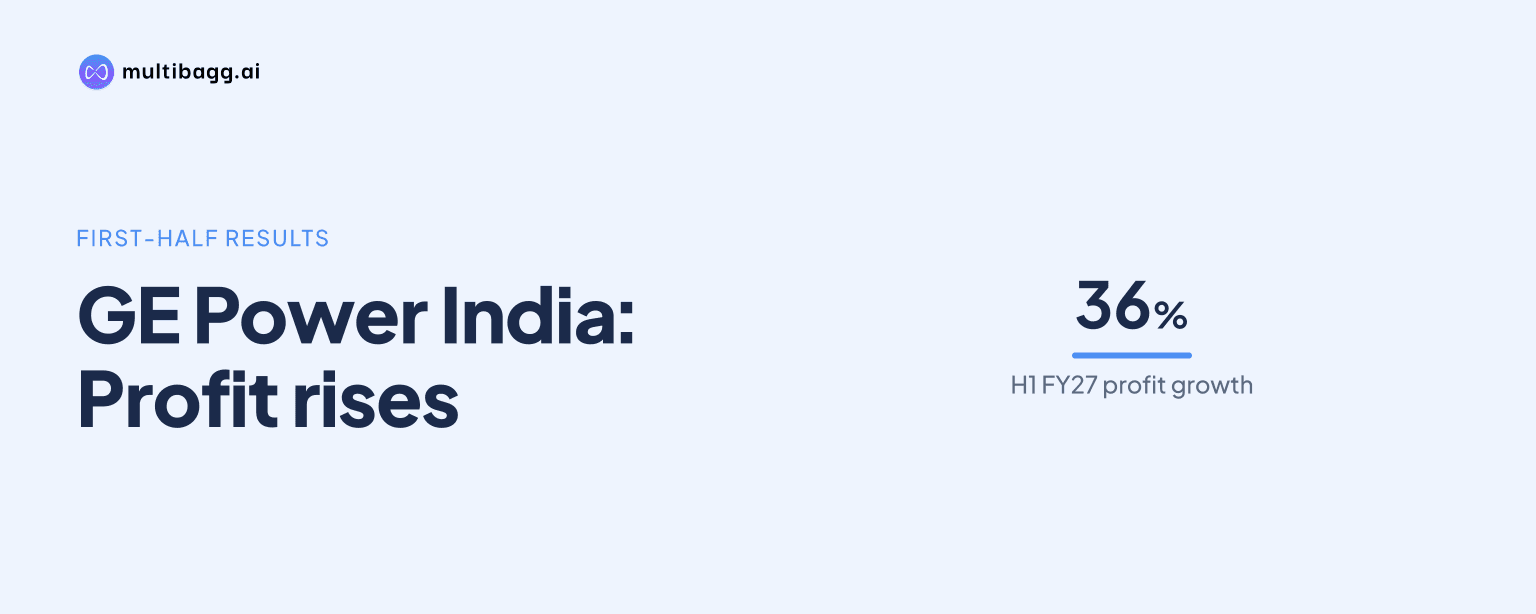
GE Power India Limited, referred to here as GE Power India, reported first-half FY 2026-27 pre-exceptional profit before tax from continuing operations of Rs 122 crore, up about 36% from Rs 90 crore, as revenue reached Rs 620 crore; reported net cash was Rs 819 crore at September 2026, down from Rs 880 crore in March.
Know GE Power India inside out
Results, valuation, peers and who's buying, in one view.
How did GE Power India’s first-half earnings change?
GE Power India’s profit before tax and exceptional items from continuing operations rose by Rs 32 crore to Rs 122 crore in HY 2026-27 from Rs 90 crore in HY 2025-26. Revenue increased by Rs 53 crore to Rs 620 crore from Rs 567 crore, while profit before tax after exceptional items increased by Rs 26 crore to Rs 91 crore from Rs 65 crore.
The gap between pre-exceptional and post-exceptional profit before tax was Rs 31 crore in HY 2026-27, compared with Rs 25 crore a year earlier. GE Power India said discontinued operations include the proposed demerged Durgapur business for both the quarter and half year, but did not provide a detailed reconciliation of the exceptional items on the financial-indicators page.
GE Power India also reported higher Q2 results. Q2 FY 2026-27 revenue was Rs 311 crore versus Rs 281 crore in Q2 FY 2025-26, while profit before tax and exceptional items from continuing operations increased to Rs 53 crore from Rs 46 crore; post-exceptional profit before tax was Rs 36 crore, against Rs 33 crore.
What drove GE Power India’s revenue and order growth?
GE Power India attributed the roughly 11% revenue increase to Core and Upgrade volumes, and said improved profitability in Core services supported quarter-on-quarter profit growth. Q2 FY 2026-27 order intake was Rs 331 crore, comprising Rs 232 crore in Core orders, Rs 99 crore in Upgrade orders and Rs 11 crore in Durgapur orders.
Core services accounted for the increase in half-year order intake. Core orders rose by Rs 101 crore to Rs 444 crore in HY 2026-27 from Rs 343 crore, while Upgrade orders declined by Rs 30 crore to Rs 99 crore and Durgapur orders fell by Rs 7 crore to Rs 4 crore; total intake still increased by Rs 64 crore to Rs 547 crore.
Quarterly orders rose by Rs 91 crore, or about 38%, from Rs 240 crore in Q2 FY 2025-26 to Rs 331 crore in Q2 FY 2026-27. GE Power India said Core services order inflows grew about 43% quarter on quarter and about 29% year on year.
Got a follow-up? Ask IRIS
Why did GE Power India’s reported net cash fall?
GE Power India reported net cash of Rs 819 crore at September 2026, down Rs 61 crore from Rs 880 crore at March 2026. The presentation does not provide a cash-flow bridge or identify the individual movements responsible for the change between those two dates.
The September 2026 net-cash figure includes Rs 741 crore of cash-pool lending. This means the reported Rs 819 crore balance includes cash-pool lending rather than only a separately disclosed cash balance; the presentation does not state the corresponding cash-pool lending balance at March 2026.
The lower cash position was reported alongside a Rs 32 crore increase in first-half pre-exceptional profit before tax and a Rs 53 crore revenue increase. However, GE Power India did not disclose operating cash flow, capital expenditure, working-capital changes, tax payments or financing movements on the supplied financial-indicators page.
How is GE Power India expanding Core services?
GE Power India booked Rs 444 crore of Core services orders in HY 2026-27, about 1.3 times the Rs 343 crore booked in HY 2025-26. Its half-year Core order series rose from Rs 134 crore in 2021-22 to Rs 444 crore in 2026-27, and the presentation cited a compound annual growth rate, or CAGR, of about 27%.
GE Power India said orders from third-party fleet, described as other original equipment manufacturer, or oOEM, fleet, increased by more than 1.5 times versus HY 2025-26. The company defines OEM as original equipment manufacturer and said it is targeting fleets where it has parts-readiness capability.
The company also plans to pursue rotor repairs with greater rigor, citing fatigue-related defects in machines operating flexibly. It booked what it described as its first specific major emergency boiler-refurbishment order for non-GEV technology from UPRUVNL, valued at about Rs 26 crore.
What international order did GE Power India disclose?
GE Power India booked the Shoaiba Fuel Conversion Project for Saudi Energy in the September 2026 quarter for about Rs 76 crore. Management said the order reflected its efforts to penetrate international markets, but the presentation did not disclose a delivery timetable, margin expectation or revenue-recognition schedule.
The Rs 76 crore Shoaiba order was booked in a quarter with total intake of Rs 331 crore and followed half-year intake of Rs 547 crore. GE Power India did not disclose an overseas-order target or a geographic revenue target, leaving the future scale of its international business unspecified.
Conclusion
GE Power India’s HY 2026-27 results combined a Rs 53 crore revenue increase, a Rs 32 crore rise in pre-exceptional profit before tax and Rs 547 crore of order intake. Core services supplied the principal disclosed order-growth contribution, with Rs 444 crore of intake, while Upgrade and Durgapur orders were lower than in HY 2025-26.
The next disclosed points to watch are conversion of the Rs 547 crore half-year order intake, including the Rs 76 crore Shoaiba project, and progress in third-party fleet and rotor-repair activity. Cash composition also remains relevant because Rs 741 crore of the Rs 819 crore September 2026 net-cash position was cash-pool lending, with no cash-flow bridge provided.