










GEE Limited Expects ₹400 Crore From Thane Land Deal
Key highlights
- GEE signed the Thane development agreement on November 24, 2025, for a 13,391-square-metre leasehold plot.
- GEE will receive approximately 2,90,000 square feet of RERA-registered commercial space with no cash development outlay.
- The company estimates cash flows of more than ₹400 crore over the project lifecycle, including about ₹50 crore from FY27.
- GEE shares hit a 10% upper circuit at ₹93.34 after the development agreement was announced.
powered by IRIS
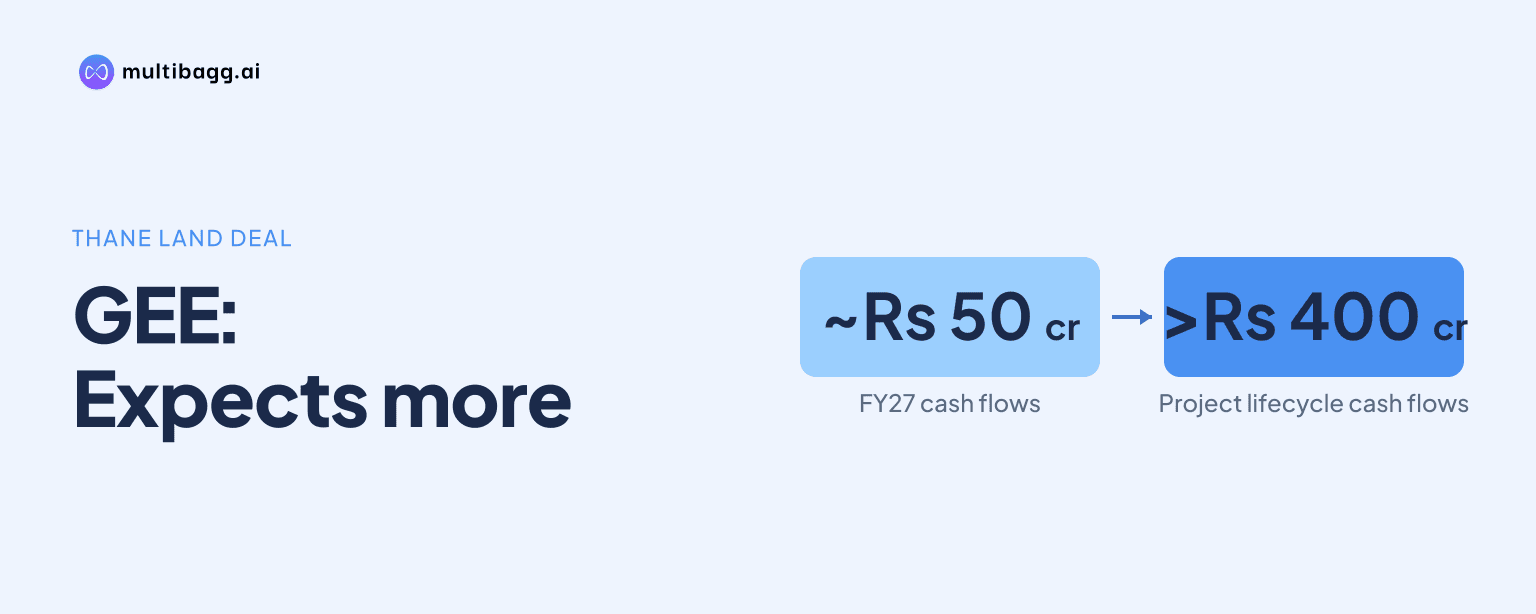
GEE Limited expects its November 2025 development agreement for a 13,391-square-metre Thane land parcel to generate cash flows exceeding ₹400 crore over the project lifecycle. The welding consumables manufacturer will receive about 2,90,000 square feet of RERA-registered commercial space instead of cash consideration, with around ₹50 crore anticipated from FY27.
Know GEE inside out
Results, valuation, peers and who's buying, in one view.
What is GEE's Thane land development agreement?
GEE signed a development agreement on November 24, 2025, to transfer development rights for its leasehold land at Wagle Industrial Estate in Thane, Maharashtra. The 13,391-square-metre parcel is proposed to be developed as a commercial or IT park under an area-sharing model.
Under the arrangement, GEE will receive approximately 2,90,000 square feet of RERA-registered constructed commercial area, along with associated amenities. The company is not making a cash outlay for the development. Instead, it intends to monetise its allotted constructed space through sales or agreements as the project progresses.
The developer identified in company disclosures is Fen-kin Infinity LLP. GEE has stated that the developer and facilitator are not related to its promoter group, classifying the arrangement as an arm's-length transaction. Shareholders ratified the transaction in January 2026.
Why is GEE monetising its Wagle Industrial Estate land?
GEE is monetising the Thane plot to unlock value from an asset that had previously housed manufacturing operations. The company has described the development as a route to generate funds while retaining its focus on welding consumables and related industrial operations.
Managing Director Umesh Agarwal said in the company's announcement that the commercial development is expected to generate revenue exceeding ₹400 crore during its lifecycle and enhance long-term stakeholder value. Management has indicated that the proceeds may support inorganic acquisitions, including in welding equipment and specialty electrodes, as well as shareholder rewards.
The manufacturing activity at the Thane location is being shifted to the existing Kalyan-Bhiwandi manufacturing setup. In a management interaction, the company said the plant-shifting process was under way and expected to be completed by the end of September 2026. This consolidation is intended to ensure that the land development does not disrupt core operations.
How much could the Thane project contribute to GEE?
GEE has estimated revenue potential of more than ₹400 crore from its share of the commercial development over about five years, while the broader project completion is expected within six years of the November 2025 agreement. The estimate is based on the eventual monetisation of the built-up area rather than an immediate land sale.
Management has indicated that about ₹50 crore could begin flowing in FY27. The investor presentation cited an assumed realisation of approximately ₹14,000 per square foot. Actual cash flows will depend on construction progress, launch timing, sales or agreements for the commercial units, and the pace at which GEE can monetise its share.
Got a follow-up? Ask IRIS
How did investors respond to the development agreement?
GEE shares hit a 10% upper circuit on the BSE at ₹93.34 after the company announced the development agreement in November 2025. The market response reflected investor attention on the estimated value of the Thane asset and the company's plan to convert it into commercial space.
The transaction is distinct from GEE's regular manufacturing revenue because the expected inflows are project-linked and one-time in nature. The company reported FY26 revenue of ₹369 crore, while the potential land monetisation is estimated at more than ₹400 crore over several years. That comparison highlights the size of the asset relative to the operating business, but the two figures represent different sources and timing of income.
For investors, the key issue is execution. The amount realised will be affected by the project's completion schedule and commercial-property monetisation. GEE has clarified that its cash flows will accrue as the constructed area is sold or otherwise monetised, rather than through an upfront payment from the developer.
What does the deal mean for GEE's operating business?
GEE's stated plan is to keep welding consumables operations running from its Kalyan-Bhiwandi facility while its Thane site is redeveloped. This means the development agreement is designed as an asset-monetisation exercise rather than an exit from manufacturing.
The company manufactures welding consumables from facilities in Kalyan and Kolkata. Its FY26 capacity utilisation was reported at 57%, with electrode capacity below 40% and wire capacity closer to full utilisation. Existing capacity availability is relevant because management has outlined growth plans that do not depend on major immediate expansion of electrode capacity.
The company has also set out an FY27 revenue target of more than ₹500 crore and a goal of double-digit EBITDA margin. These are management targets, separate from the Thane development proceeds. The land cash flows, if realised as planned, could provide funding flexibility for acquisitions without the company needing to make a cash investment in the construction of the commercial project.
Conclusion
GEE's Thane agreement converts a leasehold industrial land parcel into an entitlement to approximately 2,90,000 square feet of commercial space. With estimated cash flows of more than ₹400 crore, the arrangement is material relative to the company's manufacturing revenue, though realisation will be phased and dependent on project execution and commercial-unit monetisation.
The next disclosed milestones are the completion of the Thane plant shift, which management expected by the end of September 2026, and the start of anticipated land-related inflows of about ₹50 crore in FY27. Investors will also monitor construction progress, sales of GEE's commercial allocation, and the use of any proceeds for acquisitions or other capital-allocation decisions.