










Genus builds AMISP model on Rs 22,634 crore order book base
Key highlights
- Genus reported an approximately Rs 22,634 crore order book at Sept-26, net of taxes and including special purpose vehicles and the GIC platform.
- Genus crossed 1 crore smart-meter installations in FY26.
- Genus reported FY 2025-26 total income of Rs 4,808 crore, compared with Rs 2,522 crore in FY 2024-25.
- Genus reported FY 2025-26 profit after tax of Rs 605 crore, compared with Rs 298 crore in FY 2024-25.
powered by IRIS
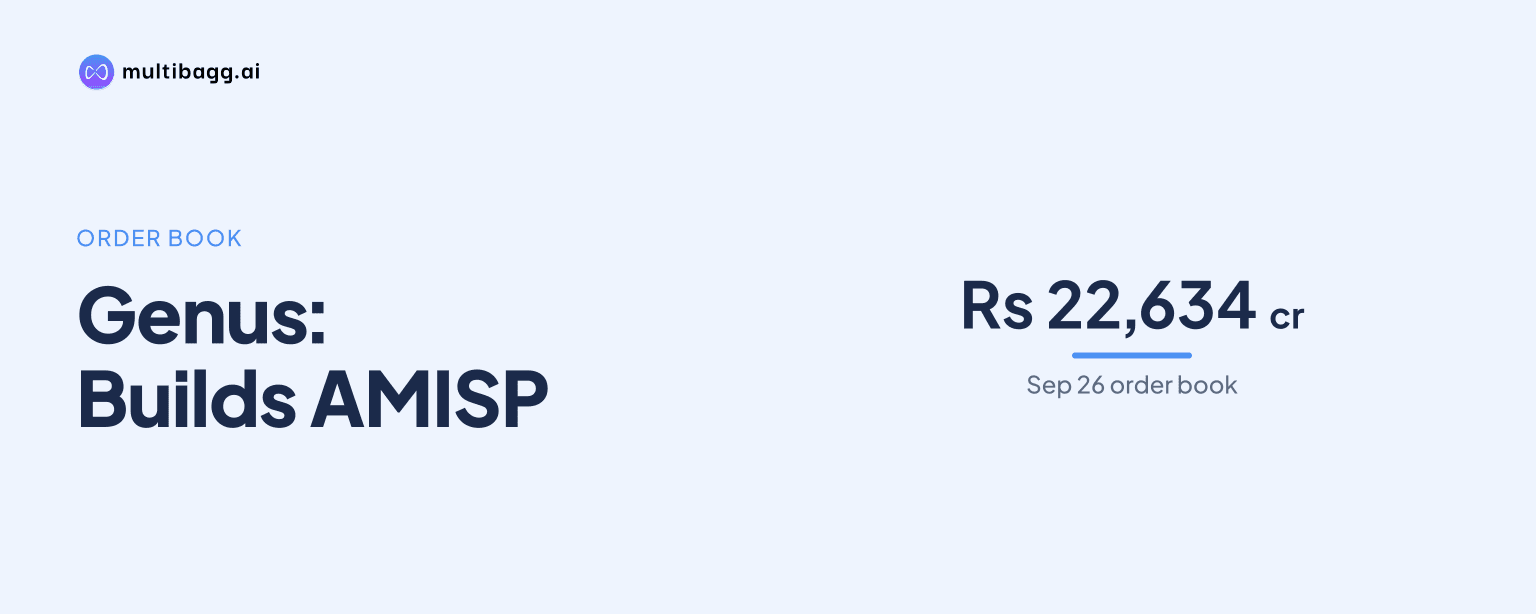
Genus Power Infrastructures Limited is building an end-to-end Advanced Metering Infrastructure Service Provider model, supported by an approximately Rs 22,634 crore order book at Sept-26, net of taxes and including special purpose vehicles and the GIC platform. Genus now describes its role as spanning meters, communications, software, deployment, integration and maintenance.
Know Genus Power Infrastructures inside out
Results, valuation, peers and who's buying, in one view.
How is Genus changing its business model?
Genus is moving from a manufacturing and technology company towards an Advanced Metering Infrastructure, or AMI, integrator, services and software provider in the energy sector. Its stated smart solutions cover power, water and gas metering management, extending beyond the electronic energy-meter production that began during 1994-1999.
Genus began participating as an Advanced Metering Infrastructure Service Provider, or AMISP, during 2022-2026 under the TOTEX model. TOTEX combines capital expenditure, or CAPEX, and operating expenditure, or OPEX. The company says AMISP contracts give it end-to-end responsibility, rather than limiting its role to supplying a meter.
This direction follows earlier smart-metering projects. During 2012-2017, Genus says it implemented India’s first end-to-end smart-metering solution at Kala Amb in Himachal Pradesh under a smart-grid pilot project. During 2018-2021, it launched smart meters with 3G communication capability and established a narrowband Internet of Things AMI setup with Vodafone Idea.
What does Genus deliver in an AMISP project?
Genus says an AMISP project covers in-house designed smart meters, communications infrastructure, Head-End Systems, or HES, Meter Data Management Systems, or MDMS, and Field Management Systems, or FMS. Its stated service scope includes deployment, integration and maintenance, with operation and data management under the TOTEX structure.
The electricity-meter portfolio remains the physical base of this model. Genus lists single-phase, three-phase, low-tension current transformer, high-tension current transformer, distribution-transformer and availability-based tariff smart meters. It also identifies single-phase and three-phase prepayment meters, a gateway, a Metering Interface Unit and smart group meters.
Genus has added smart gas meters, smart water meters and data loggers to its product lines during 2022-2026. The presentation identifies these as advanced metering solutions across utility sectors, but does not disclose revenue, order-book or installation splits between electricity, gas and water applications.
How does Genus software support smart-metering projects?
Genus uses HES and MDMS as the core software layers between meters and utility systems. HES communicates with meters, collects data, manages commands and transmits data securely to MDMS. The company says its HES supports cellular General Packet Radio Service, or GPRS, and radio-frequency, or RF, communications in a single smart-meter deployment.
Genus says HES can integrate third-party smart-meter makes and utilities’ legacy systems. It can be deployed on hyperscaler and non-hyperscaler cloud platforms and on-premise data centres. The presentation also describes modular horizontal and vertical scaling for large meter volumes, alongside Multiprotocol Label Switching, or MPLS, communication channels.
MDMS processes, stores and manages data received from HES. Genus lists data validation, analytics, prepaid and net-metering functions, asset management and AMI system integrations. Its listed Validation, Estimation and Editing, or VEE, capability sits alongside workforce-management applications for consumer indexing, meter installation, and operations and maintenance.
Got a follow-up? Ask IRIS
How large is Genus’s smart-metering order book?
Genus reported an order book of approximately Rs 22,634 crore at Sept-26, including all special purpose vehicles and the GIC platform and net of taxes. The reported balance was built from Rs 931 crore at Mar-21, during the period in which Genus moved into AMISP participation.
The comparison shows that the order book reached Rs 30,112 crore at Mar-25 before declining to Rs 25,173 crore at Mar-26 and approximately Rs 22,634 crore at Sept-26. That is a reduction of Rs 7,478 crore from the Mar-25 balance to Sept-26. The presentation does not explain whether the change reflects project execution, order revisions, cancellations or other factors.
Genus also records a partnership with GIC, Singapore, to establish a platform for smart-metering projects during 2022-2026. The presentation does not provide the ownership structure of the special purpose vehicles, the allocation of the Sept-26 order book among them, or completion dates for the underlying projects.
What financial change coincided with Genus’s AMISP expansion?
Genus reported total income of Rs 4,808 crore in FY 2025-26, compared with Rs 2,522 crore in FY 2024-25. Profit after tax rose to Rs 605 crore from Rs 298 crore over the same period, while basic earnings per share increased to Rs 19.90 from Rs 9.81.
The longer financial series shows total income rising from Rs 635 crore in 2020-21 to Rs 4,808 crore in FY 2025-26. Net worth increased from Rs 924 crore to Rs 2,203 crore, while profit before tax rose from Rs 82 crore to Rs 814 crore over the same periods.
Genus crossed 1 crore smart-meter installations in FY26, according to its 2022-2026 timeline. However, the presentation does not separate manufacturing, AMISP, software or service income, so it does not quantify the portion of FY 2025-26 financial results generated by each part of the model.
Conclusion
Genus’s stated transformation places responsibility across the smart-metering chain, from meter hardware and communications to HES, MDMS, field systems and maintenance. The approximately Rs 22,634 crore Sept-26 order book and FY 2025-26 total income of Rs 4,808 crore show the scale attached to this broader operating model, while electricity meters remain central to delivery.
The disclosed items to watch next are execution of projects within the special purpose vehicles and GIC platform after the Sept-26 order-book balance, and further installations after Genus crossed 1 crore smart meters in FY26. Genus has also introduced gas meters, water meters and data loggers, but the presentation gives no segment targets, project timetable or order-book allocation for those product lines.