










Genus H1FY27 cash flow turns positive as receivables rise
Key highlights
- Genus generated Rs 127 crore of operating cash flow in H1FY27, versus an Rs 158 crore outflow in H1FY26.
- Genus trade receivables increased Rs 487.2 crore to Rs 1,971.7 crore at September 2026.
- Genus current borrowings rose Rs 243.8 crore to Rs 2,034.3 crore between March and September 2026.
- Genus H1FY27 revenue increased 19.4% to Rs 2,497.4 crore while EBITDA margin declined to 19.4% from 21.2%.
powered by IRIS
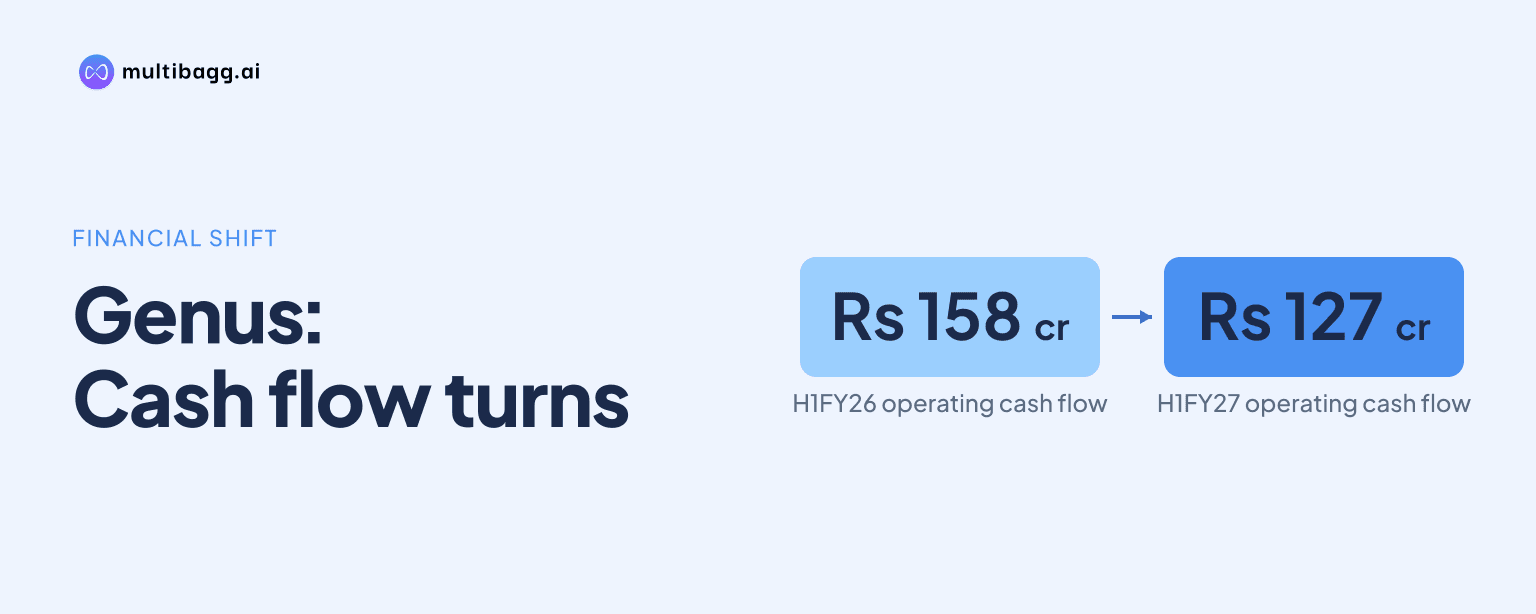
Genus Power Infrastructures Limited generated Rs 127 crore of operating cash flow in H1FY27, reversing an Rs 158 crore outflow in H1FY26, but trade receivables rose Rs 487.2 crore to Rs 1,971.7 crore at September 2026 and current borrowings increased Rs 243.8 crore from March 2026.
Know Genus Power Infrastructures inside out
Results, valuation, peers and who's buying, in one view.
Why did Genus operating cash flow turn positive in H1FY27?
Genus turned operating-cash-flow positive in H1FY27 with Rs 127 crore of cash generated, compared with an Rs 158 crore outflow in H1FY26. Management attributed the reversal partly to an inventory reduction of more than Rs 100 crore and described it as an inflection in cash generation.
The standalone balance sheet records inventories of Rs 1,247.8 crore at September 2026, down Rs 102.8 crore from Rs 1,350.6 crore at March 2026. This decline occurred while H1FY27 standalone revenue rose 19.4% to Rs 2,497.4 crore, which management linked to continued smart-meter order-book execution and higher installations than in H1FY26.
Cash balances changed in different directions during the six months to September 2026. Cash and cash equivalents fell to Rs 32.2 crore from Rs 259.6 crore, whereas other bank balances rose to Rs 649.3 crore from Rs 459.5 crore; the presentation does not provide a cash-flow statement reconciling these movements with operating cash flow.
How much did Genus working capital rise by September 2026?
Genus reported trade receivables of Rs 1,971.7 crore at September 2026, an increase of Rs 487.2 crore from Rs 1,484.5 crore at March 2026. Current loans also increased Rs 223 crore to Rs 451.6 crore, and current contract assets rose Rs 75 crore to Rs 941.6 crore, despite the inventory reduction.
Management said all projects were operationally revenue-generating and that Site Acceptance Tests, or SAT, were catching up with installations. It expects receivables to decline progressively from Q3FY27 and working-capital days to improve by 50 to 75 days in FY27; these are management expectations, while receivables remained higher at the September half-year date.
Current and non-current contract assets together were Rs 1,148.9 crore at September 2026, against Rs 1,056.2 crore at March 2026. The figures show that the Rs 102.8 crore inventory release was accompanied by higher amounts in receivables, loans and contract assets.
How did Genus borrowings change in H1FY27?
Genus's current borrowings increased Rs 243.8 crore to Rs 2,034.3 crore at September 2026 from Rs 1,790.5 crore at March 2026. Non-current borrowings declined Rs 56.3 crore to Rs 445.1 crore, resulting in combined borrowings of Rs 2,479.4 crore, up Rs 187.5 crore over the six-month period.
Trade payables rose Rs 73.7 crore to Rs 846.8 crore, while total current liabilities increased Rs 286.1 crore to Rs 3,232.5 crore at September 2026. Total assets grew Rs 631.1 crore to Rs 6,952.5 crore, and total equity rose Rs 286.8 crore to Rs 2,489.4 crore, alongside the larger short-term borrowing balance.
Management said its platform with GIC uses long-term, non-recourse project financing and AA- rated project special purpose vehicles, or SPVs. It said the platform could support 3 crore to 5 crore additional meters without fresh capital, but the standalone balance sheet does not separate this financing from the reported Rs 2,479.4 crore of borrowings.
Got a follow-up? Ask IRIS
Did Genus profit growth keep pace with revenue growth?
Genus's H1FY27 revenue grew faster than profit: revenue increased 19.4% to Rs 2,497.4 crore, while earnings before interest, tax, depreciation and amortisation, or EBITDA, rose 9.2% to Rs 484.7 crore. Profit after tax increased 7% to Rs 296.1 crore from Rs 276.6 crore.
EBITDA margin declined to 19.4% in H1FY27 from 21.2% in H1FY26, and net profit margin fell to 11.9% from 13.2%. Gross profit margin decreased to 37.6% from 40.6%, while depreciation increased to Rs 39.8 crore from Rs 23.4 crore and finance cost rose to Rs 99.7 crore from Rs 76.5 crore.
The second quarter was slower than the first-half growth rate. Q2FY27 revenue declined 1.4% year on year to Rs 1,132.6 crore and EBITDA fell 8.1% to Rs 224.6 crore; management cited the monsoon, meter mix and project-specific factors, while saying orders remained intact and the effect was one of execution timing.
What is Genus expecting in the rest of FY27?
Genus management maintained FY27 revenue guidance of Rs 6,000 crore to Rs 6,500 crore and an EBITDA-margin target of 18%. It expects H2FY27 to be seasonally stronger after the monsoon and festive season, and said it remains on track to install about 1 crore smart meters during FY27.
The order book was Rs 22,634 crore excluding taxes at 30 September 2026, including all SPVs and the GIC platform. Management said its advanced metering infrastructure service provider, or AMISP, portfolio comprised about 3.6 crore awarded meters, of which about 1.7 crore had been installed, and could exceed 4 crore meters as utilities add service connections under existing contracts.
Management expects substantial operations and maintenance, or O&M, revenue to begin contributing an annuity stream from FY28. It also expects smart gas-meter tendering to gain meaningful traction in FY28, citing an industry opportunity of about Rs 35,000 crore; neither initiative contributed reported H1FY27 revenue or operating cash flow.
Conclusion
Genus delivered a Rs 285 crore year-on-year improvement in operating cash flow in H1FY27, supported by a Rs 102.8 crore inventory reduction and 19.4% revenue growth. However, the September 2026 balance sheet also showed Rs 487.2 crore more trade receivables, Rs 92.7 crore more contract assets and Rs 187.5 crore more combined borrowings than at March 2026.
The next disclosures to watch are management's expected progressive decline in receivables from Q3FY27 and its targeted 50-to-75-day improvement in working-capital days during FY27. Delivery against the Rs 6,000 crore to Rs 6,500 crore revenue guidance, 18% EBITDA-margin target and plan to install about 1 crore smart meters will also indicate whether the seasonally stronger H2FY27 materialises.