










GFCL EV Products Limited expects Q4FY27 PVDF, PTFE supplies
Key highlights
- GFCL EV expects commercial PVDF and PTFE supplies under long-term agreements to begin in Q4FY27.
- GFCL EV says LiPF₆ sales are ramping up with five major global electrolyte players.
- GFCL EV has outlined Rs 6,000 crore of capital expenditure by FY28, including Rs 2,300 crore planned for FY27.
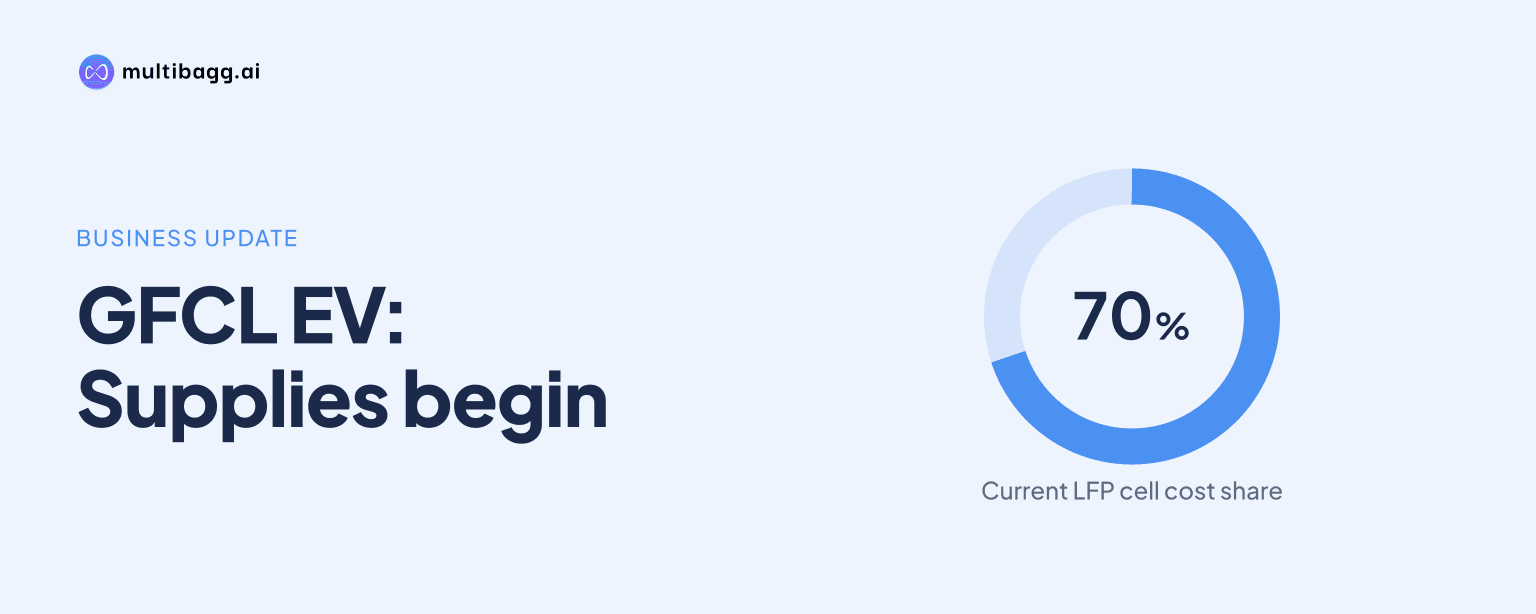
- GFCL EV says its current portfolio caters to about 70% of LFP cell cost.
powered by IRIS
GFCL EV Products Limited expects commercial supplies of polyvinylidene fluoride (PVDF) and polytetrafluoroethylene (PTFE) battery materials under long-term supply agreements to begin in Q4FY27, after advanced customer qualifications for wet- and dry-electrode uses. GFCL EV has also set out total capital expenditure of Rs 6,000 crore by FY28.
Know Gujarat Fluorochemicals inside out
Results, valuation, peers and who's buying, in one view.
When will GFCL EV begin commercial PVDF and PTFE supplies?
GFCL EV expects commercial PVDF and PTFE supplies under long-term supply agreements to commence from Q4FY27. The stated timetable follows advanced customer qualification programmes for multiple grades used in both wet-electrode and next-generation dry-electrode applications.
Customer engagement for these PVDF and PTFE grades is particularly active in the United States and Europe, according to the presentation. GFCL EV does not disclose the names of customers, contracted volumes, agreement values or the capacity assigned to the Q4FY27 supply programme.
The Q4FY27 milestone is an expected start of commercial supply rather than a reported sales figure. The presentation says customer validation, approvals and qualifications are time-consuming processes, and it provides no reported PVDF or PTFE battery-material revenue for Q2FY27.
PVDF and PTFE sit within GFCL EV's binder portfolio, alongside lithium-based salts, electrolyte formulations, lithium iron phosphate (LFP) cathode active material and natural graphite anode active material. GFL's integrated fluoropolymer operations show vinylidene difluoride as the feedstock route to PVDF, while tetrafluoroethylene is used to produce PTFE.
Which battery materials are already progressing toward sales?
GFCL EV says lithium hexafluorophosphate, or LiPF₆, sales are ramping up with five major global electrolyte players. Production is being progressively increased and new plants are being added, with management citing strong customer demand and multi-year order visibility.
The disclosure does not quantify LiPF₆ revenue, sales volumes, plant capacity or the duration of the multi-year orders. It does, however, distinguish LiPF₆ from PVDF and PTFE: LiPF₆ is in a sales ramp-up, while the binder grades remain in advanced customer qualification ahead of the Q4FY27 commercial-supply expectation.
LFP samples are progressing through customer qualification programmes globally, including in India, and GFCL EV says it is moving toward development of higher-end LFP grades. Further substantial LFP capacity expansions are under way in response to what management describes as emerging global demand.
GFCL EV is also developing customer-specific electrolyte formulations at its commercial plant for domestic cell manufacturers serving electric-vehicle and battery energy storage system, or BESS, applications. Management expects domestic electrolyte demand to pick up toward the end of the next financial year, a separate timetable from the Q4FY27 PVDF and PTFE target.
The cathode, anode and electrolyte together account for 72% of the cost breakdown shown in the presentation, while GFCL EV says its current portfolio caters to about 70% of LFP cell cost. The difference reflects that the portfolio includes selected materials rather than every cell component, including separator materials and other inputs such as aluminium and copper foil.
Got a follow-up? Ask IRIS
How much is GFCL EV investing through FY28?
GFCL EV has outlined total capital expenditure of Rs 6,000 crore by FY28, with management targeting two times asset turnover and an earnings before interest, tax, depreciation and amortisation, or EBITDA, margin above 25%. These are management targets attached to the expansion plan, not reported profitability.
The FY27 plan calls for Rs 2,300 crore of GFCL EV capital expenditure, compared with Rs 787 crore in FY26. The planned FY27 amount is higher than the Rs 669 crore spent in FY24 and Rs 519 crore spent in FY25.
The presentation notes that the FY26 figure includes four days of the GFCL EV business. The FY27 figure is labelled planned, so it should not be read as completed spending; it represents the disclosed investment plan for the financial year.
GFCL EV says all initial Phase I capacity has been commissioned and contracted for anchor clients across its products. It is also setting up a natural graphite anode active material facility at its integrated battery complex in Jolva, Gujarat.
What battery-cell materials and markets does GFCL EV address?
GFCL EV says it serves both LFP and nickel manganese cobalt, or NMC, battery chemistries through electrolyte salts, formulated electrolytes, cathode active materials, anode active materials and binders. Its product range includes LiPF₆, electrolyte formulations, high-performance additives, PVDF and PTFE binders, LFP and natural graphite anode active material.
The presentation gives indicative material intensity per gigawatt-hour, or GWh, of cell production. LiPF₆ intensity is stated at 150 metric tonnes per GWh for LFP cells, compared with 70 metric tonnes per GWh for NMC cells; formulated electrolyte is 1,200 metric tonnes per GWh for LFP and 600 metric tonnes per GWh for NMC.
For the other products, LFP cathode active material is indicated at about 2,000 metric tonnes per GWh, PVDF binder at about 40 metric tonnes per GWh, and natural graphite anode active material at about 200 metric tonnes per GWh if it represents about 20% of anode active material. These are indicative material-intensity measures, not GFCL EV capacity or sales guidance.
Management cites ex-China lithium-ion cell demand of about 500 GWh in CY26 and about 1.8 terawatt-hours in CY30, alongside a stated 338% implied compound annual growth rate. It expects LFP to remain the dominant chemistry for mass-market electric vehicles and BESS, but the presentation does not provide GFCL EV market-share, revenue or volume projections linked to those demand estimates.
Conclusion
GFCL EV's disclosed Q4FY27 milestone is the expected start of commercial PVDF and PTFE supplies under long-term agreements, while LiPF₆ sales are already ramping with five major global electrolyte players. LFP, electrolyte formulations and binder grades are progressing on different qualification and commercialisation paths across the battery-materials portfolio.
The next disclosed items to watch are the Q4FY27 PVDF and PTFE supply start, progress in domestic electrolyte qualification programmes and delivery of the Rs 2,300 crore FY27 capital-expenditure plan within the Rs 6,000 crore programme through FY28. The presentation does not quantify customer volumes, contract values, battery-material capacity or segment revenue, leaving those as unresolved measures of execution.