










GHCL Textiles Fabric Sales Reach 16.4% of Q2FY27 Revenue
Key highlights
- Fabric revenue was Rs 73 crore, or 16.4% of GHCL Textiles’ Rs 446 crore Q2FY27 revenue.
- Fabric’s revenue share rose from 11.4% in Q2FY26 and 15.6% in Q1FY27 to 16.4% in Q2FY27.
- Q2FY27 knitted-fabric sales volume reached 922 MT and greige-fabric volume reached 70 lakh metres.
- Yarn capacity utilization was 99% in Q2FY27, while yarn revenue was Rs 373 crore.
powered by IRIS
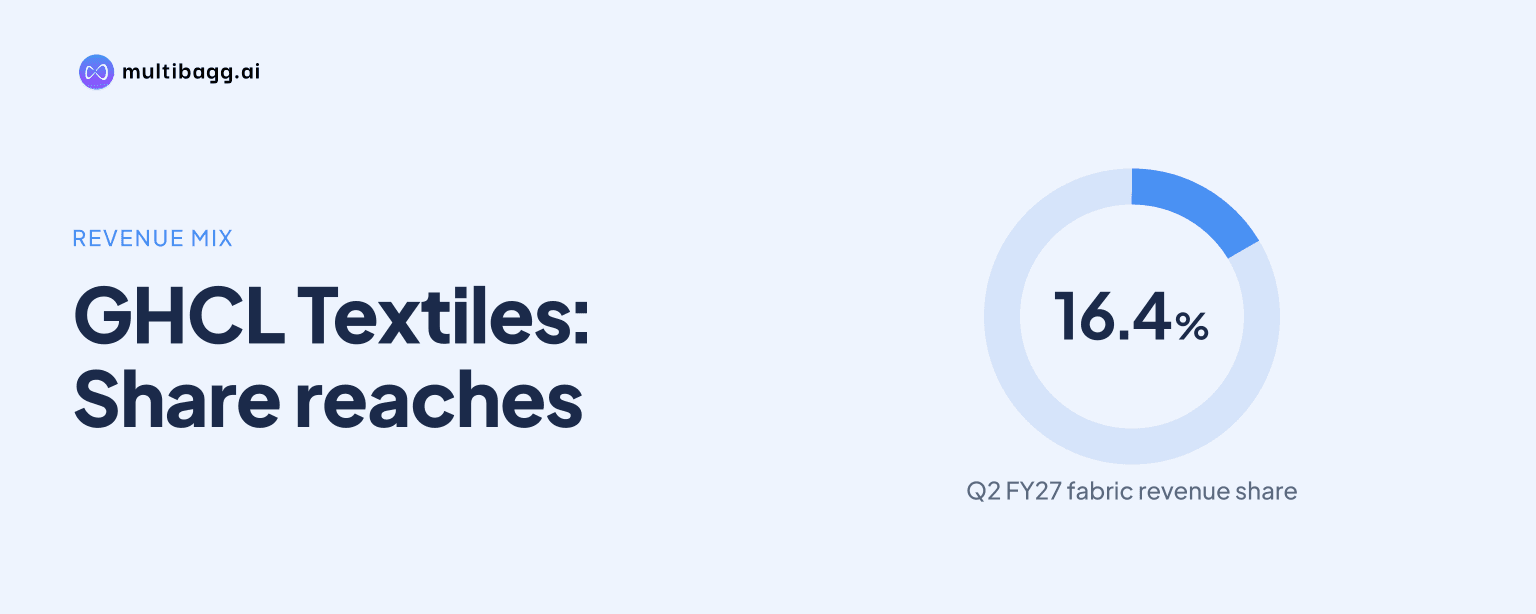
In the second quarter of fiscal year 2027 (Q2FY27), GHCL Textiles Ltd reported Rs 73 crore of fabric revenue, equal to 16.4% of Rs 446 crore total revenue, while yarn capacity utilization was 99%. Fabric sales increased from Rs 64 crore in Q1FY27 and Rs 38 crore in Q2FY26.
Know GHCL Textiles inside out
Results, valuation, peers and who's buying, in one view.
How much of GHCL Textiles’ Q2FY27 revenue came from fabric?
Fabric accounted for Rs 73 crore, or 16.4%, of GHCL Textiles’ Rs 446 crore total revenue in Q2FY27. Yarn remained the larger business at Rs 373 crore. Fabric’s share increased by 0.8 percentage points from 15.6% in Q1FY27, when fabric generated Rs 64 crore from total revenue of Rs 410 crore.
The year-on-year change was larger. Fabric revenue rose by Rs 35 crore from Rs 38 crore in Q2FY26, while yarn revenue increased by Rs 72 crore from Rs 301 crore. Fabric’s revenue share therefore rose by 5 percentage points from 11.4% in Q2FY26, although yarn remained the principal sales contributor.
Total revenue increased 9% quarter on quarter and 31% year on year in Q2FY27. Fabric revenue increased 14% from Q1FY27 and 92% from Q2FY26, compared with an 8% sequential increase and a 24% year-on-year increase in yarn revenue. Those different growth rates increased fabric’s proportion of reported sales over both comparison periods.
How have fabric volumes and yarn utilization changed?
GHCL Textiles sold 922 metric tonnes (MT) of knitted fabric and 70 lakh metres of greige fabric in Q2FY27, while yarn sales volume was 10.7 thousand MT. Knitted-fabric volume increased from 898 MT in Q1FY27 and 402 MT in Q2FY26. Greige-fabric volume increased from 59 lakh metres sequentially and 50 lakh metres a year earlier.
Yarn volume increased by 0.2 thousand MT from 10.5 thousand MT in Q1FY27 and by 0.3 thousand MT from 10.4 thousand MT in Q2FY26. Capacity utilization was 99% in Q2FY27 and Q1FY27, compared with 98% in Q2FY26. The disclosed figures show fabric volumes rising while the existing yarn manufacturing base continued to operate at near-full utilization.
For the full-year comparison, knitted-fabric sales expanded from 514 MT in FY25 to 1,665 MT in FY26, while greige-fabric sales increased from 159 lakh metres to 204 lakh metres. Fabric revenue rose from Rs 97 crore in FY25 to Rs 157 crore in FY26, while yarn revenue increased from Rs 1,071 crore to Rs 1,179 crore and capacity utilization remained 99% in both years.
How has GHCL Textiles’ sales mix changed across markets?
Domestic revenue was Rs 412 crore in Q2FY27, up from Rs 365 crore in Q1FY27 and Rs 309 crore in Q2FY26. Exports were Rs 34 crore, compared with Rs 45 crore in the preceding quarter and Rs 30 crore a year earlier. Domestic sales therefore supplied most of the Rs 446 crore quarterly revenue.
Exports represented 7.7% of Q2FY27 revenue, down from 11.0% in Q1FY27 and 8.8% in Q2FY26. In contrast, fabric’s revenue share rose to 16.4% from 15.6% and 11.4% over those two periods. The reported mix shift toward fabric occurred during a quarter in which the export share declined sequentially.
Got a follow-up? Ask IRIS
What is GHCL Textiles’ strategy for expanding beyond yarn?
GHCL Textiles says vertical integration from yarn into knitted, woven and dyed fabrics is one of four levers in its FY30 plan. Management has set a revenue target of about Rs 2,500 crore and an earnings before interest, tax, depreciation and amortisation (EBITDA) margin target of 15% to 18% by FY30, compared with Rs 1,335 crore revenue and a 12% EBITDA margin in FY26.
The other three stated levers are a greater mix of specialised yarn, renewable-energy expansion and operational excellence. GHCL Textiles describes the specialised-yarn programme as a shift toward value-added, premium yarns across product categories. Its portfolio includes cotton, blended, vortex, open-end, TFO double and cellulosic yarns, with TFO yarn counts ranging up to 2/170s.
GHCL Textiles reported Rs 92 crore of EBITDA in Q2FY27, up from Rs 70 crore in Q1FY27 and Rs 38 crore in Q2FY26. EBITDA margin was 20.6%, compared with 17.0% sequentially and 11.2% a year earlier. The presentation does not assign the margin movement to fabric sales, so it does not establish a direct fabric-mix effect.
What capacity additions support GHCL Textiles’ fabric plans?
GHCL Textiles had 21 knitting machines after adding 15 machines in Q4FY26 and six machines in Q2FY27, at a stated capital outlay of Rs 15 crore. It plans to add 19 machines by Q3FY27, taking the total to 40 machines, with total planned capital expenditure of Rs 7 crore for the ongoing expansion.
The company also plans woven and knitted fabric-processing facilities at Virudhunagar in FY29. It says 56 acres of land were allotted and paid for in Q1FY27, while park infrastructure is expected by FY28. The stated project cost is Rs 300 crore, with plant development intended to proceed alongside infrastructure work for an FY29 operational rollout.
These projects form part of a Tamil Nadu investment memorandum covering Rs 1,035 crore, of which GHCL Textiles says about Rs 675 crore had already been invested. Its FY28 plan includes 58,000 additional spindles and 5 megawatts of rooftop solar capacity at a project cost of Rs 410 crore, with expected annual revenue of Rs 400 crore. Separately, an 11-megawatt ground-mounted solar project costing Rs 32 crore is expected to be commissioned by December 2026 and is projected to save about Rs 6 crore annually in power costs.
Conclusion
GHCL Textiles’ Q2FY27 figures show a measurable change in sales composition: fabric contributed 16.4% of revenue, up from 11.4% a year earlier, while knitted and greige fabric volumes both increased. Yarn still supplied Rs 373 crore of the quarter’s Rs 446 crore revenue, and 99% utilization shows the spinning business remained heavily used as fabric sales expanded.
The next disclosed milestones are the addition of 19 knitting machines by Q3FY27, commissioning of 11 megawatts of solar capacity by December 2026, and the planned FY29 operating rollout at Virudhunagar. Progress against management’s FY30 targets of about Rs 2,500 crore revenue and a 15% to 18% EBITDA margin will indicate how the integration plan is reflected in reported product mix and financial results.