










WORKMATES H1 operating cash flow is negative Rs 4.70 crore
Key highlights
- WORKMATES reported negative Rs 4.70 crore cash flow from operations in H1 FY27, compared with negative Rs 7 lakh in H1 FY26.
- WORKMATES' PAT rose 32.49% year on year to Rs 12.03 crore in H1 FY27.
- Trade receivables increased from Rs 28.99 crore on 31 March 2026 to Rs 39.50 crore on 30 September 2026.
- Cash, bank balances and liquid investments declined Rs 10.07 crore to Rs 43.88 crore by 30 September 2026.
powered by IRIS
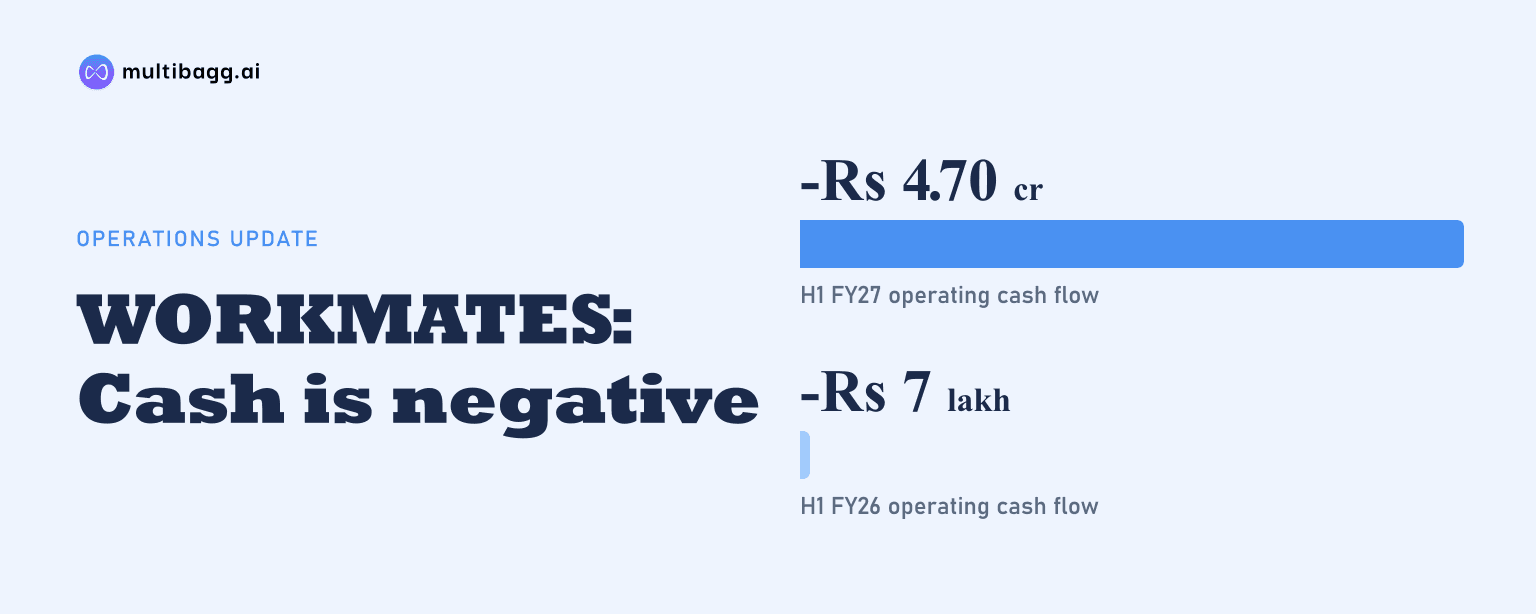
WORKMATES reported negative Rs 4.70 crore in operating cash flow in H1 FY27 despite profit after tax rising 32.49% year on year to Rs 12.03 crore, as trade receivables increased Rs 10.51 crore to Rs 39.50 crore and net working capital rose Rs 7.62 crore by 30 September 2026.
Know Workmates Core2cloud Solution inside out
Results, valuation, peers and who's buying, in one view.
Why was WORKMATES' operating cash flow negative in H1 FY27?
WORKMATES reported negative Rs 4.70 crore of cash flow from operations in H1 FY27, compared with negative Rs 7 lakh in H1 FY26. The year-on-year deterioration was Rs 4.63 crore even as H1 FY27 earnings before interest, tax, depreciation and amortisation, or EBITDA, increased to Rs 16.44 crore. The presentation reported an operating-cash-flow-to-EBITDA ratio of negative 29% for the half year.
The presentation does not attribute the outflow to a single item, but its period-end figures show more capital tied up in working capital. Trade receivables rose from Rs 28.99 crore on 31 March 2026 to Rs 39.50 crore on 30 September 2026, while debtor days increased from 62 to 64. Net working capital increased from Rs 77.04 crore to Rs 84.66 crore across the same dates. These movements coincided with the cash outflow, although the source does not quantify each item's contribution.
How did WORKMATES' cash position change by September 2026?
WORKMATES' cash, bank balances and liquid investments declined Rs 10.07 crore to Rs 43.88 crore at 30 September 2026 from Rs 53.95 crore at 31 March 2026. Total borrowings were reported at zero at both dates. The company also displayed net debt or net cash at zero at each date, separately from the reported balance of cash, bank deposits and liquid investments.
Capital expenditure, or capex, was Rs 2.36 crore in H1 FY27, compared with Rs 1.21 crore in H1 FY26, an increase of Rs 1.15 crore. The Rs 10.07 crore decline in cash was greater than the combined negative Rs 4.70 crore operating cash flow and Rs 2.36 crore capex. Therefore, the selected cash-flow data in the presentation do not provide a full reconciliation of the change in the cash balance.
How did WORKMATES report profit while cash flow was negative?
WORKMATES remained profitable during H1 FY27, reporting profit after tax, or PAT, of Rs 12.03 crore against Rs 9.08 crore in H1 FY26. EBITDA rose 24% from Rs 13.26 crore to Rs 16.44 crore, while gross profit increased 24.78% from Rs 25.58 crore to Rs 31.92 crore. The difference between these earnings measures and negative operating cash flow indicates that H1 profit did not translate into positive operating cash during the period.
Cost ratios changed modestly as profit rose. Cloud consumption and third-party costs represented 66.47% of revenue in H1 FY27, up 72 basis points from 65.75% in H1 FY26. Employee benefit expenses declined 41 basis points to 10.78%, while other operating expenses remained at 7.05%. Management said headcount was nearly unchanged at 169 from 168, but cost per resource had risen and it had invested in research and development for artificial-intelligence accelerators.
Got a follow-up? Ask IRIS
What do customer and receivable trends show for WORKMATES?
WORKMATES had 337 total customers on 30 September 2026, up from 316 on 31 March 2026, while enterprise customers increased from 38 to 44. It added 54 logos in H1 FY27, including 34 in recurring business and 20 in project implementation. Over the same six months, receivables increased Rs 10.51 crore and debtor days rose by two days, making collection timing relevant alongside customer additions.
Financial services and insurance, or FSI/BFSI, accounted for 40.56% of H1 FY27 revenue, compared with 34.2% in FY26. Information technology and IT-enabled services, or IT/ITeS, represented 34.57%, down from 36.9%. The top 20 customers contributed 71% of H1 revenue, compared with 73% in FY26, and WORKMATES reported 28 clients with annualised revenue run rates above Rs 1 crore.
WORKMATES signed Rs 30 crore of total contract value, or TCV, in H1 FY27 across recurring and project business. It also reported Rs 9.5 crore of annualised revenue carried into H2 under contracts extending over the next 12 months. Gross revenue churn was 2.6% in H1 FY27 versus 2.4% in FY26, while gross revenue retention was 97.4% versus 97.6% in H1 FY26. Management's annualised gross-revenue-churn target is 10% or less.
What recurring-revenue trends accompanied the H1 cash outflow?
WORKMATES' monthly recurring revenue, or MRR, rose from Rs 13.5 crore in April 2026 to Rs 15.9 crore in September 2026. Expansion through upselling, cross-selling and usage contributed Rs 2.34 crore of MRR, while new logos added Rs 41 lakh. Churn MRR was Rs 35 lakh, associated with 19 customer exits.
The recurring-revenue data measure contracted monthly activity, whereas the negative Rs 4.70 crore operating cash flow measures cash generated during H1 FY27. Gross revenue churn of 2.6% remained below management's annualised target of 10% or less, but was 0.2 percentage points higher than the 2.4% reported for FY26. The presentation does not state whether the MRR growth or bookings converted into H1 collections.
What should readers monitor after WORKMATES' H1 cash outflow?
WORKMATES' next cash-conversion measure will be whether operating cash flow changes as receivables of Rs 39.50 crore and debtor days of 64 are managed in later periods. At 30 September 2026, the company had Rs 43.88 crore of cash, bank balances and liquid investments, Rs 84.66 crore of net working capital and zero reported borrowings. The presentation provides no operating-cash-flow or receivables-collection target.
Management said FY26-27 expansion plans for the United States and Middle East had been triggered after an earlier pause related to geopolitical considerations, evolving industry dynamics and tariff uncertainty. A United States subsidiary had been registered to facilitate global customer billing, while the Singapore go-to-market strategy was being re-evaluated. The source does not disclose a budget, revenue target or implementation date for these initiatives.
Conclusion
WORKMATES' H1 FY27 results combined PAT growth of 32.49% to Rs 12.03 crore and EBITDA growth of 24% with negative Rs 4.70 crore operating cash flow. Receivables rose Rs 10.51 crore, net working capital increased Rs 7.62 crore and capex reached Rs 2.36 crore, while cash, bank balances and liquid investments declined to Rs 43.88 crore. The figures separate reported profitability from cash absorbed during the half year.
The next disclosed items to watch are the Rs 9.5 crore of annualised contracted revenue carried into H2, management's United States and Middle East expansion plans, and the Singapore go-to-market recalibration. Subsequent disclosures on debtor days from 64, receivables from Rs 39.50 crore and operating cash flow will show whether cash conversion changes as these plans proceed.