








GIPCL advances 750 MW project and extends Surat units
MAX Plan at ₹4,999/yr

Find your next multibaggerBe a Pro Investor
Research stocks and track your picks on the go. Download the app.
Key highlights
- GIPCL floated the EPC tender for its proposed 750 MW lignite project on 17 June 2026.
- GUVNL gave in-principle approval in August 2025 for a 25-year PPA for GIPCL’s proposed 750 MW project.
- GIPCL plans a 10-year life extension for two 125 MW SLPP Phase-I units operating commercially since 15 February 2000.
- GIPCL plans R&M for the first SLPP Phase-I unit in FY 2028-29 and the second in FY 2029-30.
powered by IRIS
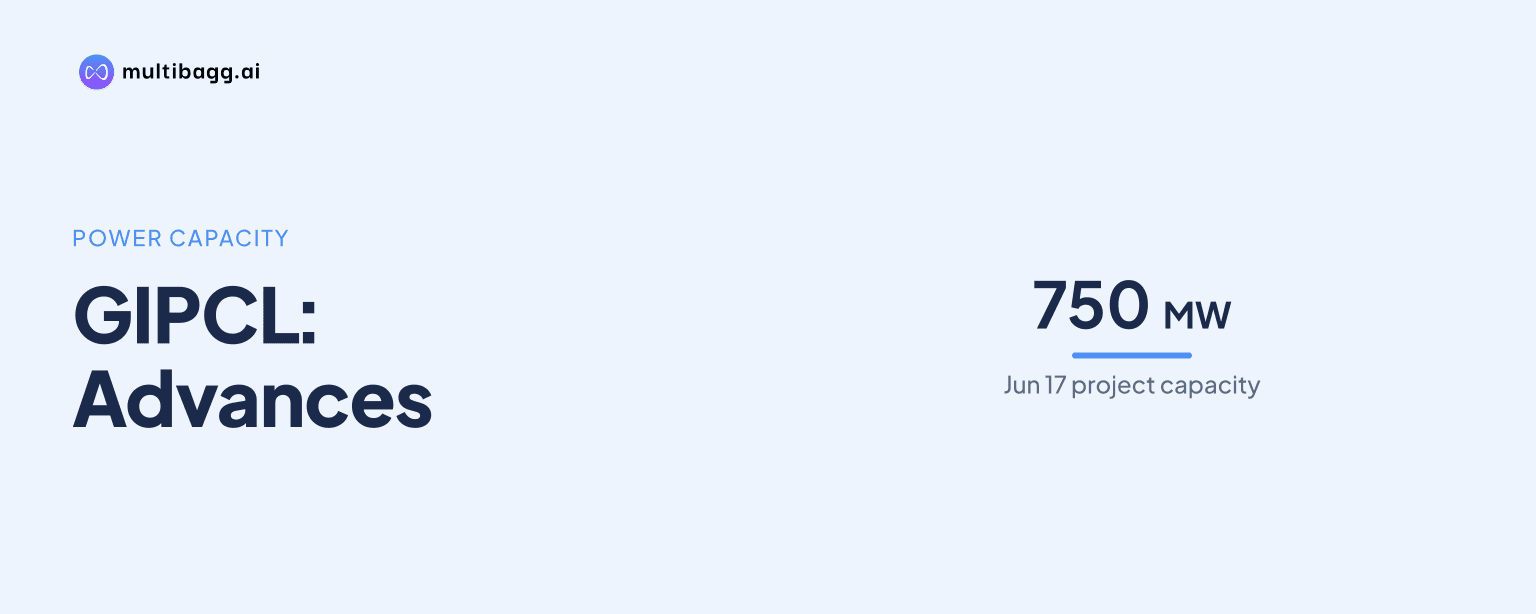
Gujarat Industries Power Company Limited is advancing a 750 MW lignite-based project after floating its engineering, procurement and construction tender on 17 June 2026, while GIPCL also plans to extend the life of two 125 MW Surat Lignite Power Plant Phase-I units by 10 years following more than 26 years of operation.
Know Gujarat Industries Power Co inside out
Results, valuation, peers and who's buying, in one view.
What is GIPCL building at Vastan?
GIPCL is developing a 750 MW lignite-based thermal power project at Vastan, Mangrol taluka, Surat district. The Government of Gujarat entrusted GIPCL with the project in July 2025 to improve grid stability and meet growing power demand in South Gujarat. At 750 MW, the proposed plant is three times the 250 MW combined capacity of the two Surat Lignite Power Plant, or SLPP, Phase-I units covered by the life-extension plan.
Gujarat Urja Vikas Nigam Limited, or GUVNL, gave in-principle approval in August 2025 for a 25-year power purchase agreement, or PPA, for the project. GIPCL says the project land at Vastan is in its possession, project-management and environment consultants have been appointed, and major site-enabling activities have been completed. The engineering, procurement and construction, or EPC, tender was floated on 17 June 2026.
Lignite for the 750 MW plant is planned to be supplied by Gujarat Mineral Development Corporation, or GMDC, from the Valia Mine E, F and G blocks. The presentation identifies the proposed fuel source and GUVNL’s in-principle PPA approval, but does not disclose the project cost, tariff, construction start date, commissioning date, EPC award or fuel-supply volumes.
Why is GIPCL extending the two Surat units?
GIPCL is pursuing renovation, modernisation and life extension because ageing equipment and lignite quality deterioration against design values have increased system partial loading at SLPP Phase-I Units 1 and 2. The two units have a capacity of 125 MW each, were commissioned in 1999, and have been in commercial operation since 15 February 2000. They had completed more than 26 years of operation when the plan was presented.
The renovation and modernisation, or R&M, programme is intended to reduce system partial loading and forced outages and improve the reliability and availability of the 250 MW block. GIPCL’s approved proposal provides for a 10-year life extension. This work is directed at retaining existing generating capacity rather than adding capacity to the company’s installed base.
The detailed project report, or DPR, was finalised in February 2024, and GUVNL approved the DPR and techno-commercial proposal in May 2025. GIPCL has appointed a project-management consultant and placed an order with Bharat Heavy Electricals Limited, or BHEL, in April 2026 for the identified R&M activities. The presentation does not disclose the cost of the programme, expected outage duration or an efficiency target after completion.
When will GIPCL carry out the Surat unit work?
GIPCL plans to implement R&M for the first 125 MW SLPP Phase-I unit in FY 2028-29 and the second 125 MW unit in FY 2029-30. The sequencing is based on BHEL’s delivery schedule and places implementation across two financial years rather than simultaneously across the full 250 MW block.
The disclosed scope is limited to SLPP Phase-I Units 1 and 2. GIPCL’s generation history lists 250 MW of lignite capacity commissioned in November 1999 and another 250 MW lignite plant commissioned in April 2010, while the R&M plan specifically identifies two 125 MW Phase-I units. GIPCL does not give a final completion date or a date for return to full operation for either refurbished unit.
The unit schedule follows the April 2026 BHEL order, while the 10-year extension was approved by GUVNL in May 2025. These are execution milestones, not disclosed evidence of completed refurbishment. The source also does not state whether the expected work will overlap with construction of the proposed 750 MW Vastan project.
Got a follow-up? Ask IRIS
How large is GIPCL’s thermal plan compared with its portfolio?
GIPCL’s installed generation capacity is 1,859.40 MW, comprising lignite and gas thermal plants as well as solar and wind assets. Its thermal fleet includes a 145 MW gas plant commissioned in February 1992, a 165 MW gas plant commissioned in November 1997, and 500 MW of lignite capacity. The proposed 750 MW project equals about 40.3% of the stated installed-capacity base, although it remains an uncommissioned development project.
The 750 MW proposal is also 500 MW larger than the 250 MW Phase-I block scheduled for life extension. The new project has a proposed 25-year PPA framework and identified Valia Mine blocks for lignite supply, whereas the existing-unit programme addresses partial loading, forced outages, ageing and fuel-quality deterioration. Both actions concern lignite generation in the Surat area but have different stated purposes.
GIPCL is simultaneously expanding renewable capacity at Khavda. It has been allocated 4,750 hectares for a 2,375 MW solar, wind and hybrid renewable energy park that it expects to be fully developed and operational by December 2026. A separate 500 MW solar photovoltaic project at Khavda is partly ready for commissioning and awaits Central Transmission Utility of India Limited readiness for charging and power evacuation; GIPCL expects full commissioning by November 2026.
What financial figures accompany GIPCL’s plans?
GIPCL reported revenue from operations of Rs 1,491.12 crore in FY 2025-26, compared with Rs 1,256.26 crore in FY 2024-25. Earnings before interest, taxes, depreciation and amortisation, or EBITDA, increased to Rs 632.87 crore from Rs 474.96 crore, while profit after tax rose to Rs 402.41 crore from Rs 211.43 crore. In contrast, profit before tax declined to Rs 244.67 crore from Rs 272.95 crore.
Term loans were Rs 3,373.46 crore at 31 March 2026, compared with Rs 1,804.90 crore at 31 March 2025, and reached Rs 3,930.99 crore at 30 September 2026. Net worth excluding capital reserve and other comprehensive income was Rs 3,881.01 crore at 30 September 2026, versus Rs 3,748.46 crore at 31 March 2026. GIPCL does not link these borrowings, earnings or balance-sheet movements to the 750 MW project or the SLPP R&M programme.
The presentation provides project milestones rather than financial estimates for the thermal initiatives. For the proposed plant, the latest stated step is the 17 June 2026 EPC tender; for SLPP Phase-I, it is the April 2026 BHEL order and implementation planned from FY 2028-29. No capital expenditure, financing mix or commissioning schedule is given for the 750 MW project.
Conclusion
GIPCL is progressing two separate lignite-generation measures in Surat: a proposed 750 MW Vastan power project with land in possession, planned GMDC lignite supply and in-principle approval for a 25-year GUVNL PPA, and a 10-year life extension for 250 MW of SLPP Phase-I capacity. The proposed plant would add new capacity if completed, while the R&M programme seeks to address partial loading, forced outages, equipment ageing and lower lignite quality at units operating commercially since February 2000.
The next disclosed milestones are the outcome and execution of the 750 MW EPC tender floated on 17 June 2026, for which GIPCL has not provided a cost or commissioning date. For SLPP Phase-I, GIPCL plans BHEL-linked implementation of Unit 1 in FY 2028-29 and Unit 2 in FY 2029-30. The separate 500 MW Khavda solar project is expected to be fully commissioned by November 2026, subject to transmission readiness.

