










Globesecure first-half loss more than doubles to Rs 1.85 crore
Key highlights
- Globesecure reported a Rs 1.85 crore first-half loss, compared with Rs 89.28 lakh a year earlier.
- Revenue from operations fell about 68% to Rs 2.51 crore from Rs 7.88 crore.
- Operating activities used Rs 4.41 crore, compared with an Rs 80.31 lakh inflow in the prior-year period.
- Short-term loans and advances increased to Rs 50.79 crore at 30 September 2026 from Rs 46.93 crore at 31 March 2026.
powered by IRIS
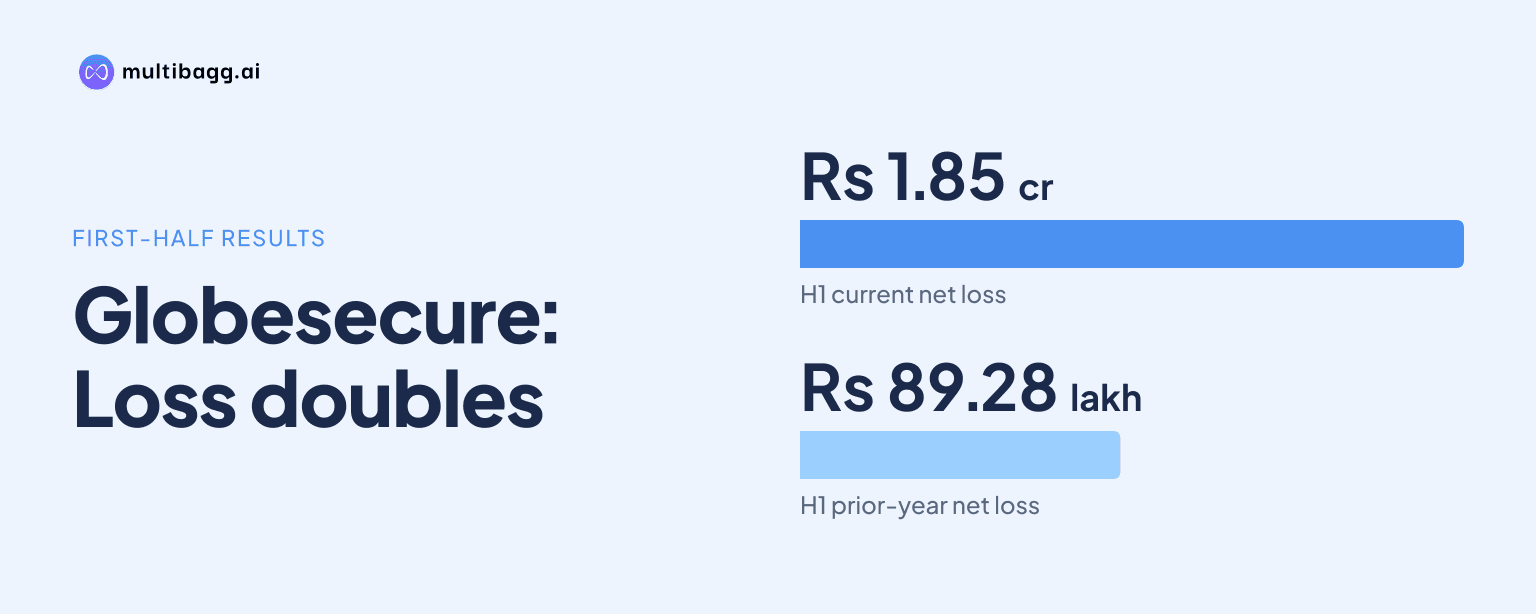
Globesecure Technologies Limited reported a Rs 1.85 crore loss for the half year ended 30 September 2026, more than double the Rs 89.28 lakh loss a year earlier, as revenue from operations fell 68% to Rs 2.51 crore and operating activities used Rs 4.41 crore of cash.
Know Globesecure Technologies inside out
Results, valuation, peers and who's buying, in one view.
Why did Globesecure’s first-half loss rise?
Globesecure’s loss after tax rose to Rs 1.85 crore in the half year ended 30 September 2026 from Rs 89.28 lakh in the corresponding 2025 period. Loss before tax was also Rs 1.85 crore, against Rs 91.67 lakh a year earlier, while basic and diluted loss per share widened to Rs 1.16 from Rs 0.56.
The September 2026 quarter accounted for a Rs 90.36 lakh loss, following a Rs 94.86 lakh loss in the June 2026 quarter. The quarterly loss therefore narrowed by Rs 4.50 lakh sequentially, but remained above the Rs 58.82 lakh loss after tax reported in the September 2025 quarter.
Total income fell to Rs 2.70 crore in the latest first half from Rs 7.87 crore a year earlier, while total expenses declined to Rs 4.55 crore from Rs 8.78 crore. Expenses fell by less than the Rs 5.17 crore decline in total income, leaving Globesecure with a higher reported loss.
How far did Globesecure’s revenue fall in the first half?
Globesecure’s revenue from operations declined by Rs 5.37 crore, or about 68%, to Rs 2.51 crore in the half year ended 30 September 2026 from Rs 7.88 crore in the prior-year period. September-quarter revenue was Rs 1.19 crore, compared with Rs 1.33 crore in June 2026 and Rs 2.06 crore in September 2025.
Globesecure reports one business segment, Cyber Security Solutions and other information technology and IT-enabled services support and services. The filing provides no product, customer or geographic split of the Rs 2.51 crore first-half operating revenue, so it does not identify the contracts or offerings behind the decline.
Purchases of stock-in-trade decreased to Rs 69.03 lakh from Rs 3.74 crore, and employee-benefit expense fell to Rs 1.20 crore from Rs 1.86 crore. Legal and professional fees increased to Rs 83.65 lakh from Rs 48.21 lakh, however, while other expenses rose to Rs 1.14 crore from Rs 80.05 lakh.
Why did Globesecure’s operating activities use cash?
Globesecure used Rs 4.41 crore in operating activities during the half year ended 30 September 2026, compared with an Rs 80.31 lakh inflow in the corresponding 2025 period. A Rs 1.85 crore loss before tax became a Rs 1.23 crore operating loss before working-capital changes after depreciation of Rs 27.11 lakh, finance costs of Rs 41.07 lakh and interest income of Rs 6.33 lakh.
Working-capital changes produced a Rs 4.40 crore outflow, compared with an Rs 93.24 lakh inflow a year earlier. Changes in loans, advances and other assets used Rs 4.81 crore, while trade receivables released Rs 59.94 lakh and changes in liabilities and provisions used Rs 18.72 lakh.
Net financing activities generated Rs 4.24 crore, including Rs 1.72 crore from long-term borrowings and Rs 2.93 crore from short-term borrowings, after Rs 41.07 lakh of finance costs paid. Cash and cash equivalents nevertheless fell to Rs 15.51 lakh at 30 September 2026 from Rs 30.09 lakh at 31 March 2026.
Got a follow-up? Ask IRIS
What did Globesecure’s auditor flag in the results?
Globesecure’s auditor issued a modified conclusion because sufficient appropriate evidence remained pending for advances aggregating Rs 53.26 crore, where receipt of related products or services had been significantly delayed. The auditor said it could not express an opinion on the carrying amount of those advances or consequential adjustments that might be required.
Note 5 refers separately to Rs 42.40 crore of advances made for business purposes under supply agreements, stating that no product or service was received during the six months ended 30 September 2026. Management said it was following up with counterparties and was reasonably certain of starting to receive products or services in the second half; the filing does not explain the difference from the Rs 53.26 crore cited by the auditor.
The auditor also highlighted tax demands of Rs 29.27 crore under Goods and Services Tax and income-tax laws that are under appeal. Globesecure disclosed a Rs 18.93 crore GST demand, including interest and penalty, and a Rs 18.99 lakh pre-deposit; management said, based on consultant advice, it did not expect an outflow.
How did Globesecure’s balance sheet change by September 2026?
Globesecure’s long-term borrowings rose to Rs 2.66 crore at 30 September 2026 from Rs 60.09 lakh at 31 March 2026, while short-term borrowings increased to Rs 9.21 crore from Rs 6.28 crore. Shareholders’ funds declined to Rs 43.48 crore from Rs 45.33 crore over the same period, alongside the Rs 1.85 crore first-half loss.
Short-term loans and advances increased to Rs 50.79 crore from Rs 46.93 crore, while long-term loans and advances remained Rs 10.86 crore. Together these advances were Rs 61.65 crore against total assets of Rs 74.04 crore at 30 September 2026.
Inventory was unchanged at Rs 4.64 crore from 31 March 2026 and was described by the auditor as very slow moving. Management said it had already marked down this inventory by almost 50% and would consider any further markdown in the second half if needed; Globesecure also received a Rs 20 lakh token advance against a proposed property sale.
Conclusion
Globesecure’s first-half figures combine a more-than-doubled loss, a 68% decline in operating revenue and a shift from an Rs 80.31 lakh operating cash inflow to an Rs 4.41 crore outflow. Higher borrowings generated Rs 4.24 crore of financing cash, but cash and cash equivalents still declined to Rs 15.51 lakh.
The next disclosed focus is the second half of the financial year, when management expects products or services to begin arriving against delayed advances and may consider a further inventory markdown. Progress on the proposed property sale, tax appeals covering Rs 29.27 crore of demands, and evidence supporting delayed advances will also remain relevant to subsequent disclosures.