










GPI H1 FY27 profit falls 41% as excise duty rises sharply
Key highlights
- GPI’s H1 FY27 consolidated net profit fell 41.3% year on year to Rs 388 crore.
- H1 FY27 net revenue declined 8.2% to Rs 2,548 crore while gross sales value rose 47.9% to Rs 11,929 crore.
- GPI’s H1 FY27 gross profit margin fell to 36.8% from 44.2% in H1 FY26.
- Q2 FY27 domestic cigarette volume was 1,902 million cigarettes per month, up from 1,866 million in Q1 FY27.
powered by IRIS
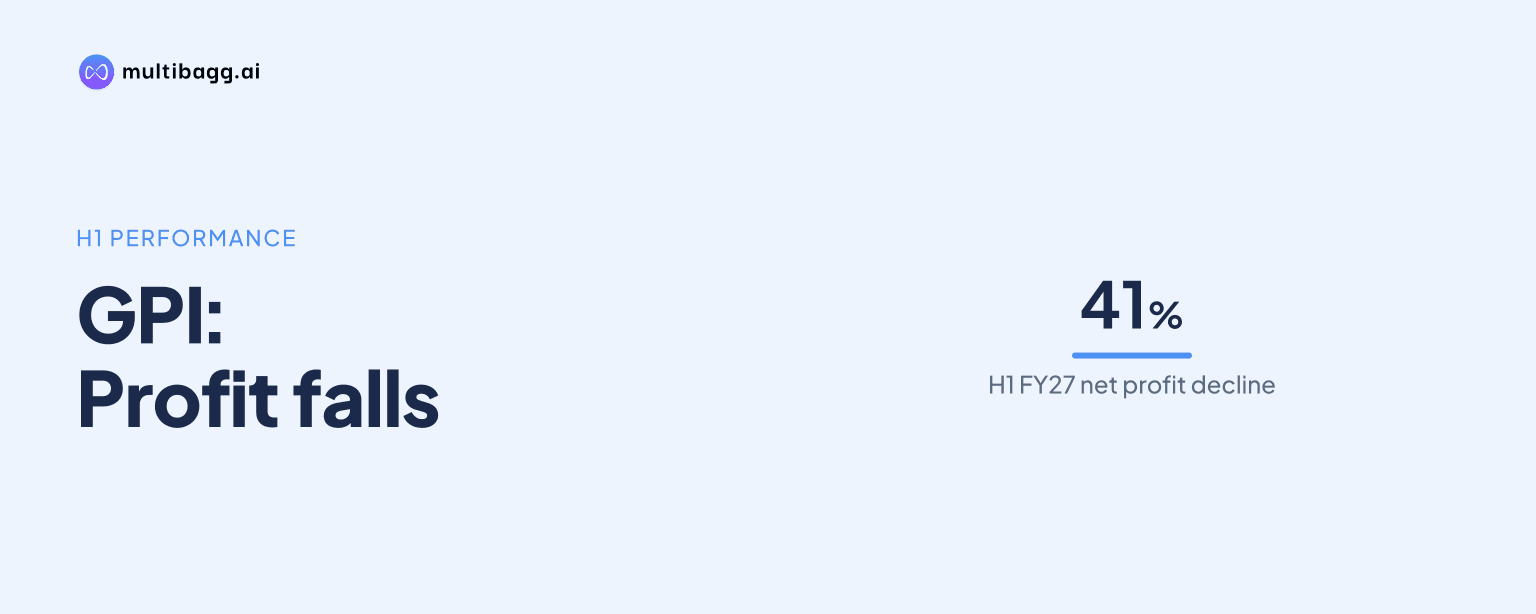
Godfrey Phillips India Limited reported H1 FY27 consolidated net profit of Rs 388 crore, down 41.3% year on year, as excise duty rose to Rs 5,470 crore. Gross sales value rose 47.9% to Rs 11,929 crore, but net revenue fell 8.2% to Rs 2,548 crore after the tax increase implemented in Q4 FY26.
Know Godfrey Phillips India inside out
Results, valuation, peers and who's buying, in one view.
Why did GPI’s H1 FY27 profit fall?
GPI’s H1 FY27 profit fell because the higher tax burden reduced revenue after indirect taxes and lowered margins. Management attributed the 41% decline in profitability against the corresponding prior-year period to the steep tax increase implemented in Q4 FY26. Net profit after tax from continuing operations was Rs 388 crore in H1 FY27, compared with Rs 661 crore in H1 FY26.
The financial summary shows the difference between tax-inclusive sales and retained revenue. Gross revenue increased from Rs 3,445 crore to Rs 8,018 crore, while excise duty rose from Rs 670 crore to Rs 5,470 crore. As a result, net revenue declined by Rs 227 crore even as gross sales value, which includes applicable indirect taxes, increased by Rs 3,861 crore.
How much did GPI’s margins change in H1 FY27?
GPI’s gross profit margin declined to 36.8% in H1 FY27 from 44.2% in H1 FY26, and its net profit margin fell to 15.2% from 23.8%. The presentation calculates margins on net revenue excluding Goods and Services Tax (GST) and excise duty. Gross profit fell by Rs 290 crore to Rs 937 crore.
Operating earnings before interest, tax, depreciation and amortisation, or EBITDA, declined 39.3% to Rs 395 crore, with its margin falling to 15.5% from 23.5%. Cost of goods sold rose 4.1% to Rs 1,611 crore despite the decline in net revenue, while other expenses rose 8.8% to Rs 383 crore. Employee benefits fell 29.0% to Rs 159 crore.
The Q2 FY27 figures show that the margin pressure continued. Gross profit was Rs 493 crore, down 17.7% from Rs 599 crore in Q2 FY26, and gross margin was 36.7% against 46.5%. Net profit was Rs 190 crore, down 37.7% year on year and below Rs 198 crore in Q1 FY27; net profit margin moved from 16.5% in Q1 FY27 to 14.2% in Q2 FY27.
What do GPI’s sales and volumes show about cigarettes?
GPI’s 47.9% increase in gross sales value does not represent an equivalent increase in net revenue because gross sales value includes indirect taxes. Tobacco contributed 99% of H1 FY27 gross sales value, comprising Rs 11,224 crore of domestic tobacco sales and Rs 627 crore of international tobacco sales. Other consumer products contributed Rs 78 crore.
Domestic cigarette volumes fell after reaching 2,190 million cigarettes per month in Q3 FY26, then partly recovered in Q2 FY27. Volumes were 1,928 million cigarettes per month in Q4 FY26, 1,866 million in Q1 FY27 and 1,902 million in Q2 FY27. Q2 FY27 was above the FY25 annual monthly level of 1,671 million, but below the FY26 level of 2,001 million.
Management said it adopted a calibrated pricing strategy to contain the impact on volumes while continuing brand investment, product innovation, market execution and portfolio enhancement. It also said higher taxation contributed to illicit-trade growth, which it described as a significant concern for the legal cigarette industry. The presentation does not quantify illicit trade or the volume effect of pricing.
Got a follow-up? Ask IRIS
What is GPI planning after the tax increase?
GPI plans to sustain and grow its cigarette business, focus on international business and strengthen its core operations. Management’s stated actions include pricing and mix optimisation to protect margins amid demand moderation following recent tax increases, better use of distribution infrastructure, and product innovation. It did not disclose a numerical target for margin, profit or cigarette volume.
International business is part of that plan through own-brand cigarettes, unmanufactured tobacco and contract-manufactured cigarettes. Unmanufactured tobacco export sales were Rs 591 crore in H1 FY27, or 7% of net sales revenue, although management said geopolitical factors affected the business. GPI also plans to strengthen its Philip Morris International partnership for manufacturing and distributing Marlboro cigarettes in India.
Outside tobacco, confectionery produced gross sales of Rs 39 crore in H1 FY27 and Ferrero food products produced Rs 37 crore. The Ferrero distribution and resale partnership had increased revenue by more than two times, from Rs 22 crore in FY25 to Rs 51 crore in FY26. Those activities remain small relative to tobacco’s Rs 11,851 crore combined domestic and international gross sales value in H1 FY27.
Conclusion
GPI’s H1 FY27 outcome shows that tax-inclusive gross sales growth did not translate into higher revenue after taxes or earnings. Excise duty increased by Rs 4,800 crore year on year, while net revenue declined by Rs 227 crore, gross profit by Rs 290 crore and net profit by Rs 273 crore. Tobacco’s 99% contribution to gross sales value means cigarette economics remained central to the consolidated result.
The next results will show whether management’s disclosed pricing, mix and distribution actions can stabilise net revenue and margins. Investors can also monitor domestic cigarette volume after the Q2 FY27 level of 1,902 million cigarettes per month, alongside progress in unmanufactured tobacco exports. The scale of illicit-trade growth and the effect of geopolitical factors on exports remain unresolved in the presentation.