










Gratex funds working-capital build-up through payables and debt
Key highlights
- Gratex’s trade payables rose Rs 46.61 lakh to Rs 95.06 lakh at 30 September 2026.
- Inventories and trade receivables together increased Rs 39.00 lakh from 31 March 2026.
- Non-current borrowings increased Rs 12.00 lakh to Rs 21.67 lakh at September 2026.
- Net operating cash flow was Rs 11.85 lakh in the half year ended September 2026.
powered by IRIS
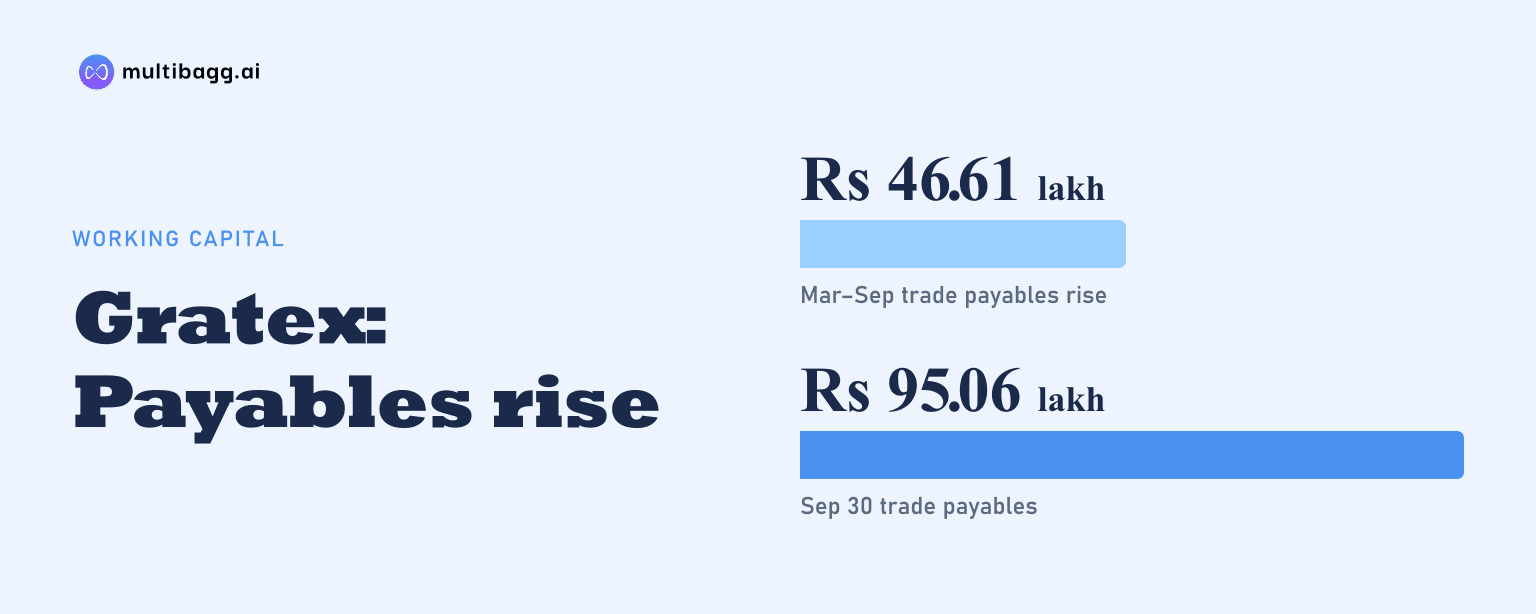
Gratex Industries Limited funded a Rs 39.00 lakh rise in inventories and trade receivables at 30 September 2026 alongside a Rs 46.61 lakh increase in trade payables and a Rs 12.00 lakh increase in non-current borrowings, while generating Rs 11.85 lakh of operating cash in the half year.
Know Gratex Industries inside out
Results, valuation, peers and who's buying, in one view.
How did Gratex’s working capital change by September 2026?
Gratex’s current assets rose to Rs 3.73 crore at 30 September 2026 from Rs 3.28 crore at 31 March 2026, an increase of Rs 44.44 lakh. Inventory was the largest current-asset item at Rs 2.33 crore, compared with Rs 2.18 crore at the March year-end. Trade receivables rose to Rs 1.29 crore from Rs 1.04 crore. Together, inventory and receivables increased by Rs 39.00 lakh, accounting for most of the reported current-asset increase.
The cash-flow statement records a Rs 14.49 lakh increase in inventories and a Rs 24.52 lakh increase in trade receivables in the half year ended September 2026. These movements used cash within operating activities because funds were tied up in stock and customer balances. Other current financial assets were Rs 1.69 lakh at September 2026, against nil at March 2026, while cash and cash equivalents increased only to Rs 0.88 lakh from Rs 0.79 lakh.
What funded Gratex’s higher inventory and receivables?
Gratex’s trade payables increased to Rs 95.06 lakh at 30 September 2026 from Rs 48.45 lakh at 31 March 2026. The Rs 46.61 lakh increase exceeded the Rs 39.00 lakh combined rise in inventory and trade receivables over the same balance-sheet dates. In the cash-flow statement, the increase in trade payables is recorded as a Rs 46.61 lakh operating cash inflow, offsetting the inventory and receivable cash outflows.
The funding effect was not limited to supplier balances because other current liabilities declined by Rs 13.48 lakh to Rs 2.40 lakh. The cash-flow statement records that reduction as a cash outflow from operations. Loans and advances rose by Rs 1.69 lakh, while other current assets increased by Rs 3.66 lakh in the cash-flow statement. The payable increase therefore offset several working-capital cash demands during the half year.
Gratex’s total current liabilities rose to Rs 1.14 crore at September 2026 from Rs 77.63 lakh at March 2026, an increase of Rs 36.22 lakh. Current borrowings, however, fell to Rs 6.23 lakh from Rs 7.22 lakh. The rise in current liabilities was consequently driven principally by trade payables rather than additional current borrowings, based on the balance-sheet classifications.
Got a follow-up? Ask IRIS
What does Gratex’s operating cash flow show?
Gratex reported Rs 11.85 lakh of net cash generated from operating activities for the half year ended September 2026, compared with Rs 8.33 lakh for the half year ended September 2025. Operating profit before working-capital changes was Rs 19.04 lakh, up from Rs 13.06 lakh a year earlier. The higher operating profit was followed by material movements in inventory, receivables, payables and other liabilities in the 2026 half year.
The comparison with the prior-year half year shows a change in the working-capital pattern. In the half year ended September 2025, the cash-flow statement showed a Rs 2.30 lakh increase in inventories, a Rs 21.52 lakh decrease in trade receivables and a Rs 19.04 lakh decrease in trade payables. In the September 2026 half year, inventories and receivables increased while trade payables also increased, replacing the prior period’s receivable cash release with a build-up in customer balances.
Interest and finance charges were Rs 1.45 lakh in the September 2026 half year, compared with Rs 0.36 lakh in the prior-year half year. Depreciation and amortisation increased to Rs 7.66 lakh from Rs 6.44 lakh. The statement also reported Rs 2.70 lakh of taxes paid, net of refunds, for the September 2026 half year, alongside the reported Rs 11.85 lakh operating cash figure.
How did Gratex’s borrowings and balance sheet change?
Gratex increased non-current borrowings to Rs 21.67 lakh at 30 September 2026 from Rs 9.67 lakh at 31 March 2026, a Rs 12.00 lakh increase. The cash-flow statement reports Rs 11.99 lakh of long-term borrowing during the half year. Current borrowings moved in the other direction, falling by Rs 0.99 lakh in the cash-flow statement and standing at Rs 6.23 lakh at 30 September 2026.
Net cash generated from financing activities was Rs 9.55 lakh in the half year ended September 2026, versus Rs 1.87 lakh in the half year ended September 2025. The 2026 figure includes the Rs 11.99 lakh long-term borrowing inflow, the Rs 0.99 lakh reduction in short-term borrowings and Rs 1.45 lakh of interest paid. Net cash used in investing activities was Rs 1.31 lakh, including Rs 1.47 lakh spent on tangible or intangible assets.
Total equity was Rs 3.83 crore at 30 September 2026, compared with Rs 3.75 crore at 31 March 2026, while total liabilities increased to Rs 1.48 crore from Rs 97.49 lakh. Other equity rose to Rs 79.15 lakh from Rs 71.84 lakh, while equity share capital remained Rs 3.03 crore. Total assets increased to Rs 5.31 crore from Rs 4.73 crore, matching the reported increase in equity and liabilities.
Conclusion
Gratex’s September 2026 half-year statements show that a Rs 39.00 lakh build-up in inventory and trade receivables coincided with a Rs 46.61 lakh increase in trade payables and a Rs 12.00 lakh rise in non-current borrowings. Operating activities generated Rs 11.85 lakh of net cash, but the cash-flow statement identifies payable growth as an important offset to cash absorbed by stock, receivables and other working-capital movements.
The filing does not disclose a repayment plan for the Rs 21.67 lakh of non-current borrowings or a management target for inventory, receivables or payables. The next financial statements will therefore show whether inventory of Rs 2.33 crore, receivables of Rs 1.29 crore and trade payables of Rs 95.06 lakh continue to rise, and whether operating cash flow remains sufficient after those movements.