










GSP Crop H1 operating cash outflow reaches Rs 83.4 crore
Key highlights
- GSP Crop reported an Rs 83.4 crore operating cash outflow in H1 FY27, versus an Rs 26.6 crore inflow in H1 FY26.
- Working-capital absorption rose to Rs 181 crore in H1 FY27 from Rs 91.4 crore a year earlier.
- Trade receivables increased to Rs 827.5 crore at 30 September 2026 from Rs 552.6 crore at 31 March 2026.
- Cash and cash equivalents declined to Rs 23.3 crore at 30 September 2026 from Rs 155.3 crore at 31 March 2026.
powered by IRIS
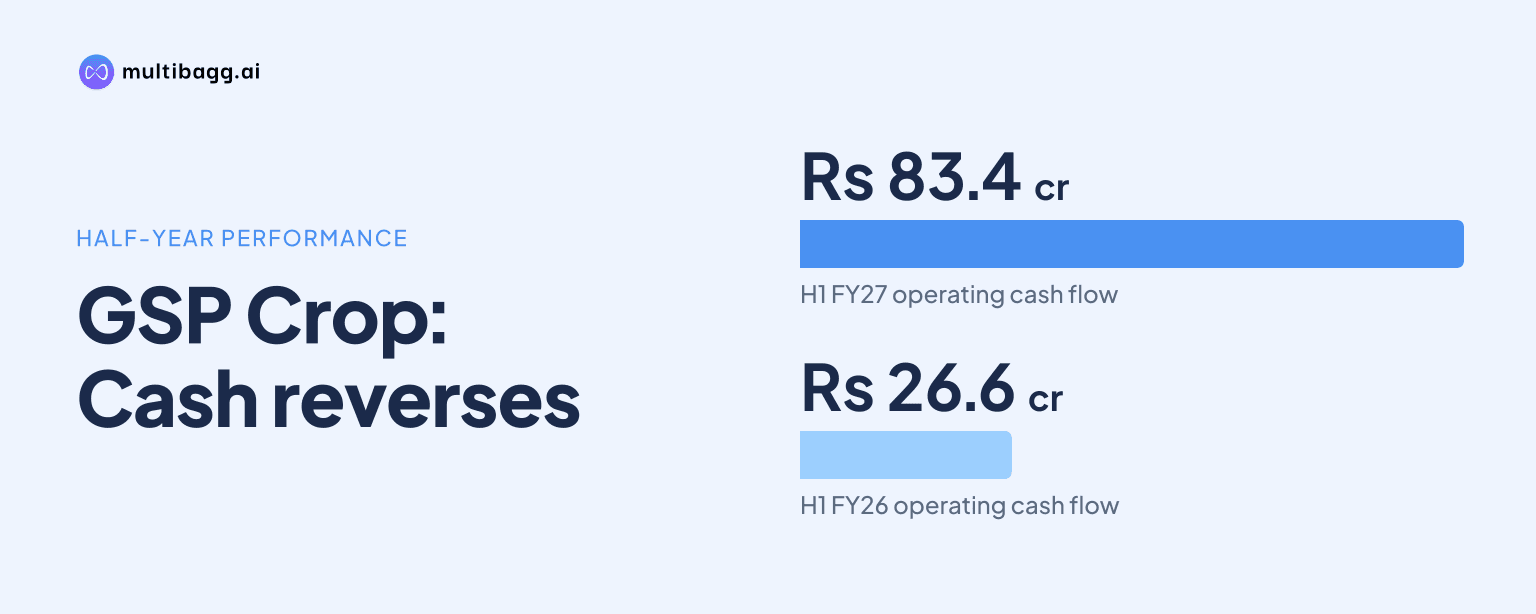
GSP Crop recorded an Rs 83.4 crore net cash outflow from operating activities in H1 FY27, compared with an Rs 26.6 crore inflow in H1 FY26, as Rs 181 crore of working-capital absorption exceeded Rs 118.9 crore of operating profit before working-capital changes. The reversal occurred despite profit after tax of Rs 71 crore.
Know GSP Crop Science inside out
Results, valuation, peers and who's buying, in one view.
Why did GSP Crop’s H1 operating cash flow turn negative?
GSP Crop’s operating cash flow turned negative because its Rs 181 crore use of working capital was larger than the Rs 118.9 crore operating profit generated before working-capital changes in H1 FY27. Working-capital absorption was Rs 89.6 crore higher than the Rs 91.4 crore reported in H1 FY26. Cash generated from operations therefore changed from an Rs 49.2 crore inflow to an Rs 62.2 crore outflow.
Direct taxes paid, net of refunds, were Rs 21.3 crore in H1 FY27, compared with Rs 22.6 crore a year earlier. These tax payments increased the operating cash outflow to Rs 83.4 crore, while H1 FY26’s Rs 49.2 crore cash generated from operations became an Rs 26.6 crore net operating inflow after tax. The reversal was consequently associated primarily with the larger working-capital movement, rather than a rise in cash taxes.
How much working capital did GSP Crop absorb in H1 FY27?
GSP Crop absorbed Rs 181 crore in working capital during H1 FY27, almost twice the Rs 91.4 crore absorbed in H1 FY26. Operating profit before working-capital changes also declined, to Rs 118.9 crore from Rs 140.6 crore. Together, these movements meant that the business did not convert pre-working-capital operating profit into positive operating cash during the six-month period.
The presentation reports working capital as one cash-flow line and does not provide a separate cash-flow reconciliation for receivables, inventory, payables and other current accounts. The balance sheet nevertheless shows trade receivables increased by Rs 274.9 crore between 31 March 2026 and 30 September 2026, while inventories rose by Rs 47 crore. These balance-sheet movements occurred alongside the larger H1 FY27 working-capital use.
Which balance-sheet movements accompanied the cash outflow?
GSP Crop’s trade receivables reached Rs 827.5 crore on 30 September 2026, from Rs 552.6 crore on 31 March 2026, while cash and cash equivalents fell to Rs 23.3 crore from Rs 155.3 crore. Current assets increased to Rs 1,425.2 crore from Rs 1,199.2 crore, reflecting higher receivables and inventories even as the cash balance declined.
Trade payables rose by Rs 165.1 crore to Rs 551.4 crore during the half year, while current borrowings declined by Rs 24.3 crore to Rs 199 crore. Non-current borrowings increased by Rs 49.8 crore to Rs 86.9 crore. Total equity and liabilities increased to Rs 1,846 crore from Rs 1,546.8 crore, matching total assets at both reporting dates.
Got a follow-up? Ask IRIS
How did GSP Crop’s profit performance compare with cash generation?
GSP Crop remained profitable in H1 FY27, reporting profit after tax of Rs 71 crore, but this was lower than Rs 81.1 crore in H1 FY26. Revenue from operations increased to Rs 944.4 crore from Rs 844.3 crore, yet earnings before interest, tax, depreciation and amortisation, or EBITDA, declined to Rs 116.1 crore from Rs 135.5 crore. EBITDA margin fell to 12.3% from 16.1%.
The half-year profit and cash-flow measures therefore moved in different directions. H1 FY27 profit after tax was positive at Rs 71 crore, while net operating cash flow was negative at Rs 83.4 crore. Profit before tax declined to Rs 95.8 crore from Rs 107.8 crore, and depreciation and other adjustments were Rs 23.1 crore versus Rs 32.9 crore. These measures resulted in Rs 118.9 crore of pre-working-capital operating profit before the subsequent cash deficit.
Quarterly results improved from Q1 FY27 to Q2 FY27. Q2 revenue was Rs 558.4 crore, compared with Rs 386 crore in Q1, while EBITDA increased to Rs 73.6 crore from Rs 42.5 crore and EBITDA margin rose to 13.2% from 11%. Management attributed the sequential margin improvement to cost optimisation, while stating that year-on-year margins remained under pressure from raw-material costs, supply challenges and lower sales of high-margin products.
What does GSP Crop’s plan indicate about future cash demands?
GSP Crop’s strategic blueprint states that management plans to reduce debt by Rs 220 crore using initial public offering proceeds. Management says the intended effects are improved net debt-to-equity, financial stability, internal accruals and capacity for future capital raising. The presentation does not quantify the debt balance after the proposed reduction or provide a date for it.
Management also identifies the Saykha facility as a backward-integration initiative intended to improve raw-material security, reduce import dependency and improve supply-chain control. The blueprint says GSP Crop operates across 39 countries and is expanding in Brazil and Latin America, while customer count is shown increasing from 5,225 to 6,047. It does not disclose a capital-cost estimate, completion date for Saykha or cash-flow target for these initiatives.
Conclusion
Taken together, the H1 FY27 figures show that GSP Crop’s Rs 71 crore profit after tax and Rs 944.4 crore revenue did not translate into operating cash generation. The principal reported bridge was Rs 181 crore of working-capital absorption, alongside a period-end receivables balance of Rs 827.5 crore and cash and cash equivalents of Rs 23.3 crore.
The next items to watch are receivables and inventory movements after 30 September 2026, and execution of management’s stated Rs 220 crore IPO-proceeds debt-reduction plan. Progress at the Saykha facility, expansion beyond the 39 countries cited, and any disclosed investment amount or completion schedule would further clarify future cash requirements.