










GSP holds 116 patents and 302 agrochemical registrations
Key highlights
- GSP reports 116 granted patents and 110 patent applications under process.
- GSP reports 302 Indian registrations: 227 formulations, 71 indigenous technicals and four imported technicals.
- GSP identifies 10 exclusive process patents for technical products.
- GSP reports 253 export registrations across 192 formulations and 61 technical products.
powered by IRIS
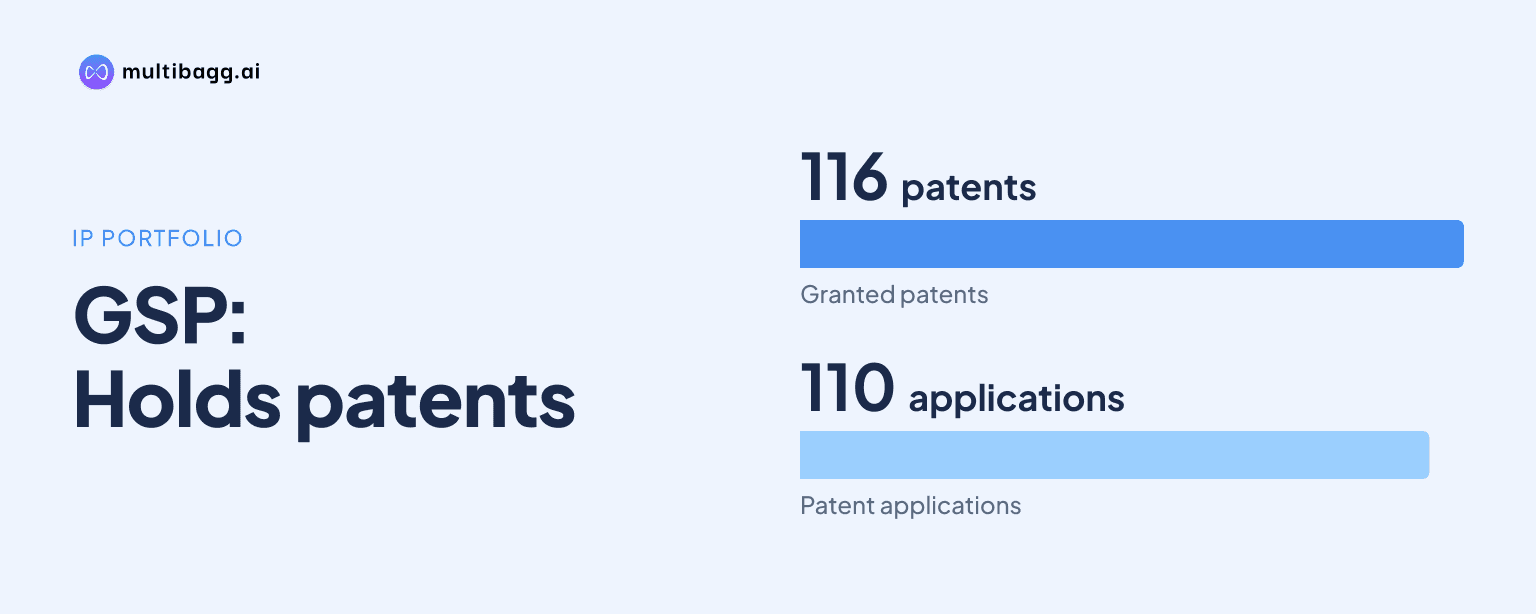
In its investor presentation, GSP Crop Science Private Limited reports 116 granted patents and 302 Indian agrochemical registrations. GSP says the Indian total comprises 227 indigenous formulation registrations, 71 indigenous technical registrations and four imported-technical registrations, while it also has 110 patent applications under process.
Know GSP Crop Science inside out
Results, valuation, peers and who's buying, in one view.
What does GSP's 116-patent portfolio include?
GSP says its intellectual-property portfolio comprises 116 granted patents, alongside 110 applications under process. Of the granted patents, the presentation identifies 10 as exclusive process patents for technical products, highlighting process-level protection in addition to the regulatory registrations for products.
GSP also says it was ranked among the top 10 Indian applicants for Patent Cooperation Treaty filings in financial year (FY) 2022 and for Scientific & Research and Development Organization patents in FY17. The presentation does not disclose the number of Patent Cooperation Treaty filings, its specific rank within the top 10, or the technologies covered by those filings.
GSP links its patent position to in-house research and development (R&D), saying R&D has enabled it to develop technological processes used at its facilities. Its stated work includes identifying formulations and technical products for commercialisation and exploring production methods intended to improve efficiency and product quality.
How are GSP's 302 Indian registrations split?
GSP's 302 Indian registrations consist of 31 registrations classified as 9(3) and 271 classified as 9(4). Formulations account for 227 registrations, while technical products account for 75 registrations after combining 71 indigenous technical registrations and four import registrations.
The 9(4) category accounts for 271 of the 302 registrations, compared with 31 registrations under 9(3). Indigenous formulations are the largest component at 227 registrations, exceeding the 71 indigenous technical registrations by 156 registrations.
GSP separately describes a domestic formulation portfolio of 227 registrations and a technical portfolio of 71 registrations. The detailed table adds four technical-product import registrations, reconciling the stated Indian total of 302, while GSP says it operates domestic technical and formulation businesses in 23 states.
Got a follow-up? Ask IRIS
Which chemistries and products does GSP identify?
GSP identifies three technical chemistries as examples of its ability to handle complex chemistries: chlorantraniliprole technical at at least 96% purity, clothianidin technical at at least 98% purity, and pymetrozine technical at at least 98% purity. The presentation does not disclose production volumes, sales values or approval dates for these technical products.
GSP says it is among the first indigenous manufacturers of certain technicals used in its approved formulations and that it holds exclusive patents. Its stated portfolio spans insecticides, herbicides, fungicides and plant growth regulators, and its listed brands include SLR 525, Platform, PCT-410, All Rounder, Afford, Author, Liger, Raavan, Lead and Element.
For domestic business, GSP says it launched Lead, a patented triple-combination insecticide for chilli crops. The presentation says Lead is used against thrips, black thrips, fruit borer and yellow mites, providing a specific crop-and-pest application for one product linked to its patent portfolio.
How does GSP connect R&D to domestic and overseas expansion?
GSP connects its R&D programme to domestic registrations and overseas market access, reporting 192 export registrations for formulations and 61 export registrations for technical products. These 253 export registrations are disclosed in addition to the 302 Indian registrations under the 9(3) and 9(4) categories.
GSP says it operates in 37 countries and that international-business revenue was 20% higher than the prior year, led by planned sales in Brazil, the United States and Africa. It attributes better sales in Brazil partly to a chlorpyriphos registration received there in the prior year, but does not disclose the revenue base or prior-year revenue amount.
For future offerings, GSP says it initiated product and source registrations in Brazil, Africa, the Middle East and Asian countries, with work focused on chlorantraniliprole and methoxyfenozide. In synthesis R&D, it says it began work on two insecticide active ingredients and one herbicide active ingredient for potential early entry when relevant patents expire.
Conclusion
GSP's presentation quantifies its R&D and regulatory portfolio through 116 granted patents, 110 pending applications and 302 Indian registrations. The registration mix is concentrated in 9(4) approvals and indigenous formulations, while 10 exclusive process patents, three named high-purity technical chemistries and the Lead launch show how GSP connects process development to products.
The next disclosed matters to watch are progress on 10 export-only technical registration applications and eight 9(4)/9(3) technical-molecule registrations, some of which GSP says are approved and others remain in progress. GSP also identifies two insecticides and one herbicide under synthesis R&D, where its stated plan depends on market entry following patent expiry.