










Gujarat Themis Biosyn Limited Q2 loss followed MBJ acquisition
Key highlights
- GTBL reported a Rs 13.8 crore consolidated loss after tax in Q2 FY27, versus standalone profit of Rs 8.5 crore.
- GTBL disclosed Rs 15.57 crore of extraordinary unrealised foreign-currency translation losses in Q2 FY27.
- Only 13 days of MBJ revenue were consolidated after the September 18, 2026 acquisition completion.
- GTBL acquired 100% of MBJ for about Rs 1,300 crore, and MBJ reported FY26 revenue of Rs 557 crore.
powered by IRIS
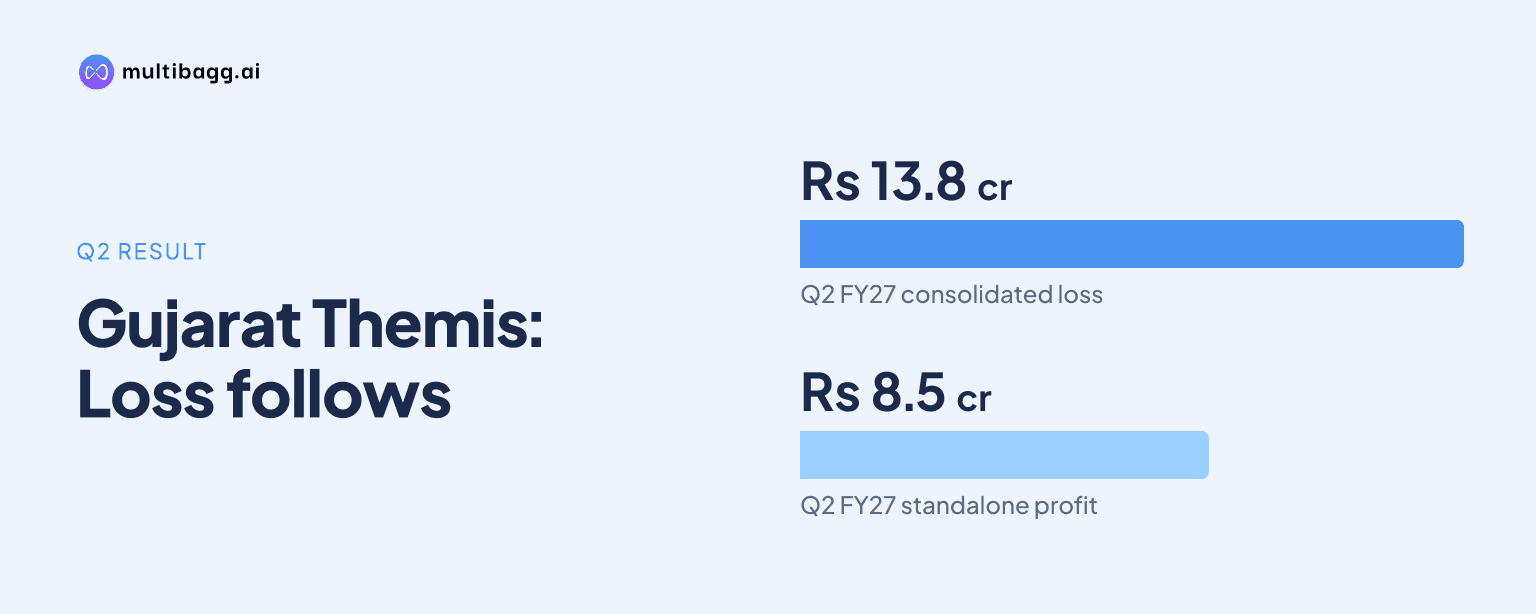
Gujarat Themis Biosyn Limited posted a Rs 13.8 crore consolidated loss in Q2 FY27 after its September 18, 2026 acquisition of MicroBiopharm Japan Co., Ltd. added only 13 days of revenue, while Rs 15.57 crore of unrealised foreign-currency translation losses and Rs 1.2 crore of earthquake-related expenses affected results.
Know Gujarat Themis Biosyn inside out
Results, valuation, peers and who's buying, in one view.
What caused GTBL's consolidated Q2 FY27 loss?
GTBL's Q2 FY27 consolidated loss resulted from Rs 15.57 crore of extraordinary unrealised foreign-currency translation losses, limited revenue from the 13-day MBJ consolidation period and Rs 1.2 crore of earthquake-related operational expenses at MBJ. Consolidated profit after tax, or PAT, was a Rs 13.8 crore loss, while profit before tax was a Rs 11.2 crore loss.
The presentation identifies the foreign-exchange translation loss as a one-time impact. It records the earthquake-related expenditure at MBJ as an exceptional item of Rs 1.2 crore. Consolidated earnings before interest, tax, depreciation and amortisation, or EBITDA, were a Rs 0.9 crore loss, with an EBITDA margin of negative 1.8%, despite other income of Rs 3.8 crore.
The acquisition completed on September 18, 2026, leaving only 13 days of MBJ revenue in Q2 FY27. GTBL did not disclose MBJ's revenue during those 13 days or separately quantify the earnings effect of the acquisition timing. The supplied presentation therefore does not support allocating the Rs 13.8 crore consolidated loss precisely between foreign exchange, partial-period revenue and exceptional costs.
How did GTBL's standalone and consolidated Q2 FY27 results differ?
GTBL reported a Rs 8.5 crore standalone PAT in Q2 FY27, whereas its consolidated accounts recorded a Rs 13.8 crore loss after tax. Standalone income from operations was Rs 47.5 crore and EBITDA was Rs 17.7 crore, compared with consolidated income from operations of Rs 49.9 crore and an EBITDA loss of Rs 0.9 crore.
The difference was visible in expenditure, which was Rs 50.8 crore on a consolidated basis against Rs 29.7 crore standalone. Consolidated interest was Rs 8.4 crore, Rs 2 crore above standalone interest of Rs 6.4 crore. Consolidated total expenditure also exceeded income from operations by Rs 0.9 crore before other income, depreciation, interest and exceptional items.
Standalone sales increased, but standalone profitability declined from the prior-year period. Q2 FY27 income from operations rose 12.1% from Rs 42.3 crore in Q2 FY26 to Rs 47.5 crore, while EBITDA fell 15.3% from Rs 20.9 crore to Rs 17.7 crore. Standalone PAT declined 40.6% from Rs 14.3 crore to Rs 8.5 crore, and the PAT margin fell to 17.8% from 33.7%.
Got a follow-up? Ask IRIS
What did GTBL acquire through the MBJ transaction?
GTBL acquired a 100% stake in MBJ for about Rs 1,300 crore through a wholly owned special purpose vehicle, or SPV, in Japan. The deal completed in Q2 FY27, with T Capital Partners, a Japan-based private-equity fund, identified as the seller. MBJ reported FY26 revenue of Rs 557 crore in the transaction snapshot.
MBJ expands GTBL's active pharmaceutical ingredient, or API, and intermediates portfolio into oncology, immunosuppressants and peptides, according to the presentation. Its disclosed technology includes a proprietary P450 enzyme library, plasmid DNA, antibody-drug conjugate, or ADC, conjugation, and strain and process optimisation. GTBL describes the transaction as part of its plan to become a globally integrated, fermentation-based contract development and manufacturing organisation, or CDMO.
MBJ has served six global pharmaceutical customers for more than 20 years, and 40% of its revenue comes from outside Japan across Asia, Europe and North America. Those figures describe the acquired business's established commercial footprint before consolidation. GTBL did not disclose a post-acquisition earnings target, integration-cost estimate or forecast revenue contribution for MBJ.
What should readers watch after GTBL's MBJ acquisition?
Readers should watch the first full quarters of MBJ consolidation because Q2 FY27 contained only 13 days of the acquired business's revenue. GTBL reported Rs 93.7 crore of consolidated income from operations and Rs 19.9 crore of consolidated EBITDA in H1 FY27, but the half year still ended with a Rs 2.8 crore loss after tax.
Financing costs and foreign-exchange effects are also reported variables after the transaction. Consolidated interest expense was Rs 8.4 crore in Q2 FY27 and Rs 10.1 crore in H1 FY27. The presentation does not state whether the Rs 15.57 crore unrealised foreign-currency translation loss will recur or specify a separate forecast for MBJ's contribution.
Management also said commissioning of GTBL's new fermentation facility temporarily affected standalone EBITDA margins, with benefits expected from Q4 FY27. The standalone EBITDA margin was 37.4% in Q2 FY27, down from 49.5% in Q2 FY26. The presentation does not provide a quantified margin target for the facility or a timetable for MBJ synergies.
Conclusion
GTBL's Rs 13.8 crore consolidated Q2 FY27 loss reflected acquisition-period accounting effects that did not appear in its Rs 8.5 crore standalone profit. The reported combination of Rs 15.57 crore in unrealised foreign-exchange losses, Rs 1.2 crore in exceptional earthquake-related expenses and only 13 days of MBJ revenue coincided with a Rs 0.9 crore consolidated EBITDA loss.
The next disclosed milestone is management's expectation of benefits from the new fermentation facility from Q4 FY27. Subsequent results will show the effect of a fuller MBJ consolidation period, while interest expense, foreign-exchange movements and any disclosed integration costs remain key reported items to monitor.