










GERC Approves Tariffs for Gujarat’s 450 MW BESS Procurement
Key highlights
- GERC adopted tariffs for GUVNL’s 450 MW/900 MWh standalone BESS procurement in Gujarat.
- NIRL won 275 MW/550 MWh at ₹231,989 per MW per month.
- Sun Drops Energia Limited won 175 MW/350 MWh at ₹231,990 per MW per month.
- The NIRL project is planned under a 12-year Battery Energy Storage Purchase Agreement.
powered by IRIS
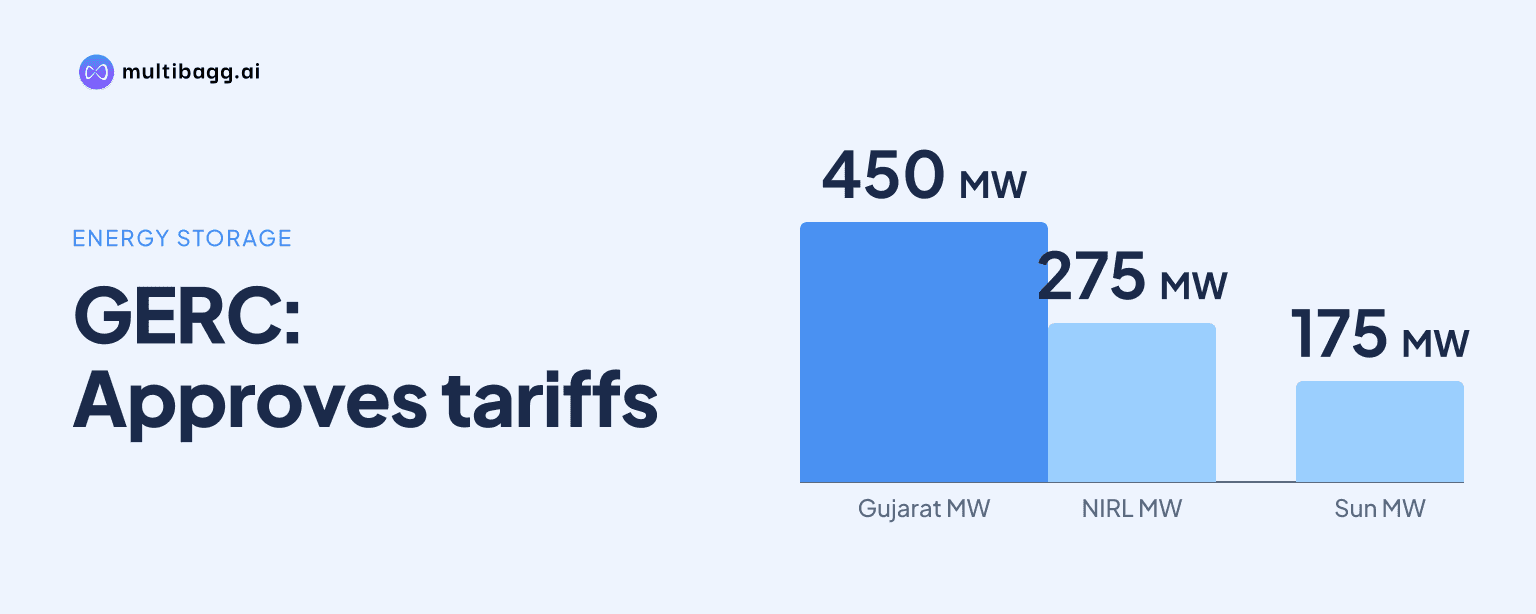
GERC approved the competitively discovered tariffs for GUVNL’s 450 MW/900 MWh standalone battery energy storage procurement in Gujarat, with NLC India Renewables Limited winning 275 MW/550 MWh at ₹231,989 per MW per month. The approval formalises the tariff framework for the full tender, including 175 MW/350 MWh awarded to Sun Drops Energia Limited.
Know NLC India inside out
Results, valuation, peers and who's buying, in one view.
What did GERC approve for Gujarat’s BESS procurement?
GERC adopted the tariffs discovered through competitive bidding for Gujarat Urja Vikas Nigam Limited’s Phase-IX procurement of 450 MW/900 MWh of standalone battery energy storage systems. The procurement is split between two successful bidders, with the tariffs differing by ₹1 per MW per month.
NLC India Renewables Limited (NIRL), a wholly owned subsidiary of NLC India Limited, secured the larger 275 MW/550 MWh portion at a tariff of ₹231,989 per MW per month. Sun Drops Energia Limited secured the remaining 175 MW/350 MWh capacity at ₹231,990 per MW per month. The approved capacity provides two hours of storage duration, as indicated by the 900 MWh energy capacity against 450 MW of power capacity.
The regulatory approval is significant because the tender was run through tariff-based competitive bidding and the adopted tariffs define the commercial terms for the selected capacity. GUVNL had floated the tender in June 2026 for standalone storage projects in the state.
How did NIRL secure the 275 MW Gujarat storage project?
NIRL secured its 275 MW/550 MWh allocation after participating in GUVNL’s tariff-based competitive bidding process for standalone BESS projects. GUVNL subsequently issued a Letter of Intent to NIRL, formally identifying it as the successful bidder for its allocated capacity.
The award was disclosed in September 2026, when NLC India said that its wholly owned renewable-energy subsidiary had received the Letter of Intent. NIRL’s bid tariff was ₹231,989 per MW per month, placing it marginally below the ₹231,990 per MW per month tariff for the capacity awarded to Sun Drops Energia.
Under the stated project arrangement, GUVNL is to enter into a 12-year Battery Energy Storage Purchase Agreement with NIRL. The storage facility will be available to GUVNL on an on-demand basis for charging and discharging, while NIRL will establish the system and connect it to Gujarat’s transmission network.
What are the operational requirements for the BESS projects?
The projects must meet specified availability, efficiency and domestic-content conditions alongside the contracted storage capacity. The tender terms cited for the project require 95% annual system availability, 85% AC-to-AC round-trip efficiency and at least 20% local content.
The project is also eligible for viability gap funding of ₹1.8 million per MWh. This support mechanism is relevant to standalone storage because the battery asset is built primarily to store and supply electricity when called upon by the procurer, rather than being paired with a particular generation plant.
For NIRL, the 275 MW/550 MWh project requires delivery of two hours of storage capacity. GUVNL will use the facility according to its charging and discharging requirements under the planned purchase agreement. The available information does not specify the project site, commissioning date or battery technology.
Got a follow-up? Ask IRIS
Why does the tariff approval matter for NLC India and Gujarat?
The tariff approval advances NIRL’s participation in India’s energy-storage market by supporting the commercial framework for its Gujarat award. NLC India’s FY2025-26 Integrated Annual Report stated that NLC India and NIRL had secured a contracted storage pipeline of 3,300 MWh across three arrangements.
The Gujarat project adds 550 MWh to the storage capacity cited for NIRL’s award in the tender. The group had also won a 50 MW/200 MWh BESS project from West Bengal State Electricity Distribution Company Limited, according to the provided information. These awards show that the company has been pursuing storage projects alongside its wider energy operations.
For Gujarat, the full 450 MW/900 MWh procurement creates contracted standalone storage capacity that GUVNL can access under the proposed agreements. The procurement structure separates the storage provider’s role from GUVNL’s operational decisions on when to charge and discharge the batteries.
How does this procurement affect the storage industry?
The GUVNL tender provides a competitively discovered tariff benchmark for 450 MW/900 MWh of standalone storage capacity in Gujarat. Both winning bids were near-identical, at ₹231,989 and ₹231,990 per MW per month, indicating the final allocation was made at closely matched commercial terms.
The tender’s technical conditions place measurable obligations on project developers. Annual availability of 95%, round-trip efficiency of 85% and 20% local content are part of the requirements cited for the project, while viability gap funding of ₹1.8 million per MWh is available to support qualifying capacity.
For investors tracking NLC India, the material disclosure is the award to its wholly owned subsidiary rather than a reported revenue figure. The source material does not provide project cost, expected annual income, commissioning milestones or the financial effect on NLC India. Those items will be important for assessing execution and contribution once disclosed.
Conclusion
GERC’s adoption of the discovered tariffs confirms the pricing outcome for GUVNL’s 450 MW/900 MWh standalone BESS procurement. NIRL holds the larger 275 MW/550 MWh allocation at ₹231,989 per MW per month, while Sun Drops Energia holds 175 MW/350 MWh at a tariff ₹1 higher per MW per month.
The next disclosed step is the planned 12-year Battery Energy Storage Purchase Agreement between GUVNL and NIRL. Investors and industry participants will also watch for details on project location, implementation timelines, financing and the final connection of the storage assets to Gujarat’s transmission network.