








Gurunanak Agriculture H1 FY27 revenue fell 48% on monsoon
MAX Plan at ₹4,999/yr

Find your next multibaggerBe a Pro Investor
Research stocks and track your picks on the go. Download the app.
Key highlights
- Gurunanak Agriculture reported H1 FY27 revenue of Rs 8.34 crore, down 48.2% year on year.
- H1 FY27 PAT was Rs 34.57 lakh, down 83.4% year on year, and PAT margin was 4.1%.
- India’s June-to-September 2026 monsoon ended at 87% of the long-period average, according to the presentation.
- Inventory rose to Rs 20.64 crore at September 2026 from Rs 9.01 crore at March 2026.
powered by IRIS
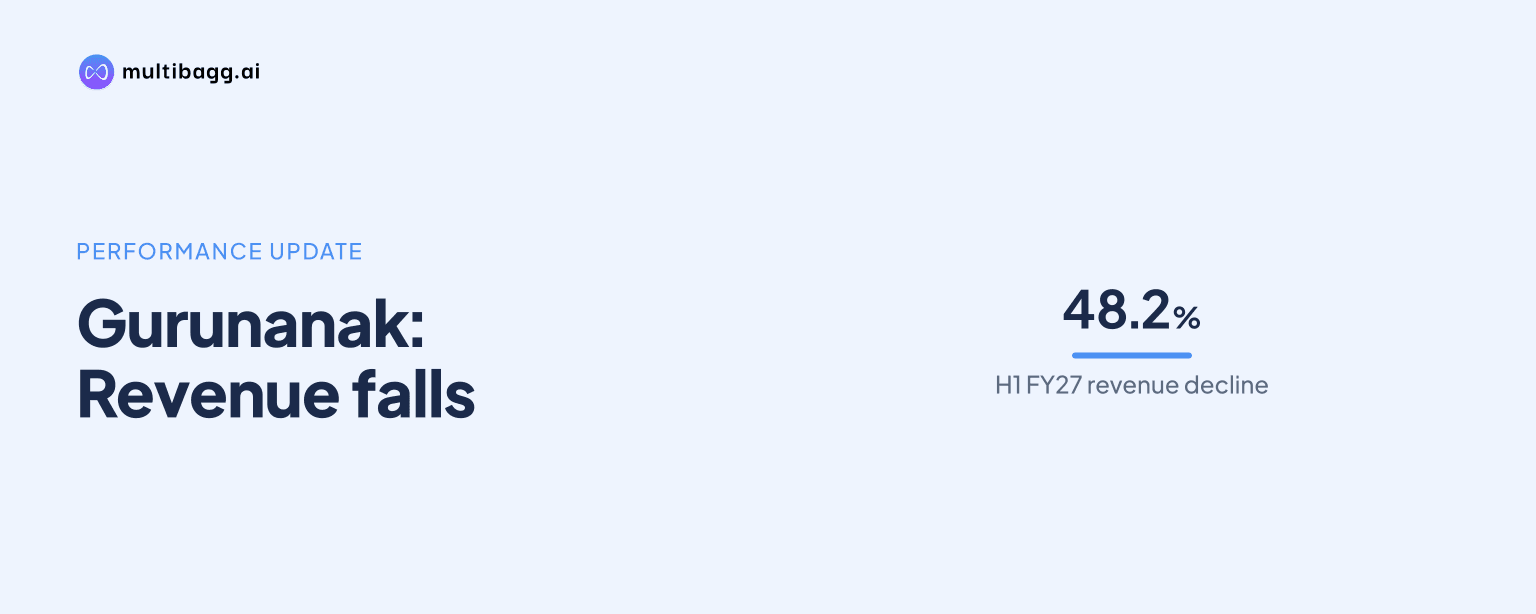
Gurunanak Agriculture India Ltd reported H1 FY27 revenue of Rs 8.34 crore, down 48.2% year on year, after a weak and late 2026 monsoon delayed farm-machinery purchases; profit after tax fell 83.4% to Rs 34.57 lakh. The presentation attributes the slowdown to postponed kharif sowing, weaker dealer stocking and deferred customer orders.
Know Gurunanak Agriculture India inside out
Results, valuation, peers and who's buying, in one view.
Why did Gurunanak Agriculture's H1 FY27 revenue fall?
Gurunanak Agriculture's H1 FY27 revenue fell because weak rainfall delayed kharif sowing and prompted farmers and dealers to postpone machinery purchases and stocking. All-India southwest monsoon rainfall in June to September 2026 reached 87% of the long-period average (LPA), which the presentation describes as the weakest monsoon since 2015. The June rainfall deficit was about 40%, while Chhattisgarh recorded a 54% deficit from 1 June to 2 July 2026.
The monsoon covered all India only by 9 July 2026, and kharif sowing was up to about 20% behind the prior year, according to the presentation. Chhattisgarh advised short-duration crops, while farmers held back equipment orders amid lower crop visibility. Dealer caution was also reflected in industry tractor dispatches, which declined 18% year on year in September 2026. The presentation characterises the H1 outcome as demand moving to a later period rather than a disclosed product-line loss.
Revenue was 67.9% below H2 FY26 as well as 48.2% below H1 FY26, showing the scale of the disruption against both comparative periods. Gurunanak Agriculture says H2 contains the October-to-February kharif harvest peak for its threshers and harvesters. Its response was to hold inventory for that selling window rather than reduce stock during the slower H1 order cycle.
How far did Gurunanak Agriculture's profit and margins decline?
Gurunanak Agriculture's earnings before interest, tax, depreciation and amortisation (EBITDA) declined 62.5% year on year to Rs 1.25 crore, while EBITDA margin fell to 15.0% from 20.7% in H1 FY26. The margin was also below 23.8% in H2 FY26, a half-on-half reduction of 886 basis points. Lower revenue therefore outpaced the reduction in operating costs.
Materials expense, including traded goods and stock changes, was Rs 3.59 crore in H1 FY27, down from Rs 9.91 crore in H1 FY26. However, employee-benefit expense increased to Rs 2.25 crore from Rs 1.79 crore, and other expenses rose to Rs 1.25 crore from Rs 1.07 crore. Depreciation and amortisation was Rs 37.49 lakh, close to Rs 36.20 lakh a year earlier, so that charge did not decline with revenue.
Profit before tax was Rs 74.83 lakh in H1 FY27 after finance costs of Rs 35.71 lakh and tax expense, including arrears, of Rs 40.26 lakh. Profit after tax (PAT) was Rs 34.57 lakh, down 83.4% year on year and 91.4% from H2 FY26. PAT margin declined to 4.1% from 13.0% in H1 FY26, while basic earnings per share were Rs 0.29 against Rs 2.54; the presentation says the per-share figure is not annualised.
Got a follow-up? Ask IRIS
What changed in Gurunanak Agriculture's inventory and funding position?
Gurunanak Agriculture held inventory of Rs 20.64 crore at September 2026, compared with Rs 9.01 crore at March 2026, after building stock for the kharif harvest season. The inventory balance was larger than H1 FY27 revenue of Rs 8.34 crore, illustrating the degree to which goods were positioned ahead of the October-to-February demand period. Management states that the inventory was in place for the harvest cycle.
Capital work-in-progress reached Rs 10.67 crore at September 2026, up from Rs 17.51 lakh at March 2026, while property, plant and equipment was Rs 8.23 crore versus Rs 8.41 crore. Gurunanak Agriculture had said its new Raipur manufacturing shed was about 80% complete in June 2026. The increase in work-in-progress is consistent with that disclosed expansion project, rather than a disclosed acquisition.
Cash and cash equivalents declined to Rs 12.82 crore at September 2026 from Rs 15.69 crore at March 2026, while trade receivables declined to Rs 5.97 crore from Rs 8.04 crore. Short-term borrowings rose to Rs 14.70 crore from Rs 77.92 lakh, and long-term borrowings rose to Rs 2.31 crore from Rs 1.29 crore. Total current liabilities were Rs 20.68 crore compared with Rs 3.40 crore, while shareholders' funds were Rs 46.40 crore versus Rs 47.16 crore.
What could move Gurunanak Agriculture's demand into H2 FY27?
Gurunanak Agriculture expects the delayed purchase cycle to shift into H2 FY27 because that half includes the October-to-February kharif harvest peak for threshers and harvesters. This is management's demand-timing expectation, not a revenue forecast. The company links the expectation to delayed sowing and dealer inventory decisions during the 2026 monsoon.
The harvester assembly line has operated since April 2026 with capacity of 300 units a year. Gurunanak Agriculture's roadmap is to ramp this line and build service support around each dealer. A 200-kilowatt solar power plant was planned for completion in Q1 FY27 to lower energy costs, although the presentation does not report commissioning status or quantify the savings.
A tyre-type harvester is another disclosed product milestone. Gurunanak Agriculture planned to complete research, development and testing in October to November 2026, followed by a March or April 2027 launch after Central Motor Vehicles Rules and Regional Transport Office certification. Its roadmap also identifies Gujarat, West Bengal, Andhra Pradesh, Tamil Nadu and Karnataka for diversification to reduce reliance on Chhattisgarh, alongside export development in Africa and South Asia.
Conclusion
Gurunanak Agriculture's H1 FY27 figures show a weather-linked earnings reversal: revenue declined 48.2% to Rs 8.34 crore, EBITDA margin fell to 15.0%, and PAT declined 83.4% to Rs 34.57 lakh. The presentation links these outcomes to 87%-of-LPA monsoon rainfall, delayed sowing and dealer caution, while the balance sheet records Rs 20.64 crore of inventory for the harvest period.
The next disclosed markers are whether the October-to-February harvest season converts inventory into sales, the ramp-up of the 300-unit annual harvester line, and progress toward the tyre-type harvester's planned March or April 2027 launch. The Raipur shed, which was about 80% complete in June 2026, and the planned geographic expansion beyond Chhattisgarh are also disclosed milestones to watch.

