








DEEP Industries Limited says onshore drilling comes first
MAX Plan at ₹4,999/yr

Find your next multibaggerBe a Pro Investor
Research stocks and track your picks on the go. Download the app.
Key highlights
- Deep Industries cites 55 DSF-IV fields, 25 OALP-X blocks and 16 CBM blocks in the CY2025–26 pipeline.
- The presentation lists 50 new E&P blocks offered and a US$100 billion E&P investment target for 2030.
- Deep Industries expects onshore and shallow-water drilling to ramp first during FY26–FY30.
- Deep Industries identifies drilling rigs, workovers, production services and integrated field services as early-demand categories.
powered by IRIS
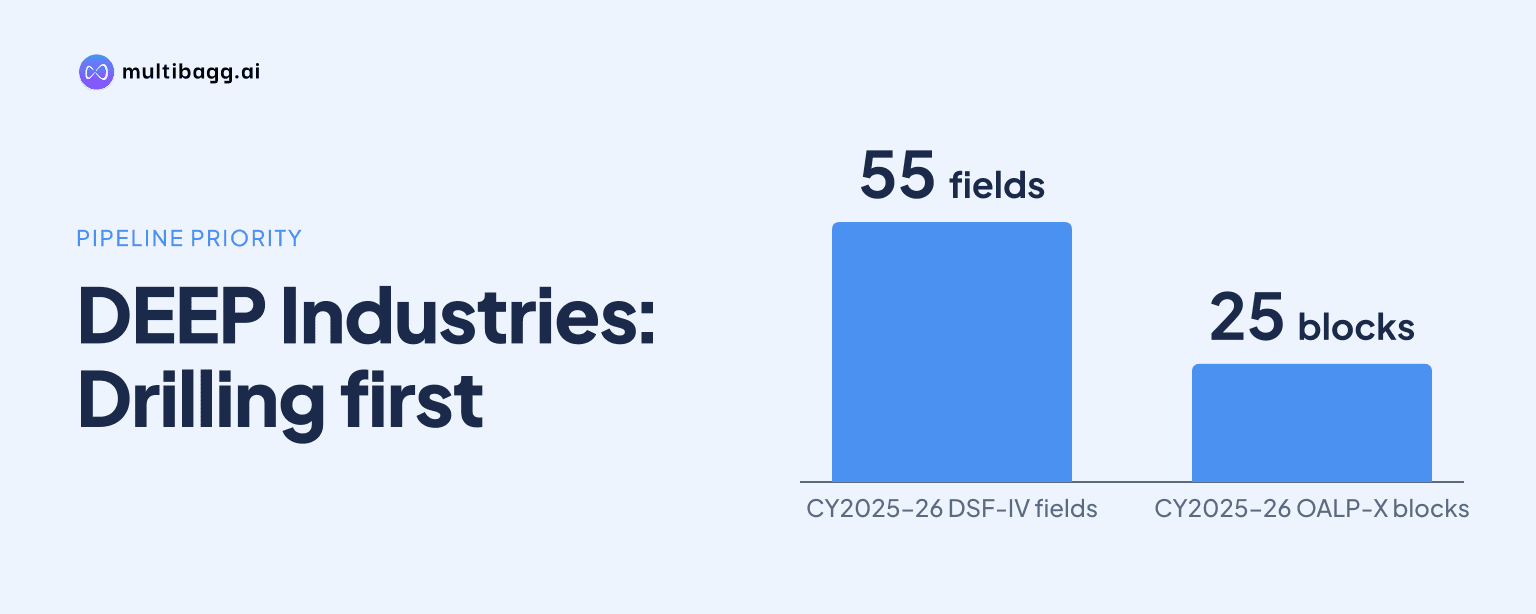
DEEP Industries Limited says India’s upstream policy reset should put onshore drilling first in FY26–FY30, citing a majority of Discovered Small Field and coal bed methane opportunities on land, 55 DSF-IV fields and a US$100 billion exploration and production investment target for 2030. The company expects lower development costs and faster execution to drive the initial phase.
Know Deep Industries inside out
Results, valuation, peers and who's buying, in one view.
Why does Deep Industries say onshore drilling comes first?
Deep Industries says onshore drilling comes first because the majority of Discovered Small Field, or DSF, and coal bed methane, or CBM, opportunities are on land. Its FY26–FY30 outlook identifies faster approvals and execution, lower development capital expenditure, and a quicker discovery-to-production cycle as the reasons land-based activity could lead the immediate execution phase.
The company contrasts onshore operations with offshore work through operating mechanisms rather than a quantified cost comparison. On land, drilling, mobilisation and operating costs are described as materially lower, while wells can be connected more quickly to existing pipeline and processing infrastructure. That sequence covers mobilisation, drilling, completion and tie-in, which Deep Industries says can bring first oil or gas to market sooner.
Offshore activity has different stated advantages, including potentially larger contiguous reserves, higher per-well productivity and longer production plateaus in deepwater and ultra-deepwater basins. However, Deep Industries presents offshore development as a different segment with a longer execution profile, while placing onshore and shallow-water drilling at the start of the FY26–FY30 ramp.
Which policy changes and acreage rounds underpin the outlook?
Deep Industries links the outlook to CY2025–26 policy initiatives that provide a single licence for conventional and unconventional hydrocarbons, allow exploration throughout the contract duration, and reduce royalty for deepwater and CBM activity. These are policy measures cited by the company, not evidence of drilling volumes, awarded service contracts or completed capital spending.
The presentation lists 50 new exploration and production, or E&P, blocks offered during the policy-opening phase. It also identifies 25 blocks under Open Acreage Licensing Policy X, or OALP-X, 55 fields under DSF-IV, and 16 blocks in CBM rounds. DSF-IV is the largest disclosed item by count at 55 fields, versus 25 OALP-X blocks and 16 CBM blocks, although fields and blocks are not directly comparable measures of reserves or expenditure.
Deep Industries also cites a US$100 billion E&P investment target for 2030. The presentation does not allocate that target between onshore and offshore work, state the spending of individual operators, or provide annual investment figures for FY26 through FY30. The target therefore frames the policy ambition behind the projected activity cycle rather than a reported measure of deployed capital.
Got a follow-up? Ask IRIS
Which services could see demand first from onshore activity?
Deep Industries identifies onshore drilling rigs, workover services, production services and integrated field services as categories that could see demand during the immediate execution phase. The company’s stated mechanism is that land-based projects can move through drilling, completion and tie-in more quickly than offshore projects, particularly where existing pipeline and processing infrastructure is available.
Workovers, interventions and equipment upgrades are also described as simpler and more cost-effective on land over a field’s operating life. Deep Industries specifically lists enhanced oil recovery, or EOR, pilots involving polymer, chemical, thermal and carbon dioxide methods as activities that can benefit from onshore operational flexibility. The presentation does not estimate rig utilisation, workover volumes, service pricing or revenue from these services.
The comparison with offshore is important because offshore operations can avoid land acquisition, community displacement and right-of-way constraints. Yet Deep Industries says its expected near-term sequence remains onshore first, followed by shallow-water drilling, rather than an end to offshore activity. Its view rests on lower development capital expenditure and a shorter path from discovery to production, not on a disclosed forecast of market share.
What is the timeline for the projected upstream cycle?
Deep Industries divides the outlook into a CY2025–26 policy-reset stage and a FY26–FY30 multi-year exploration-led growth phase. In the earlier stage, the disclosed developments are licensing changes, royalty measures and acreage offerings. In the later phase, the company expects continuous OALP, DSF and CBM rounds, with onshore and shallow-water drilling ramping first.
This compares a policy-opening period with an anticipated execution period. As of FY26, the presentation describes India as historically dependent on imported crude and gas; through FY30, Deep Industries expects domestic exploration activity to support a structural reduction in import dependence and sustained upstream capital expenditure. Those outcomes are company expectations tied to the policy setting, rather than reported changes in national production or imports.
The company’s data are stated to be current through CY2025, while the US$100 billion E&P target extends to 2030. Deep Industries does not disclose annual targets for new wells, production volumes, rig additions or commercial development rates. It also does not specify how many of the 50 new E&P blocks offered will progress into drilling programmes during FY26–FY30.
Conclusion
Deep Industries’ central case is that India’s upstream revival begins with land-based activity because DSF and CBM opportunities are predominantly onshore and can have lower development costs and faster project cycles. The company supports that view with the CY2025–26 policy reset, 55 DSF-IV fields, 25 OALP-X blocks, 16 CBM blocks and the US$100 billion E&P target for 2030.
The next measure is whether continuous OALP, DSF and CBM rounds produce awarded acreage, drilling programmes and onshore or shallow-water project starts through FY26–FY30. Deep Industries identifies the 2030 investment target and a multi-year activity pipeline, but annual spending, the onshore-offshore allocation and the resulting volume of service contracts remain undisclosed.

