










DEEP Industries Limited sees onshore ramp driving service demand
Key highlights
- India’s crude-oil import dependence was about 88.4% as of FY26, according to Deep Industries’ presentation.
- Deep Industries cited 50 new E&P blocks offered in CY2025–26, including 25 OALP-X blocks and 55 DSF-IV fields.
- Deep Industries reported a revolving order book of about Rs 3,089 crore at 30 September 2026.
- Deep Industries plans about Rs 150 crore of capital expenditure over 12 months for a production enhancement contract.
powered by IRIS
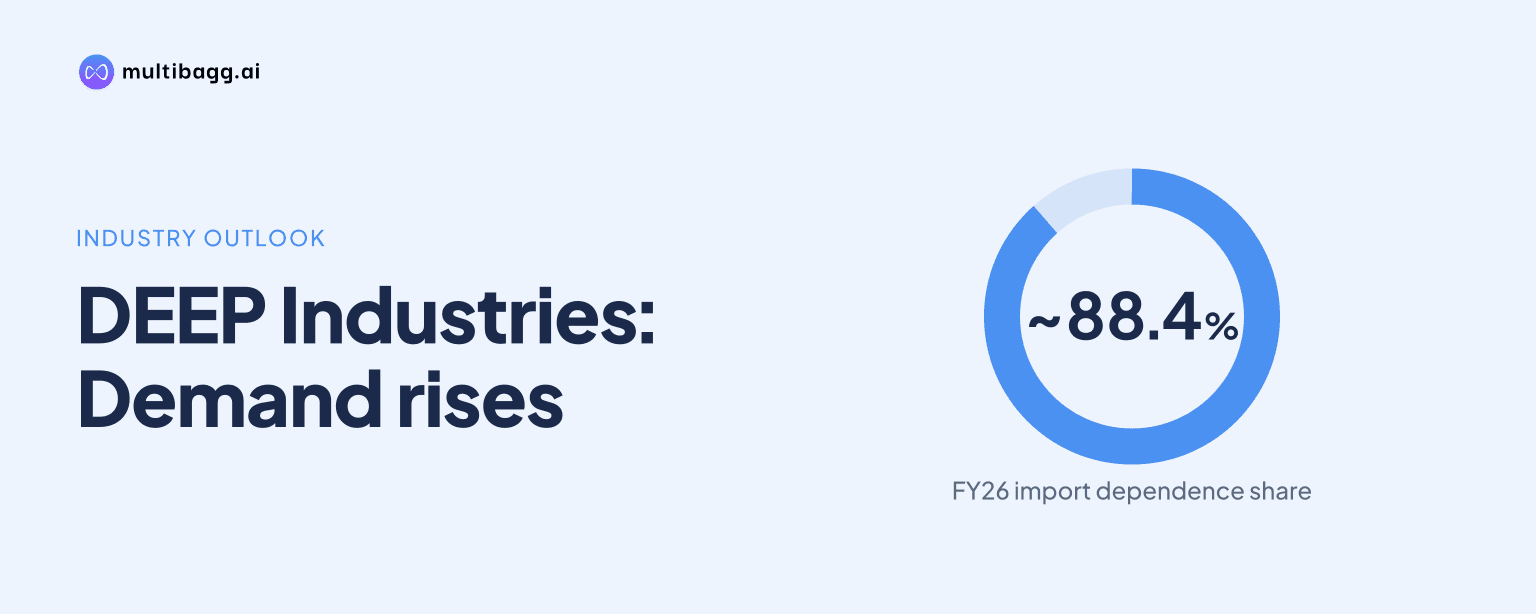
DEEP Industries Limited says India’s FY26–FY30 onshore exploration ramp can lift demand for drilling, workover and production services, citing 88.4% crude-oil import dependence and its assessment that most Discovered Small Field and coal-bed methane blocks are on land. The company links lower development costs and faster execution to this multi-year demand case.
Know Deep Industries inside out
Results, valuation, peers and who's buying, in one view.
Why does Deep Industries expect more domestic exploration?
Deep Industries bases its domestic-exploration argument on India’s import reliance and low exploration intensity. As of FY26, the presentation puts crude-oil import dependence at about 88.4% and natural-gas import dependence at about 50.7%, while describing exploration intensity as low and basin utilisation as under-explored. The company presents these conditions as the background for policy efforts to increase domestic oil and gas activity.
The presentation cites 50 new exploration and production, or E&P, blocks offered in CY2025–26. It separately lists 25 blocks in the tenth Open Acreage Licensing Policy round, or OALP-X, 55 fields in the fourth Discovered Small Field round, or DSF-IV, and 16 blocks in coal-bed methane, or CBM, rounds. It also cites an E&P investment target of US$100 billion by 2030, without providing an annual investment schedule.
Policy measures listed by Deep Industries include a single licence for conventional and unconventional hydrocarbons, exploration through the contract duration, reduced royalties for deepwater and CBM, pricing and marketing freedom, and revenue-sharing contracts with stability clauses. On its FY27 and FY28 outlook page, the company also refers to an “exploration first” policy shift, special CBM bid rounds, natural gas as a bridge fuel and royalty rationalisation.
Why does Deep Industries see onshore drilling ramping first?
Deep Industries says onshore drilling should enter an immediate execution phase because a majority of DSF and CBM blocks are on land. Its FY26–FY30 outlook expects onshore and shallow-water drilling to ramp first, citing faster approvals and execution than offshore, lower development capital expenditure and a quicker discovery-to-production cycle. The company does not provide a projected count of wells, rigs or field starts.
The company describes lower drilling, mobilisation and operating costs as mechanisms supporting onshore projects. It also cites quicker completion and tie-in to existing pipeline and processing infrastructure, which can shorten the time to first oil or gas. The demand categories it identifies are onshore drilling rigs, workover and production services, and integrated field services.
Onshore operations can also support workovers, interventions, enhanced oil recovery, or EOR, pilots and equipment upgrades, according to the presentation. It lists polymer, chemical, thermal and carbon-dioxide methods as EOR examples. By comparison, Deep Industries says offshore basins can have larger contiguous reserves and higher per-well productivity, but it identifies land-based activity as the earlier FY26–FY30 ramp.
Which services could benefit from the onshore activity pipeline?
Deep Industries identifies drilling rigs, workover services, production services and integrated field services as the principal demand channels from onshore development. Its stated sequence is that acreage issuance, approvals, drilling and quicker production start-up could create demand for those services. The presentation does not quantify the company’s share of the 50 new E&P blocks or forecast contract wins from OALP-X, DSF-IV or CBM rounds.
Higher-capacity drilling rigs are a further opportunity under integrated project management, according to the company. Deep Industries says it is exploring entry into this category because of demand for onshore drilling rigs. This is an opportunity under consideration rather than a disclosed rig purchase, committed capital expenditure or signed customer contract.
Production enhancement contracts are another mechanism named in the company’s outlook. These arrangements aim to increase output from producing assets, alongside exploration-led work from continuous OALP, DSF and CBM rounds. The presentation’s nearer-term plan states that incremental production from a production enhancement contract is expected to begin contributing revenue from Q3 FY27.
Got a follow-up? Ask IRIS
How does current order flow compare with the opportunity?
Deep Industries reported a revolving order book of about Rs 3,089 crore at 30 September 2026, compared with about Rs 3,047 crore on 1 July 2026. Additions during the quarter were Rs 337 crore, while Rs 295 crore was executed during Q2 H1 FY27, producing an approximate Rs 42 crore increase. The company does not break the order book down by onshore, offshore, drilling, workover or production services.
Consolidated revenue rose 36.6% to Rs 574.34 crore in H1 FY27 from Rs 420.51 crore in H1 FY26. Earnings before interest, tax, depreciation and amortisation, or EBITDA, increased 23.1% to Rs 255.83 crore, while profit after tax, or PAT, rose 28.2% to Rs 170.37 crore. These figures show period-on-period growth, but the presentation does not attribute H1 growth specifically to new onshore exploration work.
In Q2 FY27, revenue increased 33.7% to Rs 295.43 crore from Rs 221.01 crore in Q2 FY26. EBITDA rose 9.9% to Rs 124 crore and PAT rose 14.0% to Rs 81.22 crore. Management attributes the all-time high quarterly revenue to operational execution, rather than identifying a segment-level contribution from onshore activity.
What milestones could convert the outlook into revenue?
Deep Industries’ stated FY26–FY30 conversion path is continued acreage rounds, earlier onshore and shallow-water drilling, and demand for drilling, workover, production and integrated field services. The company expects a sustained upstream capital-expenditure cycle through the decade and a structural reduction in import dependence. These are management’s industry-outlook statements, not disclosed awards for individual OALP, DSF or CBM assets.
For FY27, the company expects incremental production from a production enhancement contract to start contributing revenue in Q3 FY27. It plans capital expenditure of about Rs 150 crore over the following 12 months for that contract and expects opportunities to bid for new production-enhancement tenders during H2 FY27. Those dates provide the presentation’s specific operating milestones.
Management has guided to operating-revenue growth of 30% to 35% in FY27, based on an existing order book of about Rs 3,089 crore. It also reports a bidding pipeline of Rs 700 crore to Rs 800 crore and expects operating revenue to grow 30% to 35% in FY28 over FY27. Management’s FY27 PAT guidance is Rs 350 crore to Rs 370 crore, followed by Rs 470 crore to Rs 500 crore in FY28.
Conclusion
Deep Industries presents India’s 88.4% crude-oil import dependence, 50 new E&P blocks offered in CY2025–26 and predominance of onshore DSF and CBM opportunities as the basis for a multi-year service-demand cycle. Its existing drilling, workover, production and integrated field-service categories align with the activity it expects to occur first, while the Rs 3,089 crore order book provides a current but unsplit measure of contracted work.
The next disclosed markers are revenue contribution from the production enhancement contract in Q3 FY27, potential tender bids in H2 FY27 and about Rs 150 crore of planned capital expenditure over 12 months. Investors can also monitor whether the Rs 700 crore to Rs 800 crore bidding pipeline converts into orders and whether management delivers its FY27 operating-revenue growth guidance of 30% to 35%.