










ARIS contract manufacturing supplied 55% of H1 total revenue
Key highlights
- ARIS contract manufacturing generated Rs 329.2 crore, or 55.0%, of H1 FY27 revenue.
- ARIS reserved capacity increased from 9.1 million tonnes on 30 June 2026 to 11.7 million tonnes on 30 September 2026.
- Management reported 72% H1 FY27 revenue growth for ARIS contract manufacturing.
- ARIS had 23 exclusive partner plants and stated that 100% of reserved capacity was exclusive to ARIS.
powered by IRIS
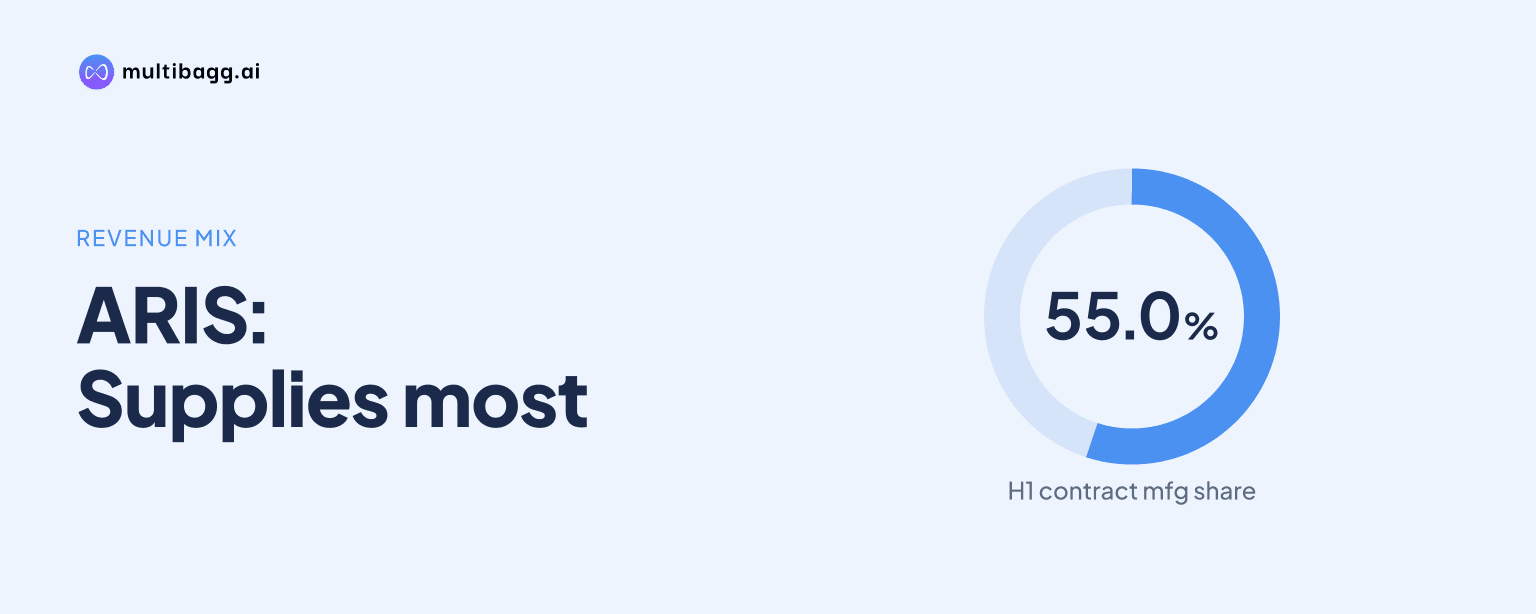
ARIS contract manufacturing generated Rs 329.2 crore, or 55.0% of consolidated revenue in the first half, or H1, of FY27, making it the company’s largest revenue segment after exclusive reserved capacity reached 11.7 million tonnes on 30 September 2026. Management said contract-manufacturing revenue rose 72% in H1 FY27.
Know Arisinfra Solutions inside out
Results, valuation, peers and who's buying, in one view.
How large was ARIS contract manufacturing in H1 FY27?
ARIS contract manufacturing was the largest of its three businesses in H1 FY27, with Rs 329.2 crore of revenue out of consolidated revenue of Rs 598.5 crore. Its 55.0% share exceeded the 35.8% contribution from Materials, the business-to-business, or B2B, supply business, and the 9.2% contribution from Developer as a Service, or DaaS.
Contract manufacturing reported Rs 34.6 crore of segment earnings before interest, tax, depreciation and amortisation, or EBITDA, at a 10.5% margin. This was 46.3% of segment EBITDA of Rs 74.7 crore, compared with Rs 7.2 crore from Materials and Rs 32.9 crore from DaaS. Reported EBITDA was Rs 66.2 crore after Rs 8.5 crore of non-cash Indian Accounting Standards, or Ind AS, adjustments.
Management reported 72% H1 FY27 revenue growth for contract manufacturing, ahead of the 32% year-on-year rise in consolidated revenue to Rs 598.5 crore from Rs 453.3 crore. The presentation does not disclose the segment’s H1 FY26 revenue, but it does state that contract-manufacturing revenue increased 309% from FY24 to FY26.
What exclusive capacity does ARIS have at partner plants?
ARIS had 11.7 million tonnes of annual reserved capacity across 23 exclusive partner plants as of 30 September 2026. The company states that 100% of this reserved capacity is exclusive to ARIS and that the arrangement requires no plant capital expenditure by ARIS.
Reserved capacity increased from 9.1 million tonnes on 30 June 2026 to 11.7 million tonnes on 30 September 2026, adding 2.6 million tonnes in one quarter. The capacity is reserved at partner plants, while the markets listed by ARIS are the end markets served rather than necessarily the locations of the plants.
Chennai was the largest end market, with 4.72 million tonnes of capacity, followed by Mumbai at 3.67 million tonnes. Bengaluru accounted for 2.17 million tonnes and Jharkhand for 1.15 million tonnes, meaning Chennai and Mumbai together represented 8.39 million tonnes of the 11.7 million-tonne network.
Got a follow-up? Ask IRIS
Which products account for ARIS contract-manufacturing capacity?
ARIS reserved 7.33 million tonnes of aggregates capacity across nine plants, representing 63% of the 11.7 million-tonne total. Ready-mix concrete represented 3.22 million tonnes, or 27%, across 11 plants, while asphalt and bitumen represented 1.15 million tonnes, or 10%, across three plants.
The product mix gives aggregates the largest capacity allocation, at more than twice the 3.22 million tonnes reserved for ready-mix concrete. ARIS lists aggregates, ready-mix concrete and asphalt or bitumen as products available through contract manufacturing at exclusive partner plants, as well as through its B2B supply offering.
Asphalt and bitumen generated Rs 73 crore in H1 FY27, which ARIS annualised to Rs 146 crore by doubling first-half revenue. Management’s Q1 FY27 outlook had indicated Rs 80 crore to Rs 100 crore of revenue from this category in 12 to 18 months; the Rs 146 crore figure is an annualised calculation, not management guidance.
The capacity expansion coincided with an increase in the segment’s contribution to group sales. Contract manufacturing and DaaS together represented 64% of H1 FY27 revenue, compared with 51% in H1 FY26, while their combined share increased by 13 percentage points according to management’s segment data.
How does ARIS connect capacity, materials and DaaS?
ARIS describes its three businesses as one integrated model: Materials supplies B2B customers, contract manufacturing provides output from exclusive partner plants, and DaaS manages developer projects. ARIS says every DaaS project buys its materials from ARIS, creating a link between the DaaS order book and material demand.
DaaS had 15 projects under mandate and a live order book above Rs 2,750 crore in the 27 October 2026 release, compared with 10 projects at 30 June 2026. Gross development value, or GDV, reached Rs 2,817 crore on 31 October from Rs 1,267 crore on 31 March, but ARIS states that GDV is expected project sale value and not ARIS revenue.
ARIS reported more than 3,560 customers and more than 2,300 vendors across its three segments as of 30 September 2026. Its in-house system recorded 3.6 lakh deliveries and more than 14 lakh digitised documents, with 64% of delivery documentation auto-created; the system also managed more than 5,860 customers and vendors.
The presentation says the system maps buying and selling prices, tracks customer credit limits and monitors receivables in real time. ARIS reported lifetime credit losses below 0.6% of revenue billed, while net working-capital days declined to 54 in Q2 FY27 from 56 in Q1 FY27 and 97 in Q1 FY26.
Conclusion
ARIS made contract manufacturing its main revenue contributor in H1 FY27, with Rs 329.2 crore of sales and a 55.0% revenue share from 11.7 million tonnes of reserved exclusive capacity. The segment’s 72% H1 revenue growth exceeded consolidated growth of 32%, while DaaS produced comparable segment EBITDA of Rs 32.9 crore on a smaller Rs 55.2 crore revenue base.
The next measures to watch are whether the 23-partner-plant network converts added capacity into sales and whether asphalt and bitumen sustains its Rs 73 crore H1 contribution. Management has guided to about Rs 57 crore of profit after tax in H2 FY27 and about Rs 100 crore for FY27, following Rs 42.9 crore reported in H1 FY27.