










Arisinfra targets ₹3,000 crore FY30 revenue and ₹225 crore PAT
Key highlights
- ARIS guides to about ₹3,000 crore of revenue and ₹225 crore of PAT in FY30.
- FY30 EBITDA margin guidance is 12% to 13%, compared with 9.4% in FY26.
- Contract manufacturing and the CM and DaaS segment are projected to reach 75% of FY30 revenue, from 56% in FY26.
- ARIS's live DaaS order book reached ₹2,817 crore on 31 October across 15 projects.
powered by IRIS
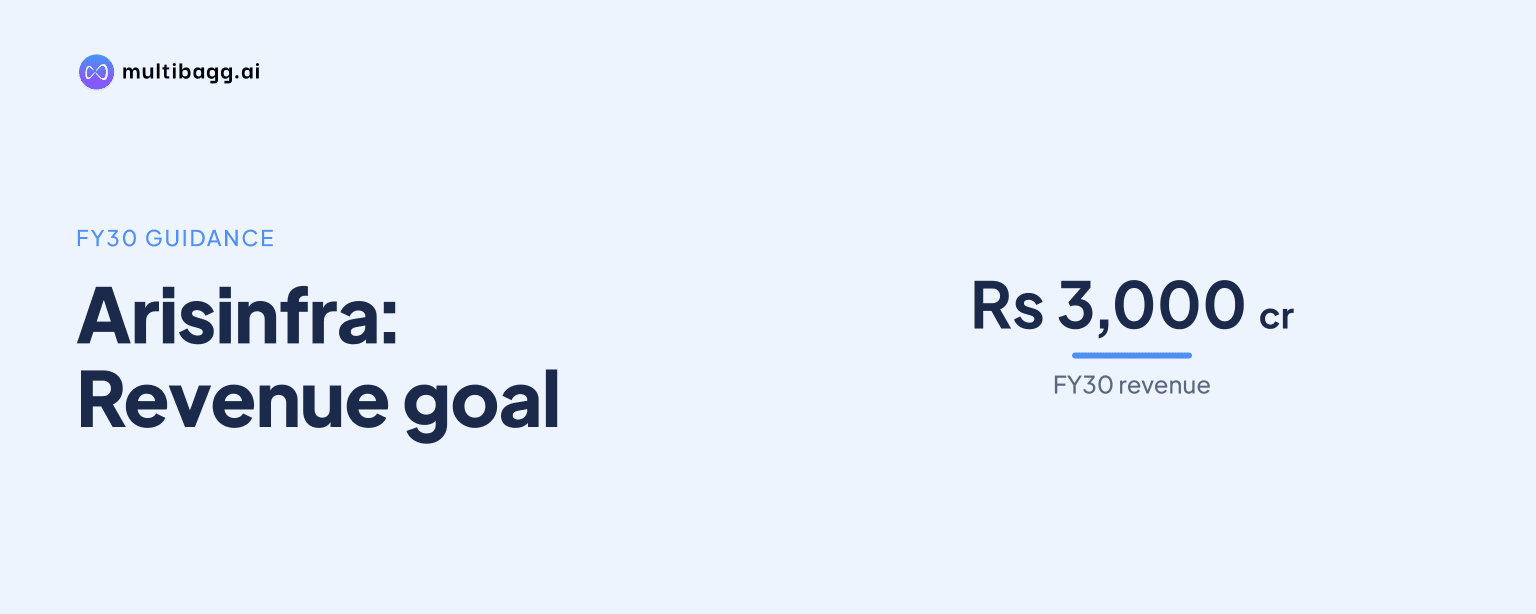
Arisinfra (ARIS) has issued management guidance for about ₹3,000 crore of FY30 revenue and about ₹225 crore of profit after tax (PAT), versus ₹1,068 crore and ₹60 crore in FY26. Management says a revenue-mix shift toward contract manufacturing and DaaS, projected to reach 75% of sales, underpins the planned margin increase.
Know Arisinfra Solutions inside out
Results, valuation, peers and who's buying, in one view.
What is ARIS's FY30 financial target?
ARIS targets about ₹3,000 crore of consolidated revenue, an earnings before interest, tax, depreciation and amortisation (EBITDA) margin of 12% to 13%, and about ₹225 crore of consolidated PAT in FY30. The presentation describes these as forward-looking management estimates, based on the business as it runs today, and says actual results may differ.
Against FY26 audited figures of ₹1,068 crore in revenue and ₹60 crore in PAT, management describes the FY30 targets as revenue growth of about 180% and PAT growth of about 270%. It presents a compound annual growth rate of about 29% for revenue and about 39% for PAT between FY26 and FY30, meaning the profit target is intended to grow faster than sales.
ARIS reports that the FY30 PAT outlook is consolidated and before non-controlling interest, while FY26 is audited. Its growth-path chart states that EBITDA excludes other income; the financial appendix defines EBITDA as revenue less purchases, inventory changes, loss allowance, employee expenses and other expenses.
How does ARIS plan to increase revenue by FY30?
ARIS plans to pursue about ₹3,000 crore of FY30 revenue by scaling DaaS, adding exclusive partner plants and expanding materials supply, contract manufacturing and DaaS into new geographies. These are its stated priorities for the next 18 months, which the presentation labels as directional rather than guidance.
The nearer disclosed measure is FY27 guidance for revenue growth of 35% to 40% and an EBITDA margin of 11.5% to 12%. Revenue rose from ₹768 crore in FY25 to ₹1,068 crore in FY26, while EBITDA margin increased from 6.5% to 9.4%; however, the presentation supplies no annual revenue targets for FY28 or FY29 and marks those years as directional only.
DaaS has a specified commercial mechanism: ARIS earns a fee on gross development value (GDV), while projects under mandate also buy materials from ARIS. The live DaaS order book was ₹2,567 crore of GDV at 30 September, and the addition of Ramdev Plaza Phase II, with ₹250 crore of GDV, lifted it above ₹2,750 crore in October. ARIS notes that GDV is expected project sale value, not its revenue.
Why does ARIS expect margins to increase by FY30?
ARIS expects the combined share of contract manufacturing and the segment labelled CM and DaaS to reach 75% of FY30 revenue, from 56% in FY26. Management attributes the planned 260 to 360 basis-point increase in EBITDA margin, from 9.4% in FY26 to 12% to 13% in FY30, to this movement in mix.
In FY26, contract manufacturing represented 47% of revenue, the segment labelled CM and DaaS represented 9%, and B2B supply represented 44%. For FY30, management projects 65% from contract manufacturing, 10% from CM and DaaS and 25% from B2B supply. The stated change is therefore an 18-percentage-point increase in contract manufacturing and a 19-percentage-point decline in B2B supply.
The capacity element of the plan is to add exclusive partner plants and direct more aggregates, ready-mix concrete, asphalt and bitumen through them. ARIS also says each DaaS project buys its materials from the company, so the model combines a GDV-linked fee with supply activity; the presentation does not provide segment-level EBITDA margins.
Got a follow-up? Ask IRIS
What reported performance precedes the FY30 estimate?
ARIS reported ₹598.5 crore of revenue, ₹66.2 crore of EBITDA and ₹42.9 crore of PAT in unaudited H1 FY27, compared with ₹453.3 crore, ₹40.7 crore and ₹20.4 crore respectively in H1 FY26. The year-on-year changes were 32% for revenue, 63% for EBITDA and 110% for PAT.
H1 FY27 EBITDA margin was 11.1%, up 210 basis points from 9.0% in H1 FY26, while PAT margin was 7.2%, up 270 basis points from 4.5%. These interim margins precede management's FY27 estimates of 11.5% to 12% EBITDA margin, about ₹100 crore PAT and about 7% PAT margin.
Cash-flow and working-capital measures also changed during the reported period. H1 FY27 operating cash flow was ₹60.1 crore, equal to 1.4 times PAT of ₹42.9 crore, while interest cover was 4.6 times versus 2.5 times a year earlier. Net working-capital days declined from 97 in Q1 FY26 to 54 in Q2 FY27, and annualised return on capital employed was 16.1% in H1 FY27 compared with 15.8% in FY26.
What should readers track against ARIS's FY30 guidance?
ARIS's FY27 revenue growth range of 35% to 40%, EBITDA margin range of 11.5% to 12% and PAT estimate of about ₹100 crore are the clearest disclosed milestones before FY30. The company reported H1 FY27 revenue growth of 32% and an EBITDA margin of 11.1%, so its second-half performance will determine whether it reaches the full-year ranges.
DaaS pipeline development is another disclosed operating measure, but it should not be treated as revenue. The live order book increased 117% from ₹1,267 crore on 31 March to ₹2,817 crore on 31 October, while DaaS mandates rose to 15 projects from 10 at 30 June. Conversion of mandates into fees and materials purchases is relevant to the plan for a 75% contract-manufacturing and CM-and-DaaS mix.
Management's next-18-month priorities also provide measures for progress: winning more DaaS mandates, securing additional partner capacity and entering new markets. The presentation does not disclose a target number of plants, markets or mandates, so reported additions and the associated revenue mix will be necessary indicators of execution.
Conclusion
ARIS's first multi-year outlook sets a substantial increase in scale and earnings, from FY26 revenue of ₹1,068 crore and PAT of ₹60 crore to FY30 management estimates of about ₹3,000 crore and ₹225 crore. The proposed shift away from B2B supply, from 44% to 25% of revenue, is central to management's planned EBITDA-margin expansion from 9.4% to 12% to 13%.
The next disclosed milestones are FY27 guidance of 35% to 40% revenue growth, an EBITDA margin of 11.5% to 12% and PAT of about ₹100 crore. Readers can also watch progress on the 15 DaaS mandates and the ₹2,817 crore live GDV order book at 31 October, alongside management's plans for partner plants and geographic expansion.