










Arisinfra DaaS order book reaches Rs 2,817 crore in October
Key highlights
- ARIS reported DaaS GDV of Rs 2,817 crore at 31 Oct, versus Rs 1,267 crore at 31 Mar.
- DaaS mandates increased to 15 projects from 10 projects at 30 Jun.
- Ramdev Plaza Phase II added Rs 250 crore of GDV in October.
- ARIS had 11.7 million tonnes a year of exclusive reserved manufacturing capacity at 30 Sep.
powered by IRIS
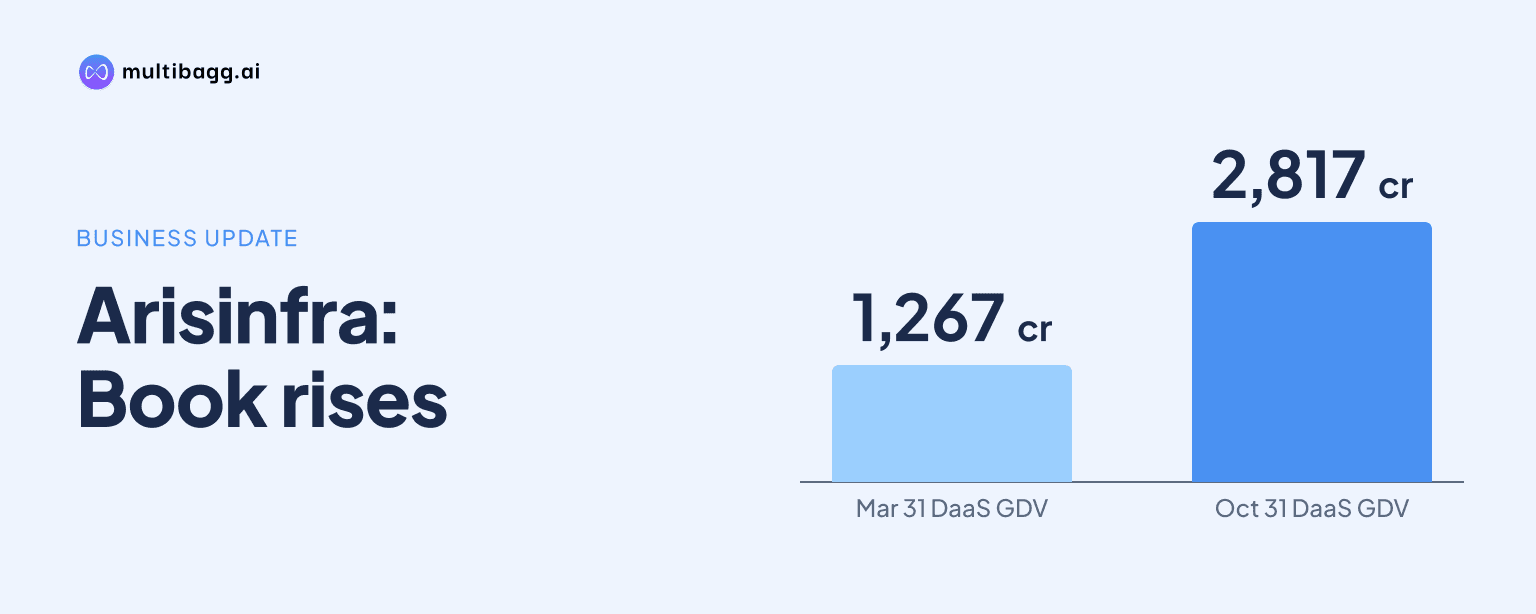
Arisinfra, referred to in the presentation as ARIS, reported Developer as a Service (DaaS) gross development value (GDV) of Rs 2,817 crore at 31 Oct and described its live order book as up 117% since Rs 1,267 crore at 31 Mar, across 15 projects. GDV is expected project sale value, not ARIS revenue.
Know Arisinfra Solutions inside out
Results, valuation, peers and who's buying, in one view.
How has ARIS’s DaaS order book changed since March?
ARIS’s DaaS order book increased from Rs 1,267 crore of GDV at 31 Mar to Rs 1,839 crore at 30 Jun and Rs 2,817 crore at 31 Oct. The presentation characterises the live order book as having grown 117% since March. The increase occurred in both reported intervals, with the order book rising by Rs 572 crore between 31 Mar and 30 Jun and by Rs 978 crore between 30 Jun and 31 Oct.
The presentation separately reports Rs 2,567 crore at 30 Sep, before an October addition. Ramdev Plaza Phase II, with Rs 250 crore of GDV, was added in October, taking the disclosed 30 Sep amount plus that addition to Rs 2,817 crore. ARIS also presents the October position as a live order book of more than Rs 2,750 crore.
What does ARIS’s DaaS order book represent?
ARIS’s DaaS order book represents GDV, defined as the expected sale value of projects under DaaS mandate, rather than revenue recognised by ARIS. The presentation attributes this definition to its 27 Oct 2026 release. Therefore, the Rs 2,817 crore reported at 31 Oct does not equal service-fee revenue, materials revenue or profit for ARIS.
ARIS had 15 projects under DaaS mandate at the disclosed October position, compared with 10 projects at 30 Jun. The addition of five mandates is a separate measure of expansion from the change in GDV, because the presentation gives a value only for Ramdev Plaza Phase II at Rs 250 crore and withholds the names and values of the other projects.
The source does not disclose a fee percentage, a monthly retainer amount, the material value per project or the timing of revenue from the Rs 2,817 crore GDV. That omission means the disclosed order book shows the scale of mandated projects, while the conversion of GDV into ARIS revenue is not quantified in the presentation.
How does ARIS earn from DaaS mandates?
ARIS says it earns through a fee on GDV, including a monthly retainer, and through exclusive material supply to every DaaS project. For the 15 mandates disclosed at 31 Oct, the model therefore has two stated commercial mechanisms: a development-services fee and sales of construction materials.
The DaaS offering can cover five project stages: planning land use and approvals, arranging and tracking finance, sourcing materials, managing execution and supporting sales, collections and handover. ARIS says mandates can cover land, plotted, villa and vertical projects, including new launches and ongoing projects. The service is delivered through Unitern, the name ARIS says is used in its company filings.
ARIS says DaaS projects are externally funded and that it puts no capital into the projects, with its cost being its team. This distinguishes the disclosed model from direct project funding. The presentation does not disclose the amount of external funding, the cost of teams assigned to the 15 mandates or the funding structure of any individual project.
Got a follow-up? Ask IRIS
How does DaaS connect with ARIS’s materials and operating platform?
ARIS says every DaaS project buys its materials from ARIS, linking the Rs 2,817 crore GDV book to its materials operations. Its portfolio includes aggregates, ready-mix concrete, asphalt or bitumen, steel, cement, blocks, electrical products, plumbing products, tiles, sanitaryware and paint. The presentation does not state what share of the DaaS project value will become materials supplied by ARIS.
At 30 Sep, ARIS had 11.7 million tonnes a year of reserved contract-manufacturing capacity across Chennai, Mumbai, Bengaluru and Jharkhand, up from 9.1 million tonnes at 30 Jun. Aggregates accounted for 7.33 million tonnes across nine plants, ready-mix concrete for 3.22 million tonnes across 11 plants, and asphalt or bitumen for 1.15 million tonnes across three plants. ARIS says 100% of this reserved capacity is exclusive to it, but does not allocate capacity between DaaS and other business-to-business supply.
ARIS’s in-house technology processed 3.6 lakh deliveries and digitised more than 14 lakh documents as at 30 Sep, with 64% of delivery documents auto-created. The system also manages pricing, customer credit limits, exposure, receivables, vendors and partner plants. ARIS reported more than 5,860 customers and vendors, alongside lifetime credit losses of below 0.6% of billed revenue.
For the wider business, net working-capital days declined from 97 in Q1 FY26 to 54 in Q2 FY27. ARIS reported operating cash flow of Rs 60.1 crore in H1 FY27, compared with profit after tax of Rs 42.9 crore and earnings before interest, tax, depreciation and amortisation of Rs 66.2 crore. These are company-level figures, and the presentation does not provide separate DaaS cash flow or working-capital data.
Conclusion
ARIS’s DaaS mandate base rose from 10 projects at 30 Jun to 15 projects in the October disclosure, while its reported GDV increased from Rs 1,267 crore at 31 Mar to Rs 2,817 crore at 31 Oct. The model combines a GDV-linked fee, monthly retainer and exclusive material supply, but GDV is not revenue and the presentation does not disclose a conversion rate from project value into fees or material sales.
What to watch next is ARIS’s stated 18-month plan to win more DaaS mandates, add exclusive partner plants and expand into new geographies. Management’s FY30 outlook calls for consolidated revenue of about Rs 3,000 crore, an earnings before interest, tax, depreciation and amortisation margin of 12% to 13%, and profit after tax of about Rs 225 crore; ARIS describes these as forward-looking management estimates subject to risks.