










Deep Industries targets FY28 PAT of Rs 470 crore to Rs 500 crore
Key highlights
- Deep Industries guides for 30% to 35% operating-revenue growth in both FY27 and FY28.
- Management targets FY28 PAT of Rs 470 crore to Rs 500 crore, versus Rs 350 crore to Rs 370 crore in FY27.
- H1 FY27 revenue from operations rose 36.6% year on year to Rs 574.34 crore.
- Deep Industries reported a Rs 3,089 crore order book and a Rs 700 crore to Rs 800 crore bidding pipeline.
powered by IRIS
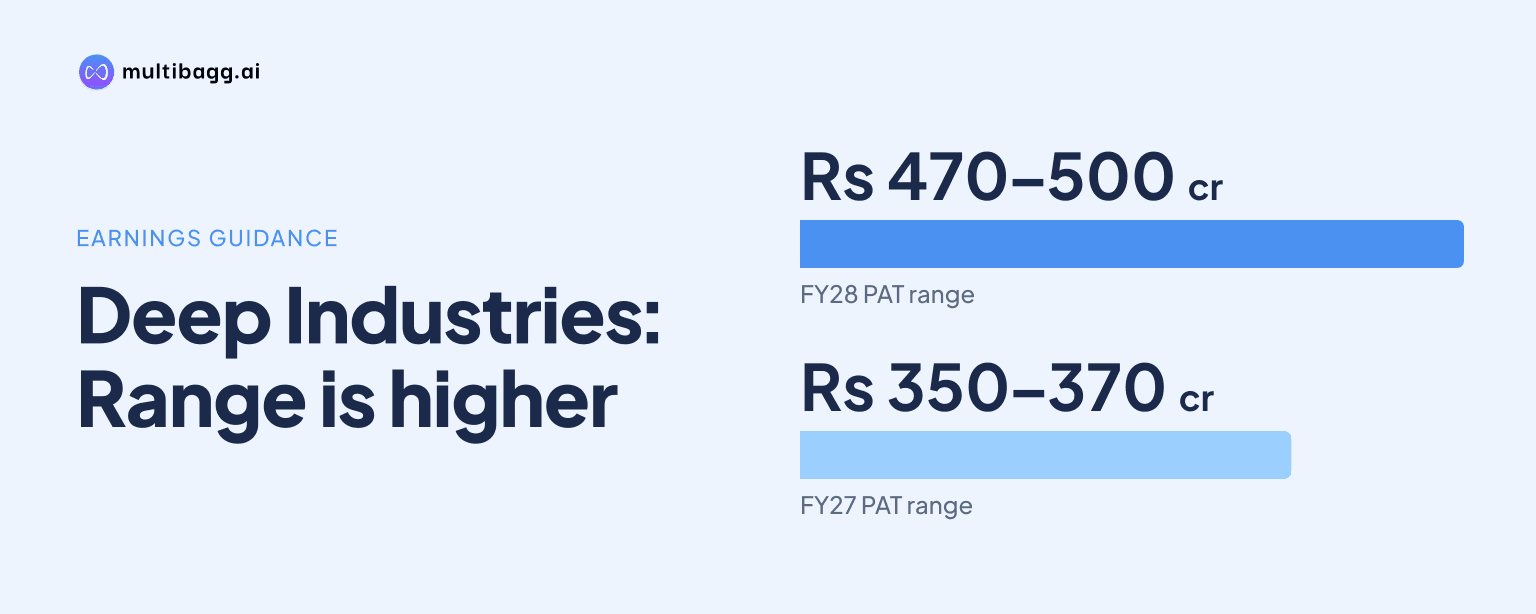
Deep Industries Limited has guided for 30% to 35% operating-revenue growth in both FY27 and FY28 and expects FY28 profit after tax, or PAT, of Rs 470 crore to Rs 500 crore. Management based the outlook on a Rs 3,089 crore order book, a Rs 700 crore to Rs 800 crore bidding pipeline and planned contributions from production-enhancement and offshore operations.
Know Deep Industries inside out
Results, valuation, peers and who's buying, in one view.
What is Deep Industries guiding for FY27 and FY28?
Deep Industries is guiding for operating-revenue growth of 30% to 35% in FY27 and again in FY28, with PAT of about Rs 350 crore to Rs 370 crore in FY27 and Rs 470 crore to Rs 500 crore in FY28. Management said the FY27 revenue expectation is based on the existing order book, while its FY28 assumption incorporates both the order book and bidding pipeline. These are management targets, not reported financial results.
The FY28 PAT range is Rs 100 crore to Rs 150 crore above the FY27 range, comparing the disclosed lower and upper bounds. Deep Industries did not provide absolute operating-revenue targets for either year, so the 30% to 35% guidance applies to annual growth rates. Management also said annual earnings before interest, tax, depreciation and amortisation, or EBITDA, margin is expected to be 42% to 43%.
Management said quarterly EBITDA margin can vary by 300 to 400 basis points because equipment moves between completed projects and newly awarded projects. It therefore asked investors and analysts to assess operating performance on a year-on-year basis rather than through sequential quarterly comparisons. The annual margin target is above the 41.6% EBITDA margin reported in H1 FY27.
What reported growth supports Deep Industries’ guidance?
Deep Industries reported consolidated revenue from operations of Rs 295.43 crore for the quarter ended September 30, 2026, up 33.7% year on year, and Rs 574.34 crore for H1 FY27, up 36.6%. The half-year growth rate was above the guided 30% to 35% range for FY27 and FY28, though the company emphasised that its project-led business should be compared year on year.
H1 FY27 total income was Rs 616 crore, exceeding Deep Industries’ full-year FY25 total income of Rs 608 crore. Management said revenue compound annual growth rate, or CAGR, was around 37% over the past four years. The new guidance is below that historical rate at its 30% lower bound and broadly near it at the 35% upper bound.
Consolidated EBITDA was Rs 124 crore in the September 2026 quarter and Rs 255.83 crore in H1 FY27. EBITDA margin was 39.6% for the quarter and 41.6% for the half year, showing a 2-percentage-point increase across those reported periods. Consolidated PAT was Rs 81.22 crore in the quarter, up 14% year on year, and Rs 170.37 crore in H1 FY27, up 28%, with respective PAT margins of 26% and 28%.
What will drive Deep Industries’ FY28 growth target?
Deep Industries expects incremental projects added in Q1 and Q2 FY27, production-enhancement work and Dolphin Offshore asset inclusion to drive growth through FY28. Management said production-enhancement revenue began contributing from Q3 FY27 and that a full-year contribution from those contracts is part of its FY28 outlook. Additional projects are another stated contributor.
The production-enhancement business includes a 15-year Rs 1,402 crore contract with Oil and Natural Gas Corporation, or ONGC. Deep Industries took over the relevant field in April 2025 and is responsible for increasing hydrocarbon production and extending the life of mature fields. Management said the Mori 5 incident delayed its incremental-production programme by five to six months.
Deep Industries has deployed its rig, resumed workover jobs and plans to start drilling new wells under that programme. Management expects incremental production to begin contributing in Q3 FY27, supported by planned capital expenditure of about Rs 150 crore over the next 12 months. The company operates 20 onshore rigs, including 14 workover rigs and six drilling rigs, and said the fleet was fully utilised.
Gas compression remains another operating platform. Deep Industries said its fleet exceeds 80 compressors, while roughly 30% of India’s compression requirement is outsourced and the company executes close to 85% of that outsourced work. Its gas-processing charter-hire model covers design, supply, installation, commissioning, operation and maintenance of facilities that deliver specification-grade gas to the custody-transfer point.
Got a follow-up? Ask IRIS
How much revenue visibility does Deep Industries have?
Deep Industries said its Rs 3,089 crore order book provides revenue visibility for FY27 and FY28, supported by a Rs 700 crore to Rs 800 crore bidding pipeline. Management described the order book as constantly revolving. The bidding pipeline is not presented as secured work, so future awards remain relevant to the FY28 outlook.
Management expects demand for onshore drilling rigs to remain strong and said Dolphin Offshore could secure more long-term charter-hire contracts. Deep Industries gained control of Dolphin Offshore in January 2023, making it a step-down subsidiary, and said the DP2 barge Prabha is already operational. It said offshore expansion is phased and contract-backed.
The company also said it is evaluating entry into higher-capacity drilling rigs through its integrated project-management business. Under this model, Deep Industries takes responsibility for drilling and completing a well under one contract. Management identified higher-capacity rigs as a possible additional growth leg, without providing a project award or revenue estimate.
What capital and execution matters should investors track?
Deep Industries is targeting about Rs 150 crore of capital expenditure for production-enhancement contracts, with some spending potentially carrying into the following financial year. Management said Dolphin Offshore may require a further Rs 100 crore to Rs 200 crore of capital expenditure, depending on contract awards. It said Deep Industries’ capital expenditure would be funded through internal accruals and debt, with no current equity-raising plan.
Free cash flow from operations rose 35% to Rs 155 crore in H1 FY27. Consolidated cash profit was Rs 106.53 crore in the September 2026 quarter and Rs 219.93 crore in H1 FY27, with cash PAT margins of 34% and 36%, respectively. Return on capital employed, or ROCE, increased by 230 basis points to 21.6% in H1 FY27 from 19.3%.
Execution timing remains a factor in the plan. Management said an ONGC production-enhancement tender due in September had been extended and was expected, in all probability, by the end of November. It also said Deep Industries had made expected credit loss provisions for Dolphin Offshore receivables, had received positive responses on collections and had not considered write-offs at the time of the call.
Conclusion
Deep Industries’ guidance calls for two more years of 30% to 35% operating-revenue growth and a FY28 PAT outcome of Rs 470 crore to Rs 500 crore. The plan follows H1 FY27 revenue growth of 36.6% and combines the Rs 3,089 crore order book with production-enhancement revenue, additional projects and the planned inclusion of Dolphin Offshore assets.
The next milestones are the expected contribution from incremental production in Q3 FY27, the outcome of the delayed ONGC tender expected by end-November and any firm offshore contract awards. Investors can also track the deployment of about Rs 150 crore of production-enhancement capital expenditure and potential Dolphin Offshore spending of Rs 100 crore to Rs 200 crore, which management has made conditional on awards.