










Deep Industries sees 25%-35% gas-compression division growth
Key highlights
- Deep Industries expects average gas-compression division growth of 25%-35%, although individual years could range from about 20% to 40%.
- Deep Industries said 30% of gas compression is outsourced, while customer equipment in use for 25 to 35 years is gradually being replaced.
- Management said conversion of 10% of customer facilities in a year could create unusually large growth in compression services.
- Deep Industries said the remaining Rs 150 crore of rig and compressor capital expenditure will follow contract awards.
powered by IRIS
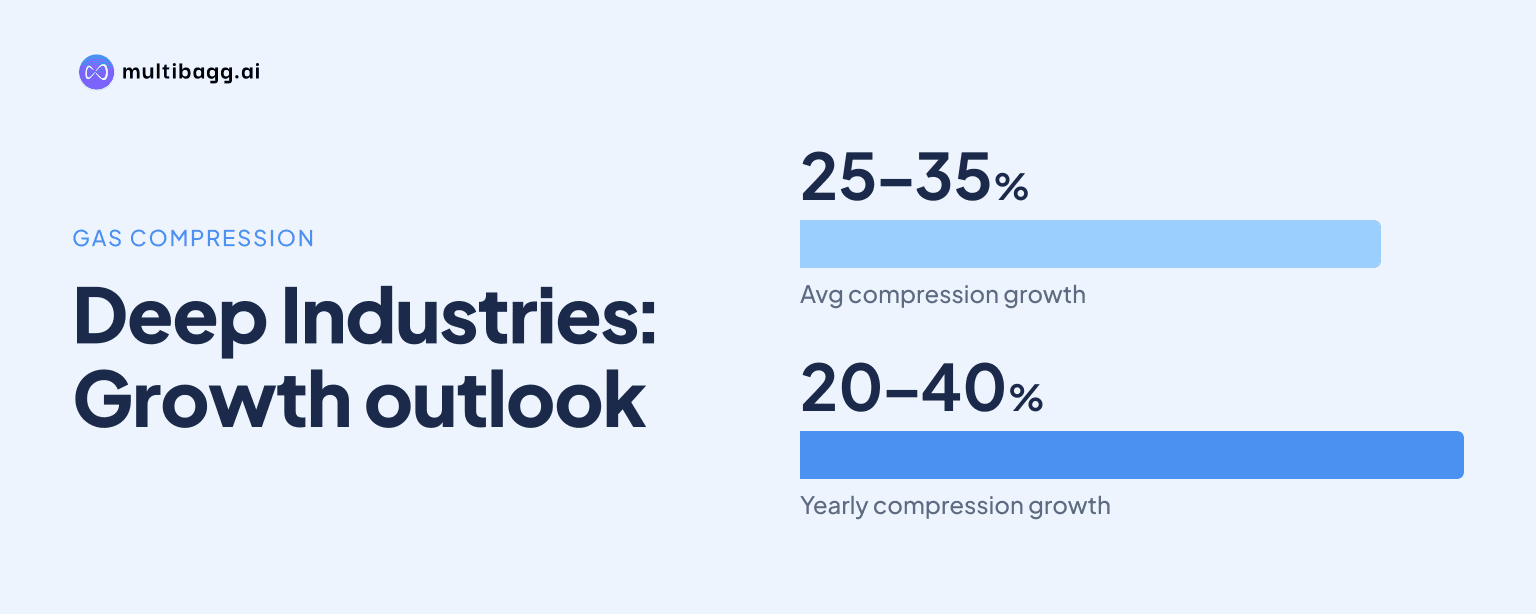
Deep Industries Limited expects its gas-compression division to grow by 25%-35% on average, management said, as customers replace equipment used for 25 to 35 years and require more compression for artificial gas lift as well pressures decline. Deep Industries said the outcome may be uneven between years rather than a steady annual increase.
Know Deep Industries inside out
Results, valuation, peers and who's buying, in one view.
What growth rate does Deep Industries expect for gas compression?
Deep Industries expects average growth of 25%-35% for its gas-compression division, with about 30% as its broad central expectation. Management said the yearly result could be lower than 30%, such as 20%, or could reach 40% in another year. The range is therefore a divisional outlook rather than a commitment to uniform annual expansion.
The company described the growth pattern as potentially chunky because customer conversion decisions can occur in concentrated periods. Management gave the example that conversion of 10% of customer facilities in one year could create an unusually large increase in compression business. It also cautioned that quarterly tracking can be distorted by maintenance costs, overlapping contracts and slippage in operating days, making a full-year assessment more relevant.
Why could Deep Industries gain from ageing customer equipment?
Deep Industries said 30% of gas compression is currently outsourced because customers still operate their own equipment, but much of that installed base has been used for 25, 30 or 35 years. Management said these facilities and technologies are becoming redundant and are being replaced gradually. This replacement cycle is the first identified route through which outsourcing could rise beyond the present 30% level.
Management said an increase in outsourcing from 30% to 40% would provide an additional source of demand beyond normal compression requirements. However, it did not set a timetable for such a shift or say how much customer-owned equipment will be converted in a particular year. The possibility of a 10% facility conversion illustrates why the division's reported growth could vary materially across periods.
How does artificial gas lift add to compression demand?
Deep Industries said artificial gas lift is the second driver of its compression business because the majority of gas compression is used for that application. As well pressures drop, management said the need for compression rises. This mechanism means demand can increase even if the share of compression outsourced by customers remains fixed at 30%.
The distinction matters because replacement-led outsourcing and artificial-gas-lift demand are separate mechanisms. In management's example, maintaining 30% outsourcing would still leave room for compression needs to rise with lower well pressures, while a move from 30% to 40% outsourcing would add another layer of demand. Management linked both drivers to planned increases in Indian gas output, while warning that the resulting revenue pattern is unlikely to be smooth.
Got a follow-up? Ask IRIS
What could limit the pace of Deep Industries' expansion?
Deep Industries' growth outlook depends on contract awards and customer conversion timing, rather than solely on its own equipment purchases. Management said the company does not procure compressors or rigs before receiving a contract, describing this as a financial-discipline policy. It said pricing for a compressor deployment is fixed from day one of the contract, so higher equipment costs cannot automatically be repriced after signing.
The company said its remaining Rs 150 crore of capital expenditure for rigs and compressors would be incurred after contract awards, with some amount already spent in the first half. This approach can limit speculative capacity additions, but it also means deployment depends on winning work first. Management separately described global conditions as uncertain despite requirements emerging from the Middle East, Africa and Venezuela, so it did not provide a quantified overseas compression forecast.
How does gas compression fit into Deep Industries' wider plans?
Deep Industries presented gas compression as a core service business while also evaluating hydrogen, biogas and compressed biogas opportunities. Management said gas compression is required to raise low-pressure gas into a high-pressure pipeline when a compressed biogas plant is established. It said it is considering engineering, procurement and construction projects as well as compression services in hydrogen, but gave no three- or four-year market-size guidance.
For its broader FY28 outlook, Deep Industries said more than 90% of expected growth was secured by the existing order book. Management also said higher-capacity drilling-rig opportunities were not included in that FY28 guidance and would be incremental if the company enters that segment. Those wider opportunities do not change the stated 25%-35% expectation for gas compression, but they show that management is treating new verticals separately from the division's established drivers.
Conclusion
Deep Industries' 25%-35% gas-compression outlook rests on two identified demand mechanisms: customers replacing equipment that is 25 to 35 years old, and increased artificial-gas-lift compression as well pressures fall. The comparison between stable 30% outsourcing and a possible move to 40% shows why management sees both baseline demand growth and an additional conversion opportunity, while expecting uneven annual results.
The next indicators are customer contract awards, the rate at which outsourced compression moves beyond 30%, and deployment of the remaining Rs 150 crore of planned rig and compressor capital expenditure. Management said it will make that expenditure after awards rather than ahead of demand, and said full-year results, rather than individual quarters affected by maintenance or contract overlap, should provide the clearer measure of progress.