










Happy Forgings Q2 revenue hits record Rs 501 crore on higher volumes
Key highlights
- Happy Forgings reported Q2 FY27 revenue of Rs 501 crore, up 32.7% year on year.
- Finished-goods volume rose 24.8% to 18,754 metric tonnes in Q2 FY27.
- Q2 FY27 PAT increased 32.8% to Rs 98 crore while PAT margin was 19.5%.
- Happy Forgings' board approved about Rs 500 crore of additional capacity capital expenditure.
powered by IRIS
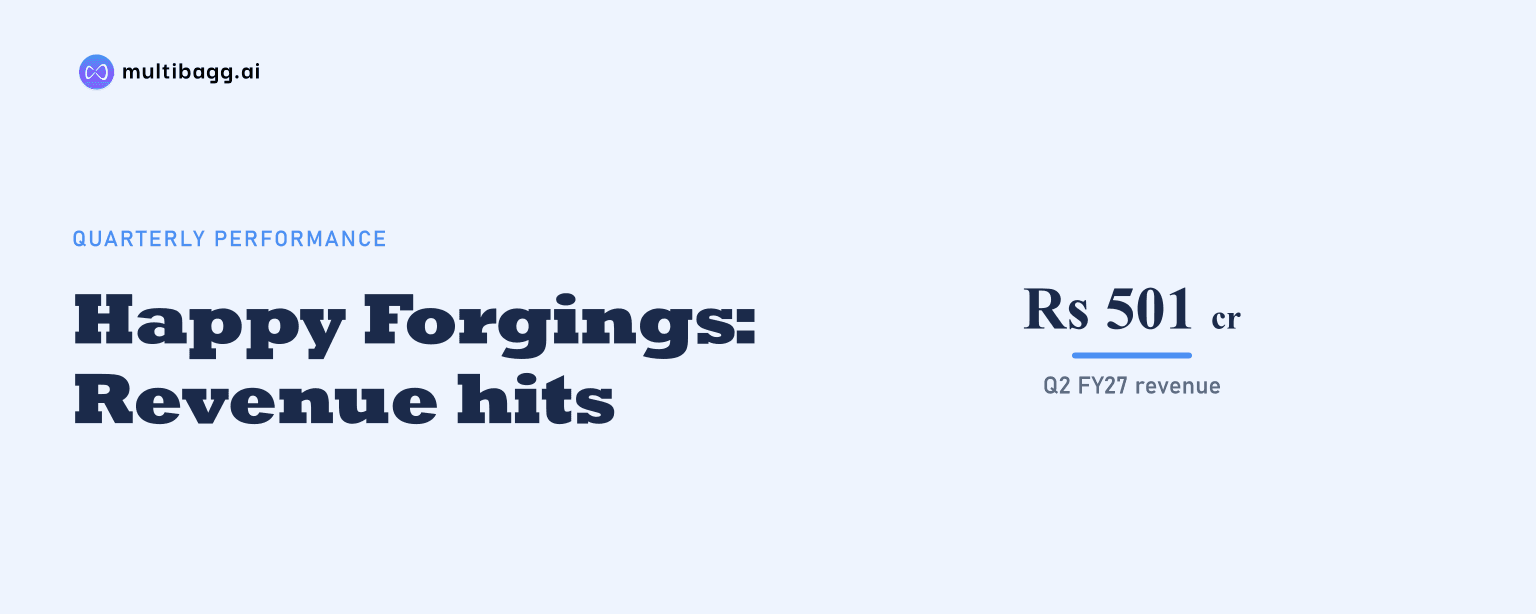
Happy Forgings Limited reported record consolidated revenue of Rs 501 crore in the quarter ended September 30, 2026, the second quarter of financial year 2027 (Q2 FY27), up 32.7% year on year, as finished-goods volume rose 24.8% to 18,754 metric tonnes and realisation increased 6.3% to Rs 267 per kg.
Know Happy Forgings inside out
Results, valuation, peers and who's buying, in one view.
How did Happy Forgings perform in Q2 FY27?
Happy Forgings delivered year-on-year growth in revenue, gross profit, earnings before interest, tax, depreciation and amortisation (EBITDA), and profit after tax (PAT) in Q2 FY27. Revenue from operations rose from Rs 377 crore in Q2 FY26 to Rs 501 crore, while gross profit increased from Rs 228 crore to Rs 305 crore.
Happy Forgings' Q2 FY27 PAT increased by Rs 25 crore to Rs 98 crore from Rs 73 crore in the prior-year quarter. Diluted earnings per share rose 32.6% to Rs 10.32 from Rs 7.78, broadly tracking the 32.8% increase in PAT.
The first half of financial year 2027 (H1 FY27) also expanded, although its revenue growth rate was lower than in Q2 alone. H1 FY27 revenue was Rs 950 crore, up 29.9% from Rs 731 crore in H1 FY26, while PAT increased 35.8% to Rs 189 crore from Rs 139 crore.
What drove Happy Forgings' Q2 revenue growth?
Happy Forgings' Q2 FY27 revenue growth came from both a 24.8% rise in finished-goods volume and a 6.3% increase in realisation per kilogram. Finished-goods volume increased by 3,726 metric tonnes to 18,754 metric tonnes from 15,028 metric tonnes in Q2 FY26, while realisation reached Rs 267 per kg from Rs 251 per kg.
Management said the higher realisation reflected raw-material-cost pass-through, conversion-cost-linked price increases, and progress in value addition and product mix. Those factors, together with higher volumes across key segments, produced the 32.7% rise in Q2 FY27 revenue to Rs 501 crore.
For H1 FY27, finished-goods volume increased 24.0% to 36,547 metric tonnes from 29,485 metric tonnes, while realisation rose 4.8% to Rs 260 per kg from Rs 248 per kg. The half-year realisation increase was lower than Q2's 6.3% increase, while the H1 volume gain was close to the quarterly 24.8% rate.
Management reported that domestic revenue rose about 30% and export revenue about 36% in H1 FY27. Happy Forgings did not disclose rupee revenue amounts for domestic and export sales, but said growth was broad-based across the two channels.
How did Happy Forgings' margins and profitability change?
Happy Forgings maintained a 30.6% EBITDA margin and a 19.5% PAT margin in Q2 FY27, while gross profit margin improved to 60.8%. Gross profit margin was 52 basis points higher than the 60.3% reported in Q2 FY26, with one basis point equal to one-hundredth of a percentage point.
EBITDA margin was 30.6% in Q2 FY27 against 30.7% a year earlier, a decline of 11 basis points, while PAT margin was unchanged at 19.5%, with the company reporting a 1-basis-point movement. EBITDA increased by Rs 37 crore and PAT by Rs 25 crore as revenue rose by Rs 124 crore.
The half-year comparison showed wider margin expansion than the quarterly comparison. H1 FY27 gross profit margin increased 161 basis points to 60.8%, EBITDA margin increased 127 basis points to 30.9%, and PAT margin increased 86 basis points to 19.9%.
Management said higher raw-material prices and near-term shipment-cost increases associated with the geopolitical situation could temporarily pressure margins. It nevertheless expects full-year profitability to remain supported by a better product mix and higher value addition, which is management's outlook rather than a reported result.
Got a follow-up? Ask IRIS
What changed in Happy Forgings' product and sector mix?
Happy Forgings increased the contribution of machined products to 90% of H1 FY27 revenue from 88% in H1 FY26. This 2-percentage-point shift occurred alongside H1 FY27 revenue growth of 29.9% to Rs 950 crore.
Within end markets, Industrials increased to 16% of H1 FY27 revenue from 13%, Off-Highway Vehicles rose to 12% from 10%, and Passenger Vehicles reached 9% from 5%. Management said Passenger Vehicle share increased as previously secured business ramped up, while it identified higher contributions from Industrials and Off-Highway Vehicles as leading non-automotive growth.
Commercial Vehicles remained the largest disclosed sector share at 33% in H1 FY27, but declined from 37% in H1 FY26. Farm Equipment fell to 31% from 34%, meaning gains in the other three disclosed categories changed the sales mix even as management said Farm Equipment and Commercial Vehicle segments registered growth.
The geographic mix was comparatively stable: domestic sales represented 72% of H1 FY27 revenue, deemed and indirect exports 12%, and direct exports 16%. In H1 FY26, the respective shares were 73%, 11% and 16%, with Happy Forgings noting that rounded percentages may not total 100%.
What is Happy Forgings planning after the Q2 FY27 result?
Happy Forgings said its ultra-heavy-component manufacturing facility and captive solar-power project are on track for completion and contribution from FY28. Management also said it is engaging several original equipment manufacturers (OEMs) on heavy components for data-centre and gas-engine applications, with discussions expected to translate into orders by early FY28.
The board has approved about Rs 500 crore of additional capital expenditure to expand machining and supplement forging capacity, according to management. The stated rationale is capacity utilisation nearing peak and demand visibility from the order book, with the investment intended to support Passenger Vehicles, Industrials and Commercial Vehicle exports.
Balance-sheet measures changed between March 31, 2026 and September 30, 2026 as gross debt excluding lease liabilities rose to Rs 529 crore from Rs 330 crore. Liquidity declined to Rs 347 crore from Rs 431 crore, and net debt moved to Rs 182 crore from net cash of Rs 101 crore, while debt-to-equity remained 0.2 times.
Conclusion
Happy Forgings combined higher unit sales and higher per-kilogram realisation to take Q2 FY27 revenue to Rs 501 crore, while PAT rose to Rs 98 crore and the PAT margin remained 19.5% year on year. The H1 figures also show a changing mix, including a 90% machined-products contribution and higher revenue shares from Industrials, Off-Highway Vehicles and Passenger Vehicles.
The next disclosed milestones are completion of the ultra-heavy-components facility and captive solar project in FY28, potential heavy-component orders by early FY28, and deployment of about Rs 500 crore in additional capacity capital expenditure. Management's outlook for the remainder of FY27 depends on production and sales-volume growth, while raw-material and shipment costs remain identified near-term margin variables.