










Happy Forgings approves Rs 500 crore FY28-FY29 capacity build
Key highlights
- Happy Forgings approved approximately Rs 500 crore of capex on November 5, 2026.
- The plan adds about 24,000 MT of annual forging capacity and 14,000 MT of machining capacity.
- H1 FY27 capacity utilisation was 60% for forging and 77% for machining.
- Standalone H1 FY27 revenue from operations rose to Rs 950.1719 crore from Rs 731.1889 crore.
powered by IRIS
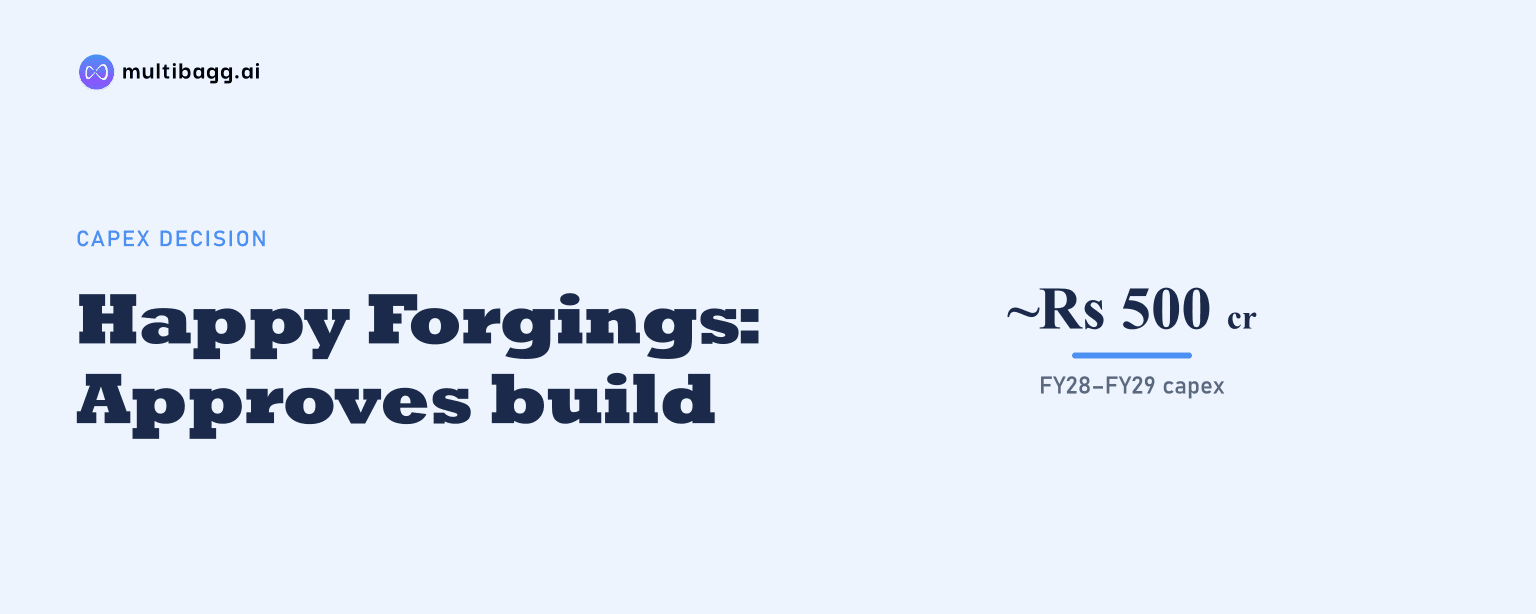
Happy Forgings Limited approved approximately Rs 500 crore of capital expenditure on November 5, 2026, to add about 24,000 metric tonnes (MT) a year of forging capacity and 14,000 MT of machining capacity. Happy Forgings expects the additions to be implemented in phases during FY28 and FY29, after reporting H1 FY27 utilisation of 60% in forging and 77% in machining.
Know Happy Forgings inside out
Results, valuation, peers and who's buying, in one view.
What capacity is Happy Forgings adding?
Happy Forgings is adding approximately 24,000 MT per annum of forging capacity and 14,000 MT per annum of machining capacity. As of September 30, 2026, its installed and operational capacity was 158,000 MT per annum for forging and 82,000 MT per annum for machining, according to the board-approved disclosure.
On an arithmetic basis, the additions would take annual forging capacity to about 182,000 MT and machining capacity to about 96,000 MT once fully implemented. The forging addition is about 15% of the September 30, 2026 base of 158,000 MT, while the machining addition is about 17% of the 82,000 MT base.
Happy Forgings identifies its business as manufacturing auto components and engineering parts. Management reviews that activity as a single operating segment under Indian Accounting Standard 108, meaning the September-quarter filing does not provide separate financial results for forging and machining.
Why is Happy Forgings expanding with 60% forging utilisation?
Happy Forgings said the Rs 500 crore programme is intended to support anticipated growth in business volumes, citing its order book and demand visibility across existing and target end markets. The company reported overall capacity utilisation of 60% for forging and 77% for machining in H1 FY27, covering April through September 2026.
Management gave different operational reasons for the two additions. It said the additional machining capacity would address increasing capacity requirements in the near term, whereas the forging addition would provide a capacity buffer for future demand. The filing does not disclose order-book value, customer names, product mix, delivery dates or the expected split of demand between the two processes.
The disclosed utilisation rate leaves more unused installed capacity in forging than in machining. Applying the reported rates to annual capacity for illustration, 60% of 158,000 MT equals 94,800 MT, while 77% of 82,000 MT equals 63,140 MT; these are calculations from capacity and utilisation data, not reported production volumes for the six-month period.
When will Happy Forgings install the new capacity?
Happy Forgings expects the forging and machining additions to be implemented in phases during FY28 and FY29. The November 5, 2026 announcement does not state separate commissioning dates, annual capacity additions, equipment schedules or expenditure milestones for either the 24,000 MT forging project or the 14,000 MT machining project.
The timetable follows a rise in the asset base during the half year ended September 30, 2026. Standalone property, plant and equipment stood at Rs 1,240.2538 crore at September 30, 2026, compared with Rs 1,096.8711 crore at March 31, 2026, while capital work-in-progress rose to Rs 369.8394 crore from Rs 229.3099 crore.
Standalone cash payments for acquisition of property, plant and equipment, including capital work-in-progress, capital creditors and capital advances, were Rs 374.3169 crore in H1 FY27. That was higher than Rs 205.2686 crore in H1 FY26, but the filing does not allocate either period's spending between the newly approved programme and other capital projects.
Got a follow-up? Ask IRIS
How will Happy Forgings fund the Rs 500 crore project?
Happy Forgings said it will fund the approximately Rs 500 crore expansion through a combination of internal accruals and debt. The disclosure does not specify the share to be financed from each source, prospective lenders, borrowing terms, interest rates, security or the timing of future fund raising.
Standalone net cash flow from operating activities was Rs 124.4637 crore in H1 FY27, compared with Rs 217.4515 crore in H1 FY26. The cash-flow statement recorded an Rs 88.7924 crore increase in trade receivables in H1 FY27, against an Rs 51.2331 crore decrease a year earlier, while net cash used in investing activities increased to Rs 290.6777 crore from Rs 150.1399 crore.
Borrowings were higher at September 30, 2026 than at March 31, 2026. Standalone current borrowings were Rs 428.9798 crore, up from Rs 329.6225 crore, and non-current borrowings were Rs 99.7198 crore compared with no reported non-current borrowings at March 31, 2026. During H1 FY27, Happy Forgings reported Rs 125.5949 crore of long-term borrowing availment and Rs 73.4822 crore of net short-term borrowing availment.
What do Happy Forgings' latest results show?
Happy Forgings reported standalone revenue from operations of Rs 500.7496 crore for the quarter ended September 30, 2026, compared with Rs 377.3855 crore in the quarter ended September 30, 2025. Revenue was also above Rs 449.4223 crore in the preceding quarter ended June 30, 2026.
Standalone profit before tax was Rs 130.6106 crore in the September 2026 quarter, against Rs 98.6062 crore a year earlier, while profit for the period was Rs 97.5106 crore compared with Rs 73.4383 crore. The company reported basic earnings per share of Rs 10.33 for the September 2026 quarter, versus Rs 7.79 in the comparable quarter of FY26.
For H1 FY27, standalone revenue from operations was Rs 950.1719 crore, up from Rs 731.1889 crore in H1 FY26, and profit for the period rose to Rs 188.974 crore from Rs 139.1285 crore. Finance costs increased to Rs 6.033 crore from Rs 4.1955 crore over the same periods, alongside the higher borrowing balances reported at September 30, 2026.
Happy Forgings also declared and paid a final dividend of Rs 4 per share for FY26 during the September 2026 quarter. The dividend aggregated to Rs 37.7515 crore before the stated net-of-tax amount of Rs 34.5212 crore, following shareholder approval at the annual general meeting on July 27, 2026.
Conclusion
Happy Forgings is committing approximately Rs 500 crore to add 38,000 MT of combined annual forging and machining capacity. The plan follows H1 FY27 utilisation of 60% in forging and 77% in machining, with management saying machining capacity is required in the near term and additional forging capacity is intended as a buffer for anticipated future demand.
The disclosed next milestone is phased execution during FY28 and FY29, with funding to come from internal accruals and debt. Progress on the commissioning timetable, the eventual funding mix and whether management provides further order-book or demand details will determine how the planned 24,000 MT forging and 14,000 MT machining additions are translated into operating capacity.