










Happy Forgings plans Rs 1,150 crore expansion from FY28
Key highlights
- Happy Forgings plans Rs 1,150 crore of capacity investment across FY28 and FY29.
- The Rs 650 crore ultra-heavy components project is scheduled to commence operations in FY28.
- Happy Forgings had 158,000 MT of forging capacity and 82,000 MT of machining capacity in H1FY27.
- H1FY27 revenue rose 29.9% year on year to Rs 950 crore.
powered by IRIS
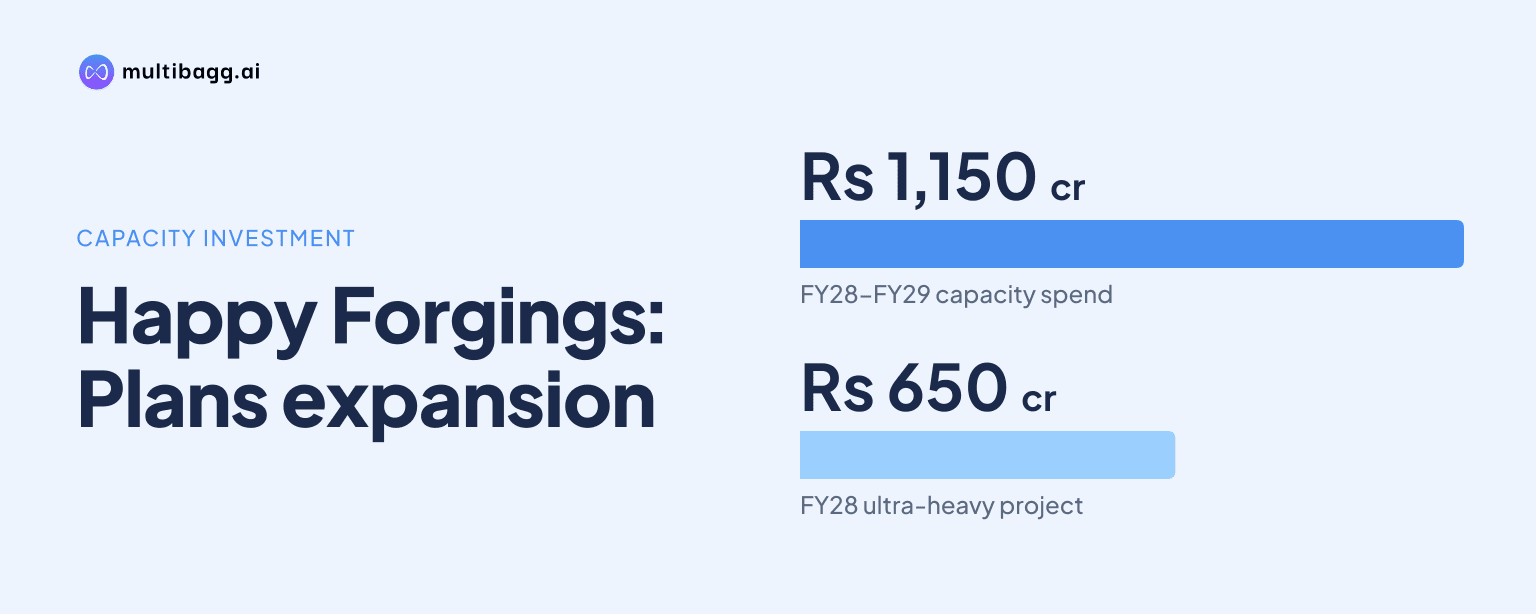
Happy Forgings Limited plans Rs 1,150 crore of capacity projects from FY28, led by a Rs 650 crore ultra-heavy forging facility for 300-3,000 kg components and a Rs 500 crore phased expansion. The ultra-heavy operation is scheduled for FY28, while the second project will be added across FY28 and FY29.
Know Happy Forgings inside out
Results, valuation, peers and who's buying, in one view.
What is Happy Forgings building under the Rs 1,150 crore plan?
Happy Forgings is pursuing two capacity projects: a Rs 650 crore heavy-components programme and a Rs 500 crore additional expansion. Management says the heavy-components project will provide advanced forging capability, including one of the world’s largest forging hammers, to make large and complex forged components weighing 300 kg to 3,000 kg. Operations are scheduled to commence in FY28.
Happy Forgings says the separate Rs 500 crore project will add forging and machining capacity for anticipated growth across existing and target end markets. This expansion is planned in phases during FY28 and FY29 rather than on one disclosed commissioning date. Passenger cars, industrials and commercial-vehicle exports are the named target segments, unlike the ultra-heavy project’s focus on larger industrial components.
The planned equipment includes an 8,000-tonne vertical upsetter for near-net forging and a 125-tonne hammer. Happy Forgings’ operational forging equipment already includes one 14,000-tonne press, one 10,000-tonne press, three 8,000-tonne presses, one 6,300-tonne press and 10 hammers in the 1.5-tonne to 5.0-tonne range. One additional press was commissioned in Q1FY27 and one hammer in Q2FY27.
How much capacity does Happy Forgings have and plan to add?
Happy Forgings had annual operational forging capacity of 158,000 metric tonnes (MT) and machining capacity of 82,000 MT in H1FY27. The presentation lists planned additions of 59,000 MT for forging and 34,000 MT for machining. Ultra-heavy-component additions are expected to be operational by FY28, while other additions are due in phases in FY28 and FY29.
The existing capacity is split between Kanganwal and Dugri in Ludhiana. Kanganwal has 67,000 MT of forging capacity and 29,500 MT of machining capacity, while Dugri has 91,000 MT and 52,500 MT, respectively. The planned new capacity is identified with the Dugri facility, where the company also has unutilised land shown in its plant layout.
Forging utilisation was 60% in H1FY27, while machining utilisation was 77%, based on average available capacity for the period. The 17-percentage-point difference means machining operated at a higher rate than forging during the half year. Happy Forgings says its current machining infrastructure can process crankshaft and non-crankshaft components to tolerances as low as 5 microns, with additional machining intended to support volume growth and heavy and near-net forging lines.
Got a follow-up? Ask IRIS
Which markets will Happy Forgings target with new capacity?
Happy Forgings says the Rs 650 crore heavy-components project will serve power generation, including backup power for data centres, marine, mining, high-horsepower farm equipment, wind energy and oil and gas. The Rs 500 crore expansion is intended mainly for passenger cars, industrials and commercial-vehicle exports. The projects therefore address both a larger component-weight range and the company’s existing automotive and industrial end markets.
The H1FY27 sector mix changed from H1FY26 in several of the named markets. Passenger vehicles represented 9% of the mix, up from 5%, while industrials rose to 16% from 13% and off-highway increased to 12% from 10%. Commercial vehicles remained the largest sector at 33%, but its share declined from 37%, while farm equipment fell to 31% from 34%.
Forged and machined products accounted for 90% of Happy Forgings’ H1FY27 product mix, compared with 88% in H1FY26, while forged-only products fell to 10% from 12%. Direct exports were unchanged at 16%, deemed and indirect exports rose to 12% from 11%, and domestic revenue declined to 72% from 73%. The presentation notes that these percentages are rounded and may not total 100%.
How will Happy Forgings finance the capacity projects?
Happy Forgings says the Rs 650 crore ultra-heavy forging project will be financed primarily through internal accruals. The Rs 500 crore additional expansion will be financed through debt and internal accruals. Management does not disclose the debt and internal-accrual proportions for the phased Rs 500 crore programme.
Borrowings and lease liabilities were Rs 543 crore at September 30, 2026, compared with Rs 330 crore at March 31, 2026. Net worth increased to Rs 2,285 crore from Rs 2,128 crore, and capital employed rose to Rs 2,829 crore from Rs 2,458 crore. Gross fixed and intangible assets, including capital work in progress, increased by Rs 349 crore to Rs 2,074 crore.
Happy Forgings reported Rs 124 crore of net cash from operating activities in H1FY27, after Rs 57 crore of net direct taxes paid. Net investing activities used Rs 291 crore, while net financing activities generated Rs 156 crore. Working-capital and other current-asset movements included a Rs 35 crore outflow for advances to raw-material suppliers, and debt to equity was 0.2 at H1FY27, unchanged from FY26.
What operating growth accompanied Happy Forgings’ expansion plan?
Happy Forgings reported H1FY27 revenue of Rs 950 crore, up 29.9% year on year, with finished-goods volume rising 24.0% to 36,547 MT. Realisation per kilogram increased 4.8% to Rs 260, compared with Rs 248 in H1FY26. The capacity plan is disclosed alongside this increase in volume and per-kilogram realisation.
Gross profit rose 33.5% to Rs 577 crore in H1FY27, while earnings before interest, tax, depreciation and amortisation, or EBITDA, increased 35.5% to Rs 294 crore. EBITDA margin rose by 127 basis points to 30.9% from 29.7%; one basis point equals one-hundredth of a percentage point. Profit after tax increased 35.8% to Rs 189 crore and its margin increased by 86 basis points to 19.9%.
In Q2FY27, revenue was Rs 501 crore, up 32.7% from Q2FY26, as finished-goods volume rose 24.8% to 18,754 MT. Gross profit was Rs 305 crore and EBITDA was Rs 153 crore, up 33.8% and 32.2%, respectively, from the year-earlier quarter. Q2FY27 EBITDA margin was 30.6%, 11 basis points below Q2FY26.
Conclusion
Happy Forgings’ Rs 1,150 crore programme combines entry into 300-3,000 kg ultra-heavy components with further forging and machining additions for passenger vehicles, industrials and commercial-vehicle exports. The projects follow H1FY27 volume growth of 24.0%, revenue growth of 29.9%, and higher sector-mix shares for passenger vehicles and industrials than in H1FY26.
The next disclosed milestones are the start of ultra-heavy forging operations in FY28 and phased additions under the separate Rs 500 crore programme in FY28 and FY29. Management’s presentation leaves the funding split for the Rs 500 crore project unresolved, while forging and machining utilisation stood at 60% and 77%, respectively, in H1FY27.