










Happy Forgings Q2 revenue tops Rs 500 crore on volume growth
Key highlights
- Happy Forgings reported Rs 501 crore of Q2FY27 revenue, up 32.7% year on year.
- Finished-goods volume rose 24.8% to 18,754 metric tonnes in Q2FY27.
- Q2FY27 realisation increased 6.3% to Rs 267 per kilogram.
- H1FY27 EBITDA rose 35.5% to Rs 294 crore and margin increased 127 basis points to 30.9%.
powered by IRIS
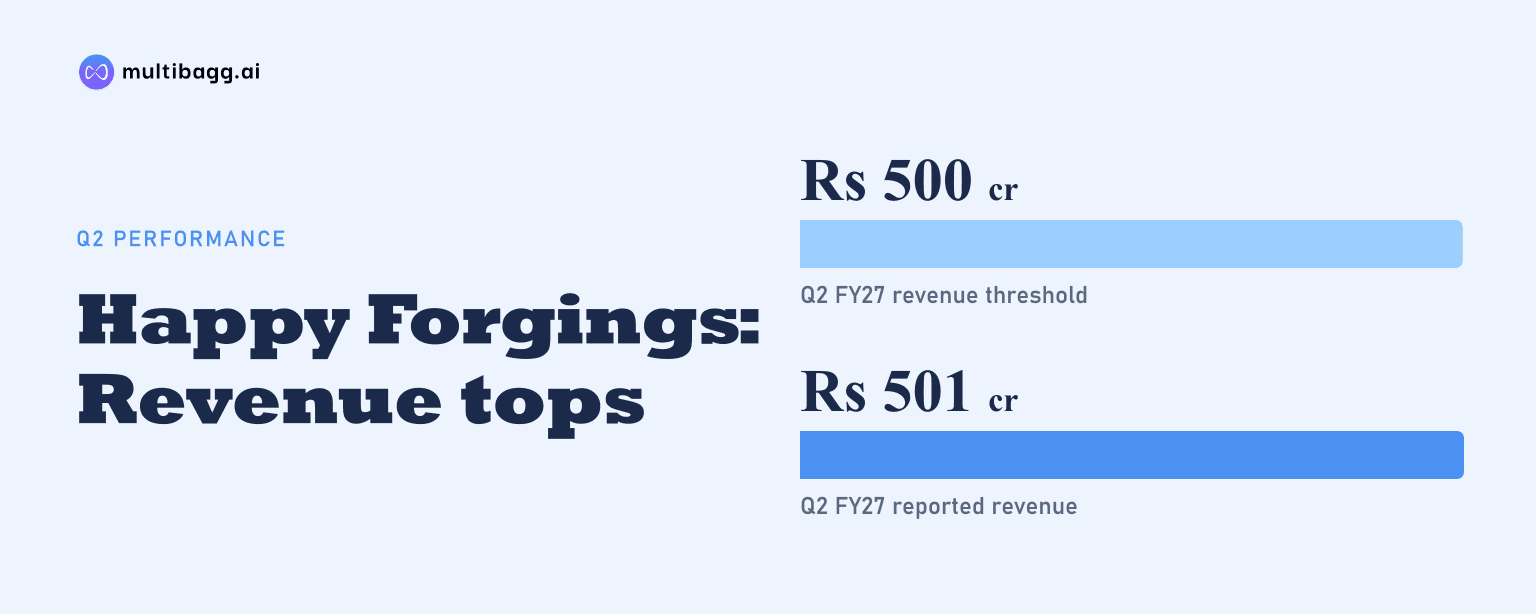
Happy Forgings Limited crossed Rs 500 crore of quarterly revenue for the first time in Q2FY27, reporting Rs 501 crore, up 32.7% year on year, as finished-goods volume rose 24.8% to 18,754 metric tonnes and realisation increased 6.3% to Rs 267 per kilogram.
Know Happy Forgings inside out
Results, valuation, peers and who's buying, in one view.
How did Happy Forgings cross Rs 500 crore in Q2FY27?
Happy Forgings reached Rs 501 crore in revenue from operations in Q2FY27, compared with Rs 377 crore in Q2FY26 and Rs 449 crore in Q1FY27. The year-on-year increase was 32.7%, while sequential growth was 11.4%, taking quarterly sales above the Rs 500 crore mark for the first time, according to Managing Director Ashish Garg.
The immediate driver was finished-goods volume, which increased to 18,754 metric tonnes from 15,028 metric tonnes a year earlier. That 24.8% rise accounted for most of the sales expansion, while realised revenue per kilogram moved to Rs 267 from Rs 251. Management attributed the higher realisation to raw-material cost pass-through, conversion-cost-linked price increases, greater value addition and product-mix progress.
The first-half result followed the same pattern. H1FY27 revenue was Rs 950 crore, up 29.9% from Rs 731 crore in H1FY26, while finished-goods volume increased 24.0% to 36,547 metric tonnes. Realisation for the six months rose 4.8% to Rs 260 per kilogram from Rs 248, meaning both higher output and price or mix contributed to sales growth.
Did Happy Forgings improve profit per kilogram?
Happy Forgings improved gross profit per kilogram to Rs 162 in Q2FY27 from Rs 151 in Q2FY26, a 7.2% increase that exceeded the 6.3% increase in realisation. Earnings before interest, tax, depreciation and amortisation, or EBITDA, per kilogram rose 6.0% to Rs 82 from Rs 77 over the same period.
Gross profit increased 33.8% to Rs 305 crore in Q2FY27, slightly faster than revenue, and gross margin rose to 60.8% from 60.3%. That was an improvement of 52 basis points, with one basis point equal to one-hundredth of a percentage point. The presentation links per-unit profitability to product mix and higher value addition, while management also cited raw-material and conversion-cost pricing mechanisms.
EBITDA rose 32.2% to Rs 153 crore from Rs 116 crore, although its margin was 30.6%, compared with 30.7% a year earlier. Profit after tax, or PAT, grew 32.8% to Rs 98 crore from Rs 73 crore, and the PAT margin remained 19.5% in both quarters. In other words, absolute quarterly profitability rose broadly in line with revenue, but the EBITDA margin was 11 basis points lower year on year.
For H1FY27, the margin movement was more favourable than in the single quarter. Gross profit rose 33.5% to Rs 577 crore and EBITDA increased 35.5% to Rs 294 crore, compared with revenue growth of 29.9%. The six-month gross margin was 60.8%, up 161 basis points, EBITDA margin was 30.9%, up 127 basis points, and PAT margin was 19.9%, up 86 basis points from H1FY26.
Got a follow-up? Ask IRIS
Which Happy Forgings businesses changed their revenue mix?
Happy Forgings increased the share of forged-and-machined products to 90% in H1FY27 from 88% in H1FY26, while the forged-only share declined to 10% from 12%. This is the mix change most directly aligned with management’s reference to greater value addition, because machining accounted for nine-tenths of the reported product mix in the first half.
The sector mix also shifted across several end markets. Passenger Vehicles rose to 9% of H1FY27 revenue from 5% in H1FY26 as previously secured business ramped up, while Industrials increased to 16% from 13% and Off-Highway to 12% from 10%. Commercial Vehicles declined as a share to 33% from 37%, and Farm Equipment was 31% compared with 34%, despite management saying those businesses registered growth in absolute terms.
Geographically, domestic revenue represented 72% of H1FY27, down from 73% a year earlier. Direct exports held at 16%, while deemed plus indirect exports rose to 12% from 11%. Management said domestic revenue increased about 30% and export revenue about 36%, so the mix indicates exports grew faster than domestic sales even though domestic business remained the largest channel.
What capacity and investment plans does Happy Forgings disclose?
Happy Forgings reported operational forging capacity of 158,000 metric tonnes and machining capacity of 82,000 metric tonnes at H1FY27. Forging utilisation was 60%, while machining utilisation was 77%, based on average available capacity for the period. The higher machining utilisation is relevant because forged-and-machined products accounted for 90% of H1FY27 mix.
The company lists planned forging additions of 59,000 metric tonnes and planned machining additions of 34,000 metric tonnes. These include an 8,000-tonne vertical upsetter for near-net forging and a 125-tonne hammer. The presentation says ultra-heavy component additions are to be operational by FY28, while other additions will be phased through FY28 and FY29.
Management said the board approved about Rs 500 crore of additional capital expenditure for machining and supplementary forging capacity, financed through debt and internal accruals. It also disclosed a Rs 650 crore heavy-components project, primarily funded through internal accruals, expected to commence operations in FY28. That project is intended to make components weighing 300 to 3,000 kilograms for sectors including power generation, marine, mining, high-horsepower farm equipment, wind energy and oil and gas.
Conclusion
Happy Forgings combined a 24.8% increase in Q2FY27 finished-goods volume with a 6.3% rise in realisation, producing Rs 501 crore of revenue and Rs 98 crore of PAT. The comparison with Q2FY26 shows profit per kilogram and gross margin increased, while the H1FY27 figures show broader margin expansion alongside a larger forged-and-machined product share and faster export growth than domestic revenue.
The next disclosed milestones are the FY28 start of the ultra-heavy components facility and captive solar project, alongside phased FY28 and FY29 capacity additions. Management also said it is discussing heavy-component opportunities for data-centre and gas-engine applications with original equipment manufacturers, with orders expected by early FY28, while citing raw-material prices and shipment costs as potential near-term margin pressures.