










HCG East outgrew West as Gujarat reset slowed regional growth
Key highlights
- HCG East revenue rose 23% year on year to Rs 92.8 crore in Q2 FY27.
- HCG West revenue rose 10% year on year to Rs 314.7 crore in Q2 FY27.
- HCG East inpatient volumes increased 18% to 13,038 in Q2 FY27.
- HCG added 146 operational beds in H1 FY27, including seven in Kolkata and five in Nagpur.
powered by IRIS
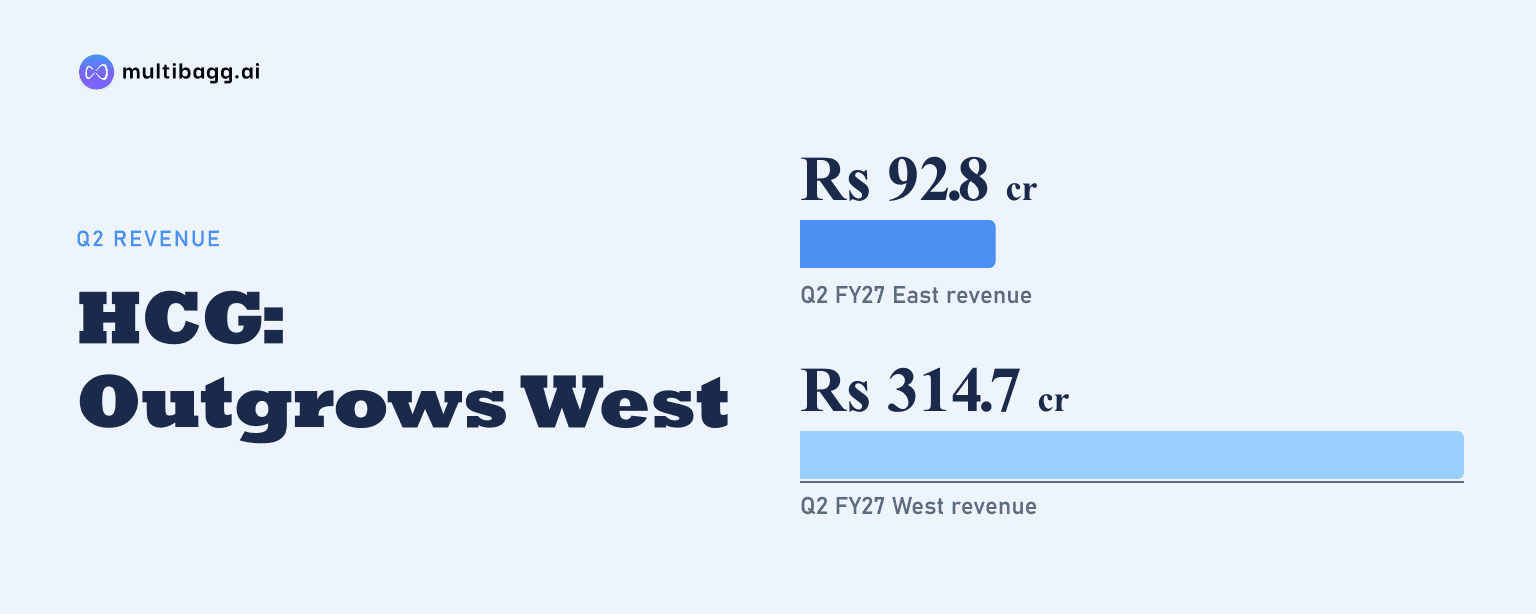
HCG’s East region grew revenue 23% year on year to Rs 92.8 crore in Q2 FY27, outpacing the West region’s 10% increase to Rs 314.7 crore, as 18% East inpatient-volume growth and Ranchi performance contrasted with Gujarat institutional-mix rationalisation and lower high-value, lower-margin therapies in West.
Know Healthcare Global Enterprises inside out
Results, valuation, peers and who's buying, in one view.
How did HCG’s East and West revenue growth compare in Q2 FY27?
HCG’s East region grew 13 percentage points faster than West in Q2 FY27, recording 23% revenue growth against West’s 10%. East revenue increased from Rs 75.3 crore in Q2 FY26 to Rs 92.8 crore, while West revenue rose from Rs 287.1 crore to Rs 314.7 crore. West nevertheless remained more than three times the size of East by quarterly revenue.
The difference persisted over the first half of FY27. East revenue increased 23% from Rs 140.9 crore in H1 FY26 to Rs 172.7 crore in H1 FY27, while West revenue grew 9% from Rs 562.3 crore to Rs 615.7 crore. West accounted for 44% of HCG revenue in H1 FY27, compared with 12% for East, showing that the faster-growing cluster remained the smaller contributor.
HCG’s overall Q2 FY27 revenue was Rs 731.8 crore, up about 16% year on year. West contributed 43% of quarterly revenue and East contributed 13%, according to HCG’s Q2 highlights. The regional growth gap therefore occurred within a company-wide increase in inpatient volumes of 9% to 82,405.
Why did HCG’s East region grow faster than West?
HCG said East’s 23% Q2 FY27 growth was broad-based and led by strong performance at Ranchi. East inpatient volumes rose 18% year on year, from 11,066 to 13,038, while average revenue per patient, or ARPP, increased 5% from Rs 68,022 to Rs 71,209. The combination of higher patient throughput and higher ARPP matched the region’s revenue increase.
Ranchi’s ARPP improvement was offset partly by case-mix changes at other East units. East ARPP growth therefore measured 5% in Q2 FY27, but slowed to 1% in H1 FY27, when ARPP was Rs 68,187 versus Rs 67,527 in H1 FY26. HCG did not identify a region-wide pricing action as the cause of the East increase.
West’s growth was led by the Maharashtra cluster but partly offset by subdued performance in Gujarat. HCG attributed the Gujarat outcome primarily to rationalisation of the institutional mix. West still recorded 7% inpatient-volume growth to 33,144 in Q2 FY27, indicating that the reported moderation involved business mix as well as patient volumes.
HCG also said West ARPP growth was moderated by a reduction in high-value, lower-margin therapies. ARPP rose 3% from Rs 92,452 in Q2 FY26 to Rs 94,938 in Q2 FY27, below East’s 5% increase and South’s 14% rise. This identifies a different growth composition in West rather than an across-the-board fall in activity.
What do HCG’s volume and ARPP figures show by region?
HCG’s East growth in Q2 FY27 was more volume-led than West’s, with East volumes rising 18% and West volumes rising 7%. East added 1,972 inpatient patients year on year, compared with West’s addition of 2,086 patients, but the percentage increase was higher because East began from a lower base of 11,066 patients.
West retained the higher ARPP, at Rs 94,938 in Q2 FY27 compared with Rs 71,209 in East. East’s ARPP rose by Rs 3,187 over the year, while West’s increased by Rs 2,486. HCG linked East’s movement to Ranchi and case-mix changes elsewhere, while it linked West’s moderation to institutional-mix rationalisation and fewer high-value, lower-margin therapies.
The H1 FY27 figures show volume remained the principal regional growth driver in both clusters. East volumes grew 21% to 25,334 while ARPP increased 1%, producing 23% revenue growth. West volumes rose 8% to 64,933 while ARPP also increased 1%, producing 9% revenue growth, compared with the higher quarterly ARPP increase of 3% in Q2 FY27.
Got a follow-up? Ask IRIS
How large are HCG’s East and West operating networks?
HCG’s West network had 11 centres, more than 1,190 operating beds and 16 linear accelerators, or LINACs, in Q2 FY27. East had three centres, more than 350 operating beds and five LINACs. West represented 41% of HCG’s operating-bed share in H1 FY27, while East represented 12%; operating beds include census and non-census beds.
The regional scale difference aligns with revenue contribution. West generated Rs 615.7 crore in H1 FY27, versus Rs 172.7 crore from East, and served 64,933 inpatients compared with 25,334 in East. East’s 21% H1 volume growth was faster than West’s 8%, but the source does not provide unit-level revenue or profitability for Ranchi, Kolkata, Cuttack or West’s individual centres.
HCG added 25 operational beds in Q2 FY27, including seven beds in Kolkata and five beds in Nagpur, taking total additions to 146 beds in H1 FY27. Kolkata is part of the East cluster and Nagpur is part of West, giving both regions incremental capacity during the half. HCG reported H1 FY27 capital expenditure of Rs 127.9 crore, primarily for North Bengaluru, advanced medical equipment and selected facility upgrades.
What should be monitored in HCG’s next regional disclosure?
HCG’s next regional disclosure can clarify whether the Gujarat institutional-mix rationalisation continues to affect West ARPP and revenue growth. West ARPP rose only 1% in H1 FY27 to Rs 94,823, despite the 3% increase reported in Q2 FY27. Any change in the mix of institutional business or high-value therapies would be relevant to comparing the next quarter with the current 10% West revenue growth.
East’s subsequent disclosure can show whether Ranchi-led momentum and the 18% Q2 FY27 volume increase are sustained as Kolkata’s seven new beds contribute. East generated 23% revenue growth in both Q2 and H1 FY27, but H1 ARPP growth was 1%, compared with 5% in Q2. That difference makes future volume and case-mix data central to understanding the region’s revenue progression.
Conclusion
HCG’s regional disclosures show two different growth profiles in Q2 FY27: East expanded 23% to Rs 92.8 crore on 18% volume growth, while the larger West cluster grew 10% to Rs 314.7 crore as Maharashtra performance was partly offset by Gujarat institutional-mix rationalisation. West retained materially higher ARPP and a larger network, while East delivered the faster rate of patient and revenue growth.
The next update should show the effect of 146 H1 FY27 bed additions, including seven in Kolkata and five in Nagpur, and whether HCG’s North Bangalore facility continues its ramp-up. HCG reported a Rs 6.1 crore North Bangalore loss excluded from adjusted EBITDA in Q2 FY27, making the facility’s progression and the regional revenue mix disclosed in future periods relevant items to watch.