










HCG gross mortality rate fell to 0.9% as discharges rose
Key highlights
- HCG reported gross mortality rate declined from 3.4% in 2016 to 0.9% in 2025.
- HCG said patient discharges increased 4x between 2016 and 2025.
- HCG reported more than 36,000 tumour-board cases and more than 250 participating oncologists.
- HCG reported 26 hospitals, more than 3,000 capacity beds and 40 linear accelerators.
powered by IRIS
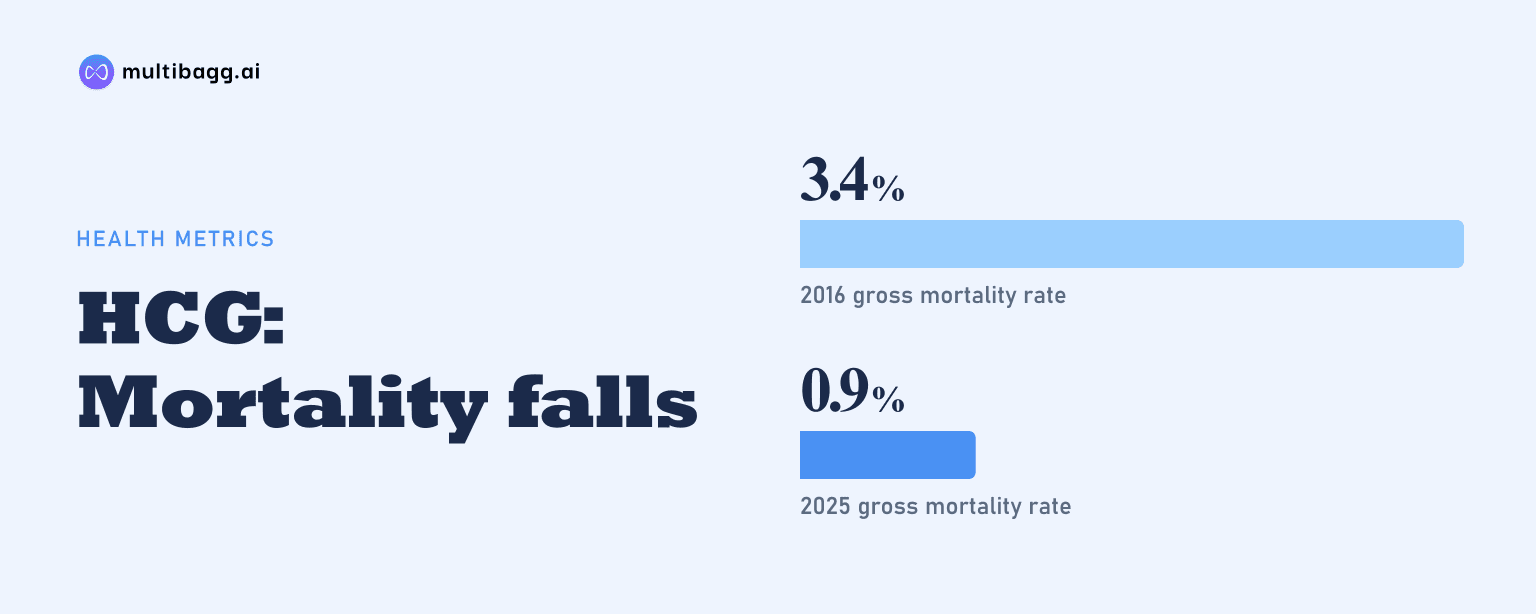
HCG reported a gross mortality rate of 0.9% in 2025, compared with 3.4% in 2016, while patient discharges increased fourfold over the same period. HCG calculates the measure as deaths divided by discharges and attributes its clinical model to multidisciplinary treatment decisions, recurrence-focused care and targeted follow-up.
Know Healthcare Global Enterprises inside out
Results, valuation, peers and who's buying, in one view.
How did HCG's gross mortality rate change from 2016 to 2025?
HCG's reported gross mortality rate fell by 2.5 percentage points, from 3.4% in 2016 to 0.9% in 2025. HCG defines gross mortality rate as the number of deaths divided by the number of discharges, so it is an aggregate discharge-based measure rather than a disclosed patient-level survival measure.
The largest movement in the displayed series was the 1.4-percentage-point decline from 3.2% in 2017 to 1.8% in 2018. The rate then reached 1.4% in 2019, remained at 1.2% in 2021 and 2022, held at 1.0% in 2023 and 2024, and declined to 0.9% in 2025. HCG describes the 2016-2025 change as a 74% reduction.
What does HCG's fourfold discharge growth show?
HCG says patient discharges increased 4x between 2016 and 2025 while its gross mortality rate declined from 3.4% to 0.9%. Since discharges are the denominator in HCG's disclosed measure, the presentation shows a lower death-to-discharge ratio during a period of substantially higher reported discharge activity.
HCG does not disclose absolute deaths or discharges for 2016 through 2025. The presentation therefore does not permit calculation of annual death counts, case-mix-adjusted mortality, cancer-stage-specific outcomes, or outcomes by treatment type. The disclosed comparison is limited to the annual rate series and the stated 4x rise in discharges.
HCG presents genomics-driven assessment, molecular histopathologic examination, positron emission tomography-computed tomography scans and prognostication of risk and uncertainty as elements of its recurrence-minimisation strategy. It also lists integrated multidisciplinary therapy for advanced, complex and recurrent cases, plus communication of treatment options and outcomes, but does not quantify the contribution of each mechanism to the 0.9% rate in 2025.
How does HCG run its tumour-board process?
HCG says its nationwide tumour boards have been held weekly for more than 17 years, with more than 36,000 cases discussed and more than 250 oncologists participating. Multiple local tumour boards supplement the nationwide process, according to the presentation.
HCG says Dr. Ajai spearheads the model and also heads an Institutional Research Committee of more than 30 oncologists for investigator-initiated research studies. The decision-making body includes a tumour-board convenor, chairman and special committee, while panelists include oncologists, radiologists, pathologists, clinical experts and academicians.
HCG describes a four-stage process of case selection, preparation, deliberation and execution. Treating clinicians and support specialties take part, with the cited specialties including clinical pharmacology, genomics, clinical nutrition and dietetics, yoga, speech and swallow, and dental services. HCG does not separately disclose mortality outcomes for cases reviewed by the tumour board.
Got a follow-up? Ask IRIS
What care pathway does HCG describe for cancer patients?
HCG describes a pathway covering diagnostics, treatment and post-care, with targeted follow-ups at appropriate intervals for investigation and review. Its diagnostics offering includes genomics, molecular diagnostics, digital positron emission tomography, preventive oncology and circulating tumour cell detection.
HCG lists medical oncology, haemato-oncology, radiation oncology, surgical oncology, molecular imaging and theranostics within treatment. Its treatment menu also includes chemotherapy, immunotherapy, targeted drug therapy, robotic surgery, bone marrow transplant, liver transplant, actinium and lutetium therapy, iodine therapy and endocrine therapy.
HCG's post-care services include psychological support, nutrition, rehabilitation, genetic counselling, home health services and preventive oncology. The presentation identifies improved patient satisfaction as an intended result of appropriately timed investigation and follow-up, but it does not break down the 2025 gross mortality rate of 0.9% by tumour type, service line or use of post-care services.
What clinical scale and technology does HCG report?
HCG reports 26 hospitals, more than 3,000 capacity beds, 40 linear accelerators, 20 positron emission tomography-computed tomography systems, 105 operation theatres and 12 robotic machines. The network operates across 19 cities and 10 states, excluding Kenya, and HCG says it has leading positions in 16 of 19 markets based on management estimates.
HCG also reports more than 400 revenue-generating oncologists, more than 1,000 papers published to date and more than 30 new clinical trials in fiscal year 2026. It reported an 88% doctor retention rate in fiscal year 2026, more than 450 robotic surgeries, and approximately 15,000 surgeries as of the second quarter of fiscal year 2027.
HCG's technology timeline identifies cyclotron capability in 2006, CyberKnife and stereotactic radiosurgery or stereotactic body radiation therapy in 2009, genomics in 2013, tomotherapy in 2016, Radixact in 2018 and artificial-intelligence-based RIS PACS in 2022. It lists magnetic resonance linear accelerator technology for 2026 and says it is introducing organ-specific working committees, including gastrointestinal, head and neck and breast committees, for data collection and analysis.
Conclusion
HCG's disclosed data show that its gross mortality rate declined from 3.4% in 2016 to 0.9% in 2025 as patient discharges rose 4x. The company places this trend alongside weekly tumour boards, multidisciplinary therapy, genomics and imaging-led assessment, and targeted follow-up, although it does not provide evidence assigning the rate change to any individual intervention.
The next disclosures to watch are updates to the mortality-rate series after 2025 and any added reporting on absolute deaths, discharges, cancer types or treatment pathways. HCG has listed magnetic resonance linear accelerator technology for 2026 and is introducing organ-specific working committees to improve data collection and analysis, which may provide additional clinical detail in later presentations.