










Hero MotoCorp Q2 FY27 Profit Rises 41% on One-Time Gain
Key highlights
- Hero MotoCorp reported Q2 FY27 consolidated revenue of ₹14,971 crore, up 23% year-on-year.
- Q2 FY27 consolidated profit rose 41% year-on-year to ₹1,861 crore, including a ₹397 crore one-time gain.
- Standalone EBITDA was ₹1,968 crore in Q2 FY27, with an EBITDA margin of 13.4%.
- VIDA retail volumes reached 66,000 units in Q2 FY27, up 74% year-on-year.
powered by IRIS
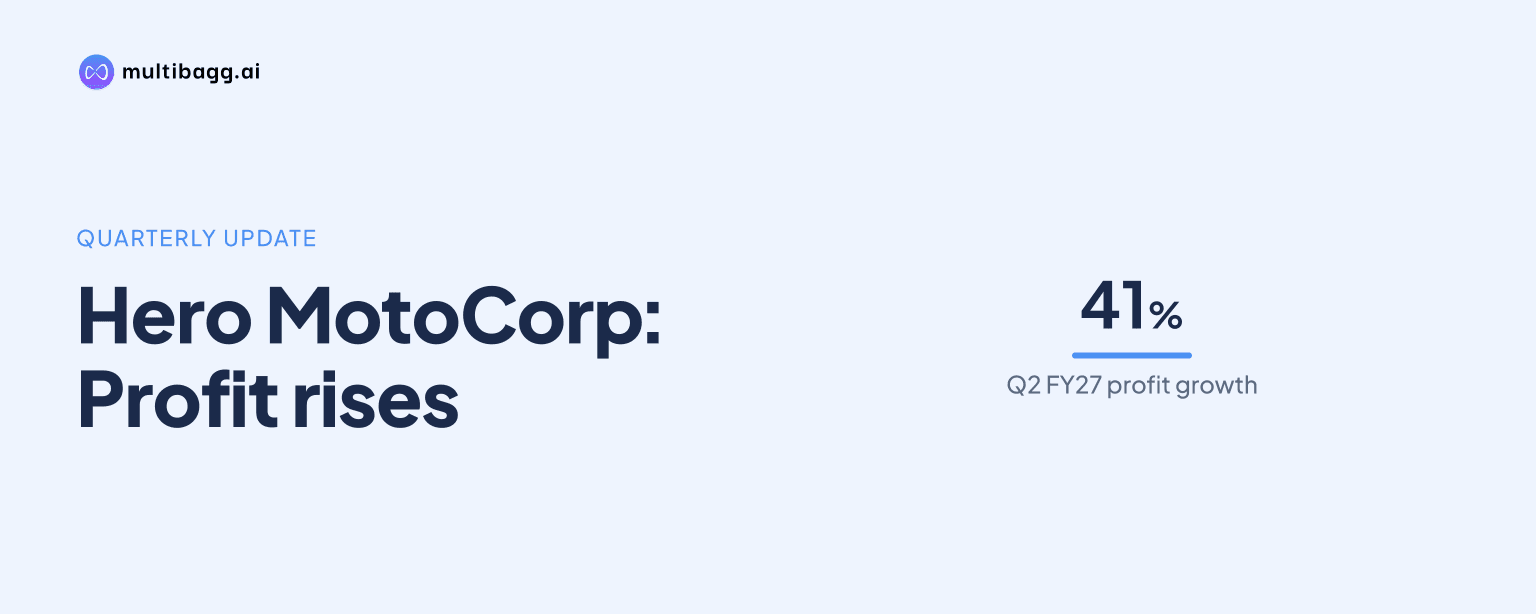
Hero MotoCorp Limited reported consolidated profit of ₹1,860.55 crore for Q2 FY27, up 41% year-on-year, while consolidated revenue rose 23% to ₹14,970.50 crore; the profit included a ₹397 crore one-time gain from the equity consolidation of an associate company. The company has also made the earnings-call recording for the quarter and half year ended September 30, 2026 available on its investor relations website.
Know Hero MotoCorp inside out
Results, valuation, peers and who's buying, in one view.
What did Hero MotoCorp report for Q2 FY27?
Hero MotoCorp reported stronger revenue and profit for the July-September quarter of FY27, supported by higher two-wheeler volumes and a one-time accounting gain. Consolidated revenue from operations increased 23% year-on-year to ₹14,971 crore, while consolidated profit after tax rose 41% to ₹1,861 crore.
On a standalone basis, revenue from operations grew 21% year-on-year to ₹14,687 crore, from ₹12,126 crore in Q2 FY26. Standalone EBITDA increased 8% to ₹1,968 crore, and the EBITDA margin stood at 13.4%, up 10 basis points sequentially. Standalone profit after tax was ₹1,456 crore, up 5% year-on-year.
The difference between growth in standalone and consolidated profit is material. The company said consolidated Q2 FY27 profit included a ₹397 crore one-time gain from the equity consolidation of an associate company after that associate raised capital through a qualified institutional placement and private placement.
The company reported 28% revenue growth and 16% profit after tax growth for the first half of FY27. These half-year figures indicate that the September-quarter performance followed a period of rising demand across the domestic two-wheeler market.
How did volumes and the electric-vehicle business contribute?
Higher wholesale volumes and faster electric-vehicle growth supported Hero MotoCorp's top-line performance. Total wholesale volume increased 10.5% year-on-year in Q2 FY27, with internal-combustion-engine volumes up 8.4% and electric-vehicle volumes up 98%.
Management said domestic internal-combustion-engine retail sales grew 24% year-on-year during the quarter and that market share increased in every month of the period. Industry conditions were also favourable, with two-wheeler Vahan retail registrations rising by more than 27% in Q2, according to the earnings-call remarks. Internal-combustion-engine retail grew 23%, while electric-vehicle retail grew 82%.
VIDA, the company's electric-vehicle business, recorded retail growth of 105% year-on-year. Retail volumes were 66,000 units, up 74% year-on-year, and the business added 170 basis points of market share in H1 FY27. The company said VIDA became gross-margin positive in the September quarter.
Hero MotoCorp also cited ₹70 crore of quarter-on-quarter spend optimisation in the electric-vehicle business. It recognised production-linked incentive accruals of ₹63 crore after securing certification for nearly its full portfolio, according to the earnings-call information.
Got a follow-up? Ask IRIS
Why did margins remain under pressure despite revenue growth?
Commodity costs constrained margin expansion even as Hero MotoCorp delivered revenue growth above its wholesale-volume growth. Gross margin compressed by 30 basis points quarter-on-quarter, while EBITDA margin improved by 10 basis points sequentially to 13.4%.
The results show the effect of product mix, operating controls and higher sales scale alongside input-cost pressures. Revenue rose 21% on a standalone basis, compared with 10.5% wholesale-volume growth, which is consistent with a higher revenue realisation or a favourable sales mix. However, the company did not provide a separate quantified explanation for each driver in the provided material.
For investors, the one-time associate-related gain is important when comparing consolidated profit with the standalone result. The ₹397 crore gain lifted consolidated profit, whereas standalone profit growth was 5%. EBITDA, which was ₹1,968 crore, provides a measure of operating performance before the reported one-time consolidated item.
Cash flow from operations was ₹2,159 crore in Q2 FY27, nearly double the year-earlier level, which the company attributed to working-capital optimisation. This was a separate operational indicator from revenue and reported profit.
What has Hero MotoCorp disclosed about its earnings call?
Hero MotoCorp has disclosed that the audio recording of its Q2 and H1 FY27 earnings call is available on its investor relations website. The call was held in connection with the financial results for the quarter and half year ended September 30, 2026.
The company made the disclosure under Regulation 30 read with Schedule III of the SEBI Listing Obligations and Disclosure Requirements Regulations, 2015. Its regulatory filing was submitted to the National Stock Exchange of India and BSE, and was digitally signed by Prabhat Singh, Company Secretary and Compliance Officer, on October 29, 2026.
The conference call was hosted by PhillipCapital India Private Limited. Participants included Chief Executive Officer Harshvardhan Chitale, Chief Financial Officer Vivek Anand and the investor-relations team. The company had earlier informed exchanges about the scheduled analyst and investor call and released its Q2 and H1 FY27 financial presentation.
Access to the recording gives investors the ability to review management's discussion on revenue, margins, industry conditions, electric vehicles and working capital. It also provides the context behind the consolidated one-time gain and the company's operational metrics.
Conclusion
Hero MotoCorp's Q2 FY27 results reflected solid revenue momentum, a 10.5% increase in wholesale volume and rapid expansion in its electric-vehicle operations. Consolidated profit rose 41% to ₹1,861 crore, but the result included a ₹397 crore one-time gain, making the 5% increase in standalone profit and the 13.4% EBITDA margin relevant measures of underlying quarterly performance.
The next disclosed reference point is the company's available earnings-call recording and Q2-H1 FY27 results presentation, which cover management's comments on commodity costs, VIDA profitability, production-linked incentive accruals and market-share trends. Investors can monitor subsequent disclosures for whether these operating measures continue to translate into margin and profit movement.