










Hero MotoCorp VIDA turns gross-margin positive in Q2 FY27
Key highlights
- Hero MotoCorp said VIDA became gross-margin positive in Q2 FY27, ahead of earlier guidance.
- VIDA retail volume rose 74% year on year to 66,000 units in Q2 FY27.
- Hero MotoCorp recognised Rs 63 crore of EV PLI accruals in Q2 FY27.
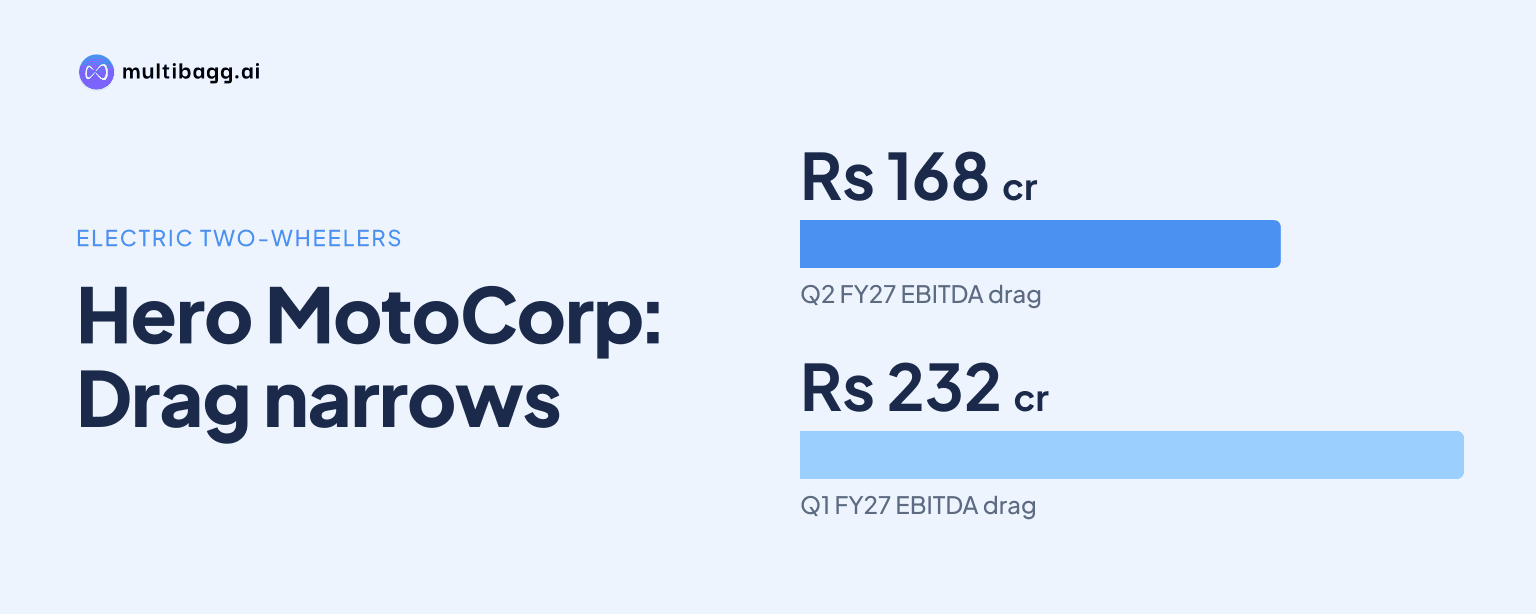
- VIDA's EBITDA drag narrowed to Rs 168 crore in Q2 FY27 from Rs 232 crore in Q1 FY27.
powered by IRIS
Hero MotoCorp Limited said its VIDA electric-vehicle business became gross-margin positive in Q2 FY27, ahead of earlier guidance, supported by Rs 63 crore of production-linked incentive accruals, cost actions and 66,000 retail units, up 74% year on year. The company had raised VIDA production capacity to 30,000 units a month in September.
Know Hero MotoCorp inside out
Results, valuation, peers and who's buying, in one view.
What made Hero MotoCorp VIDA gross-margin positive?
Hero MotoCorp said VIDA reached gross-margin positivity in Q2 FY27 through structured bill-of-materials cost optimisation, healthier margins on new products, selective price increases and production-linked incentive, or PLI, accruals. The company recognised Rs 63 crore of PLI during the quarter, when approximately 70% of its EV portfolio qualified. Management also cited potential non-vehicle and software revenue streams as part of its unit-economics programme.
Gross-margin positivity does not mean VIDA was profitable at the earnings before interest, tax, depreciation and amortisation, or EBITDA, level. Hero MotoCorp reported an EV EBITDA drag of Rs 168 crore in Q2 FY27, down from Rs 232 crore in Q1 FY27. The Rs 64 crore sequential reduction broadly aligns with management's statement that it optimised EV spending by Rs 70 crore over the preceding quarter.
VIDA generated Rs 1,000 crore of revenue in Q2 FY27, according to Chief Financial Officer Vivek Anand. The Rs 63 crore PLI accrual equalled about 6.5% of that revenue, based on management's figures. The quarterly outcome therefore reflects improved product economics, while operating costs associated with scaling production, distribution and the business continue to affect EBITDA.
How fast is Hero MotoCorp scaling VIDA volume and capacity?
Hero MotoCorp's VIDA retail volume rose 74% year on year to 66,000 units in Q2 FY27, while EV wholesale volume increased 98%. Management attributed the retail growth to a broader range of price points and increased production. The portfolio includes the VIDA VX2 Go with a 3.1 kilowatt battery and the VIDA VX2 Plus with a 4.4 kilowatt battery, both launched earlier in FY27.
VIDA monthly capacity rose from 15,000 units at the end of FY26 to 30,000 units in September FY27. Hero MotoCorp plans to increase that capacity to 45,000 units a month by Q4 FY27 and said further work had begun to take it above 80,000 units a month by Q2 of the following financial year. These targets indicate that capacity is being expanded substantially faster than the starting level.
Dealer inventory stood at about one day during the festival period, which management said showed that VIDA remained capacity constrained. That position provides context for the 66,000 Q2 FY27 retail units because sales were delivered without a large dealer-stock build. Management described demand as strong during the festival period, although it did not provide a separate quarterly demand forecast for VIDA.
How will PLI coverage change Hero MotoCorp VIDA economics?
Hero MotoCorp said it received PLI certification for nearly 100% of its EV portfolio in October 2026, compared with about 70% that qualified during Q2 FY27. Management expects PLI benefits to equal around 13% of EV revenue from Q3 FY27, versus approximately 6.5% in Q2 FY27. The expected change follows wider certification rather than a disclosed change in the Q2 incentive accrual.
The Rs 63 crore Q2 FY27 PLI accrual was one contributor to the gross-margin result, alongside component-cost work and margins on new products. A bill of materials, or BOM, is the list of components used to make a vehicle. Hero MotoCorp said it was pursuing BOM optimisation, price actions and non-vehicle revenue opportunities, which are mechanisms intended to improve economics beyond the incentive benefit.
The wider PLI certification creates a measurable point for the next reported quarter. Q2 FY27 gross-margin positivity was achieved with roughly 70% portfolio coverage, while management expects nearly full portfolio certification from Q3 FY27. Hero MotoCorp did not disclose a target for VIDA gross margin or a date for EV EBITDA profitability, so the 13% PLI-revenue expectation should not be treated as a profit-margin forecast.
Got a follow-up? Ask IRIS
How does VIDA fit Hero MotoCorp's wider Q2 FY27 margin result?
Hero MotoCorp reported revenue from operations of Rs 14,687 crore in Q2 FY27, up 21% year on year, while EBITDA rose 8% to Rs 1,968 crore and profit after tax increased 5% to Rs 1,456 crore. Total wholesale volume expanded 10.5%, comprising 8.4% growth in internal-combustion-engine, or ICE, vehicles and 98% growth in EVs. Revenue grew faster than volume as management cited pricing and a 5% positive mix impact.
Company-level EBITDA margin increased 10 basis points sequentially to 13.4% in Q2 FY27, despite gross margin declining 30 basis points. A basis point is one-hundredth of a percentage point. Management attributed the difference to overhead control and operating leverage, while identifying inflation in steel, aluminium, plastic, rubber, freight and currency-related costs.
VIDA's progress came alongside growth in other product areas. Hero MotoCorp said ICE scooter dispatches increased 34% year on year in Q2 FY27, while its parts business revenue rose 27%. The company said premium variants, ICE and EV scooters, parts, accessories and merchandise supported the higher revenue mix, which was relevant to the 21% revenue growth against 10.5% wholesale-volume growth.
What is Hero MotoCorp's next margin and investment plan?
Hero MotoCorp expects company-level margins to remain stable in Q3 FY27 despite input-cost pressure linked to the extended West Asia conflict and commodity inflation. Management said it would use cost rationalisation, savings under its LEAP programme, EV unit-economics improvements and selective price actions. It did not give a Q3 FY27 target for VIDA EBITDA or a forecast for EV profitability.
The company reiterated a medium-term EBITDA-margin corridor of 14% to 16%, compared with 13.4% in Q2 FY27. Its stated route includes investment behind premium motorcycles, scooters, EVs and global operations. Hero MotoCorp spent close to Rs 600 crore in H1 FY27 against full-year capital-expenditure guidance of Rs 1,500 crore.
That investment includes VIDA capacity at 30,000 units a month, ICE scooter capacity of 80,000 units a month and a dedicated premium assembly-line expansion at Neemrana. Hero MotoCorp is also advancing Phase II of Global Parts Center 2.0 at Tirupati, which management expects to be fully operational by the end of the next calendar year. These projects show that the company is funding capacity and distribution infrastructure while pursuing its 14% to 16% margin corridor.
Conclusion
VIDA's gross-margin-positive result in Q2 FY27 marks a defined improvement in Hero MotoCorp's EV economics, supported by 66,000 retail units, Rs 63 crore of PLI accruals and a Rs 168 crore EBITDA drag that was lower than Rs 232 crore in Q1 FY27. The figures also distinguish improved vehicle-level economics from full-business profitability, as operating costs and expansion spending remain material.
The next disclosures to watch are the expected PLI benefit of around 13% of EV revenue from Q3 FY27, the planned rise in VIDA capacity to 45,000 units a month by Q4 FY27 and the longer-term move above 80,000 units by Q2 of the following financial year. Management's expectation of stable Q3 FY27 company margins and its 14% to 16% medium-term EBITDA-margin corridor are the stated benchmarks for progress.