










Hero Motors H1 FY27 PAT climbed 84.2% as margins expanded
Key highlights
- Hero Motors’ H1-FY27 consolidated PAT rose 84.2% to Rs 27.6 crore.
- H1-FY27 revenue from operations increased 22.9% to Rs 684.1 crore.
- Consolidated PAT margin increased 1.4 percentage points to 4.0% in H1-FY27.
- EV and hybrid revenue share reached 24% in H1-FY27, while export share declined to 37%.
powered by IRIS
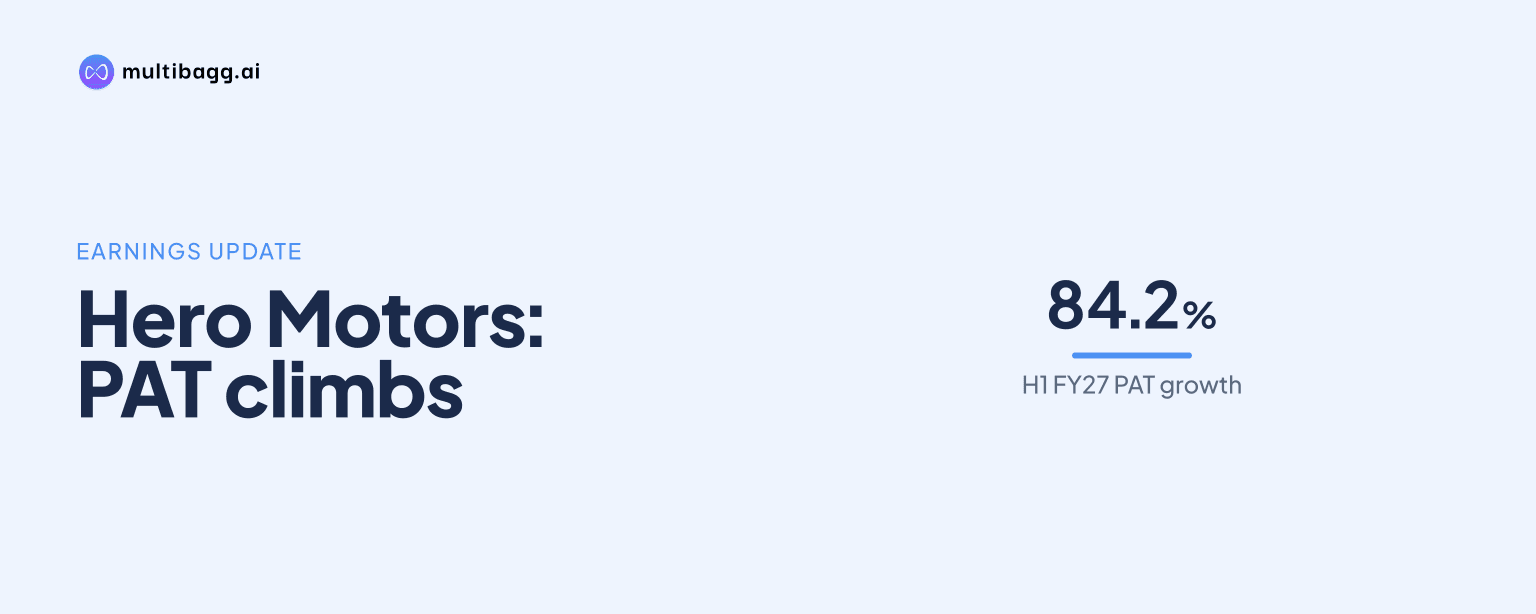
Hero Motors Limited reported consolidated profit after tax of Rs 27.6 crore in H1-FY27, up 84.2% year on year, as revenue from operations increased 22.9% to Rs 684.1 crore and PAT margin rose 1.4 percentage points to 4.0%. EBITDA increased 32.2% to Rs 86.6 crore despite a decline in other income.
Know Hero Motors inside out
Results, valuation, peers and who's buying, in one view.
What drove Hero Motors’ H1-FY27 profit growth?
Hero Motors’ H1-FY27 figures show operating expenses growing more slowly than revenue, while profit before tax and tax expense moved at different rates. Revenue from operations increased by Rs 127.6 crore from Rs 556.5 crore in H1-FY26 to Rs 684.1 crore, while operating expense rose by Rs 100.6 crore to Rs 606 crore. EBITDA, or earnings before interest, tax, depreciation and amortisation, increased 32.2% to Rs 86.6 crore.
Other income fell 41.2% to Rs 8.5 crore from Rs 14.4 crore, while depreciation rose 14.3% to Rs 25.4 crore and finance cost increased 13.6% to Rs 22.2 crore. Profit before tax, or PBT, rose 64.3% to Rs 39 crore from Rs 23.8 crore, whereas tax expense increased 30.3% to Rs 11.4 crore. Consolidated PAT consequently rose from Rs 15 crore to Rs 27.6 crore.
How did Hero Motors’ consolidated margins change in H1-FY27?
Hero Motors reported EBITDA margin of 12.5% in H1-FY27, compared with 11.5% in the detailed H1-FY26 consolidated table, a rise of 1.0 percentage point. The H1 earnings summary separately shows an H1-FY26 EBITDA margin of 12.1% and states that its EBITDA percentage is calculated on total income, including other income. Revenue from operations grew 22.9%, ahead of the 19.9% increase in operating expense.
Hero Motors’ PAT margin increased to 4.0% from 2.6%, a gain of 1.4 percentage points. The company reported no exceptional item in either H1-FY27 or H1-FY26, while total comprehensive income increased 82.9% to Rs 29.3 crore from Rs 16 crore. Diluted earnings per share increased 78.0% to Rs 0.73 from Rs 0.41.
The quarterly comparison also recorded margin expansion. In Q2-FY27, revenue from operations increased 21.3% to Rs 364.8 crore and EBITDA rose 22.7% to Rs 47.3 crore, lifting EBITDA margin to 12.8% from 12.6%. Quarterly PAT rose 62.3% to Rs 18 crore and PAT margin increased to 4.9% from 3.6%.
How did Hero Motors’ revenue mix shift between H1-FY26 and H1-FY27?
Hero Motors’ H1-FY27 revenue mix became more domestic and more weighted toward electric vehicle, or EV, and hybrid applications. Domestic revenue represented 63% of H1-FY27 revenue, compared with 58% in H1-FY26, while exports represented 37%, down from 42%. This five-percentage-point shift toward domestic revenue occurred as consolidated revenue reached Rs 684.1 crore.
EV and hybrid applications accounted for 24% of H1-FY27 revenue, up from 20% in H1-FY26. Internal combustion engine, or ICE, applications accounted for the remaining 76%, compared with 80% a year earlier. The presentation provides revenue shares rather than rupee amounts by powertrain type, so it does not disclose the absolute EV and hybrid revenue change.
The Q2 comparison showed a larger movement in both measures. Domestic revenue share increased to 66% in Q2-FY27 from 57% in Q2-FY26, while export share fell to 34% from 43%. EV and hybrid share rose to 26% from 20%, while ICE share declined to 74% from 80%.
Got a follow-up? Ask IRIS
Which Hero Motors segments contributed to Q2-FY27 revenue growth?
Hero Motors’ Alloys & Metallics segment delivered the largest absolute Q2-FY27 revenue increase, while Bike Powertrain had the highest percentage growth among the three disclosed segments. Alloys & Metallics revenue rose by Rs 33.9 crore to Rs 174.4 crore from Rs 140.5 crore. Gear & Transmission revenue increased by Rs 19.9 crore to Rs 142.3 crore, and Bike Powertrain increased by Rs 10.3 crore to Rs 48.1 crore.
Bike Powertrain’s 27.2% revenue growth exceeded consolidated Q2 growth of 21.3%, while Alloys & Metallics accounted for more than half of the Rs 64.1 crore total revenue increase. Gear & Transmission grew 16.3%, below the consolidated rate. The presentation does not provide H1 segment revenue, segment margins, volumes or customer-level data.
How did Hero Motors’ standalone earnings compare with consolidated earnings?
Hero Motors’ standalone H1-FY27 PAT grew faster than consolidated PAT, increasing 91.2% to Rs 47.2 crore. Standalone revenue from operations rose 28.1% to Rs 596.3 crore, compared with consolidated revenue growth of 22.9%. Standalone EBITDA increased 57.2% to Rs 92.1 crore and its EBITDA margin rose to 15.2% from 12.3%.
Standalone PAT margin increased by 2.6 percentage points to 7.8%, compared with a 1.4-percentage-point increase to 4.0% on the consolidated basis. Standalone PBT reached Rs 63.2 crore, up 91.9%, while consolidated PBT was Rs 39 crore, up 64.3%. The presentation does not explain the difference between the standalone and consolidated results.
Hero Motors also reported debt-to-equity of 0.21 times at H1-FY27, compared with 0.89 times for FY26. The presentation does not disclose the underlying debt or equity amounts, cash-flow changes, or financing actions behind the movement. The ratio therefore provides a period-end comparison without identifying the cause of the reduction.
Conclusion
Hero Motors combined 22.9% H1-FY27 revenue growth with a 1.0-percentage-point increase in reported EBITDA margin and a 1.4-percentage-point increase in PAT margin, resulting in 84.2% growth in consolidated PAT to Rs 27.6 crore. Revenue mix shifted toward domestic and EV or hybrid applications, while Alloys & Metallics produced the largest absolute Q2 segment revenue increase.
The next results will show whether the Q2-FY27 mix changes, including a 34% export share and 26% EV and hybrid share, continue through the rest of FY27. The presentation does not set a financial target, segment-margin target or specific operating plan, leaving the durability of margin expansion and the standalone-to-consolidated difference unresolved.