










Hero Motors: Powertrain Revenue Share Reaches About 54% in FY26
Key highlights
- Hero Motors says powertrain increased from 20% of revenue in FY20 to about 54% in FY26.
- System revenue rose from 7% to roughly 66% of Hero Motors’ powertrain business between FY20 and FY26.
- Overseas business increased from 13% of overall revenue in FY20 to about 43% in FY26.
- Hero Motors’ 60,000-square-foot Bangalore facility is scheduled to begin operations in March-April 2027.
powered by IRIS
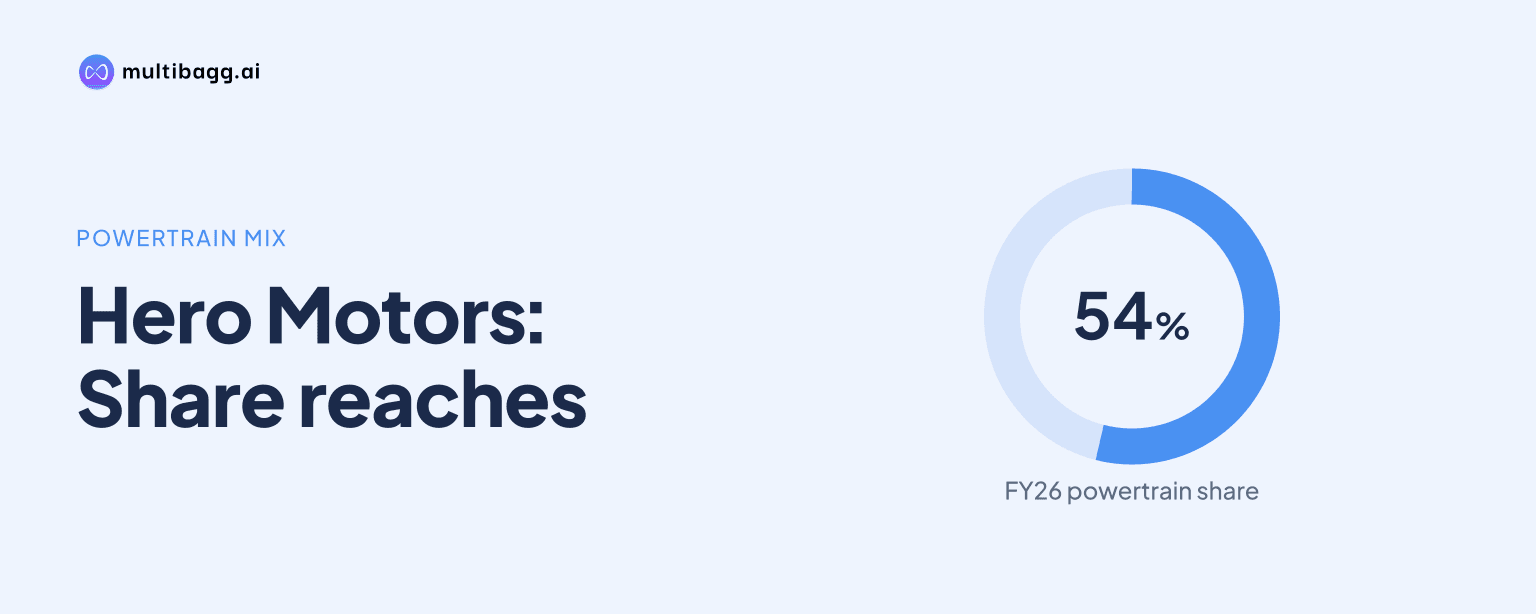
Hero Motors Limited says powertrain represented about 54% of revenue in FY26, up from 20% in FY20, as systems rose to roughly 66% of powertrain revenue from 7%. The shift combines a higher share of gears, transmissions and Bike Powertrain with overseas business reaching about 43% of overall revenue.
Know Hero Motors inside out
Results, valuation, peers and who's buying, in one view.
How did Hero Motors change its revenue mix?
Hero Motors changed its revenue mix by increasing powertrain’s combined share from 20% in FY20 to about 54% in FY26. In FY20, alloys and metallics accounted for 80% of revenue, while gears and transmissions accounted for 19% and Bike Powertrain accounted for 1%. By FY26, the alloys and metallics share had fallen to 46%, while gears and transmissions reached 41% and Bike Powertrain reached 13%.
The presentation’s 20% FY20 powertrain figure is the combination of the 19% gears-and-transmissions share and 1% Bike Powertrain share. The approximately 54% FY26 figure similarly combines 41% for gears and transmissions with 13% for Bike Powertrain. This means powertrain gained about 34 percentage points of the revenue mix over the period, while alloys and metallics declined by 34 percentage points.
This is a portfolio rebalancing rather than an indication of total revenue growth, because the presentation provides revenue shares rather than revenue amounts for FY20 and FY26. Still, the mix identifies gears and transmissions as the largest contributor to the powertrain increase, rising 22 percentage points, while Bike Powertrain increased 12 percentage points from its 1% starting point.
Why is the system-business share important for Hero Motors?
Hero Motors says systems represented roughly 66% of powertrain business in FY26, compared with 7% in FY20. The stated change marks a move from supplying individual components toward supplying system-level products, which the presentation describes as high-value business and as a route to larger business with existing customers and new global customers.
The presentation uses a specific classification method for this comparison. Only individual gears count as components; gearsets, gearboxes and transmissions count as systems. All revenue from the Bike Powertrain division is also classified as system or sub-system revenue. That definition means the FY26 system share captures both gearbox-related assemblies and all Bike Powertrain revenue, rather than standalone gear sales alone.
The 59-percentage-point rise from 7% to roughly 66% follows the increase in gears and transmissions and Bike Powertrain within the overall revenue mix. In FY26, gears and transmissions made up 41% of Hero Motors revenue and Bike Powertrain made up 13%, versus 19% and 1%, respectively, in FY20. The presentation therefore links the higher powertrain share with a change in the type of product supplied within powertrain.
How international is Hero Motors’ business now?
Hero Motors says overseas business increased to about 43% of overall revenue in FY26 from 13% in FY20. The 30-percentage-point increase in the overseas share of total business coincides with powertrain becoming about 54% of overall revenue, compared with 20% six years earlier.
Powertrain was already internationally oriented in FY20, when overseas revenue represented 69% of the powertrain business. That proportion rose to 75% in FY26, a 6-percentage-point increase. The larger shift was therefore in the overall group mix: as powertrain expanded from 20% to about 54% of revenue, its high overseas exposure lifted the overseas share of Hero Motors’ overall business from 13% to about 43%.
Hero Motors’ manufacturing and customer footprint provides the operating context for those figures. Its listed customer locations span the United States, Europe, the United Kingdom, the Association of Southeast Asian Nations, Japan and India, while its facilities include gearbox assembly in Samut Prakan, Thailand, for ASEAN markets and design, prototyping and low-volume gearbox operations in Maidenhead, United Kingdom.
Got a follow-up? Ask IRIS
What capabilities support Hero Motors’ system strategy?
Hero Motors supports the system strategy through technology centres in Southam, United Kingdom, and Gautam Buddha Nagar and Noida, India. The Southam centre covers gears, e-axles and drive-unit testing, while the Indian centres focus on motors and complete drive systems. These capabilities align with the presentation’s stated focus on complete systems and powertrain solutions for e-mobility.
The company’s listed engineering work includes design, development, prototyping, validation, production and supply. Its stated use cases cover electric vehicles, performance automotive, e-bikes, micro-mobility, electric two-wheelers and three-wheelers, electric vertical take-off and landing aircraft, off-road and specialty electric vehicles, and premium motorcycles. The presentation says these integrated research and development capabilities support bespoke conventional, hybrid and electric powertrain applications.
Hero Motors also identifies three partnership routes relevant to the system transition: co-development of continuously variable transmissions, a Yamaha joint venture for electric hub motors, and a joint venture with Schmiedetechnik Plettenberg for precision forgings. Its strategy lists increasing systems contribution, expanding electric-vehicle gearbox capabilities and providing integrated electric drive units for micro-mobility with after-sales support.
A further operational step is a leased Bangalore facility in the Narsapura Industrial area, with a built-up area of 60,000 square feet. Operations are scheduled to begin in March-April 2027, and the plant is intended to make drivetrains, frames and other components. River Mobility is identified as the anchor customer, while discussions with other original equipment manufacturers are under way, according to the presentation.
Conclusion
Hero Motors’ disclosed FY20-to-FY26 mix data show two linked changes: powertrain increased from 20% to about 54% of revenue, and systems increased from 7% to roughly 66% of powertrain business. The figures also show that overseas revenue became more important to the overall company, rising from 13% to about 43%, while powertrain’s overseas share moved from 69% to 75%.
The next disclosed milestone is the Bangalore facility’s scheduled March-April 2027 start of operations, with drivetrains, frames and other components planned for production. Readers can also watch whether Hero Motors advances its stated plans to expand electric-vehicle gearbox capabilities, integrated electric drive units, ASEAN manufacturing and technology partnerships, including continuously variable transmission co-development and the Yamaha hub-motor joint venture.